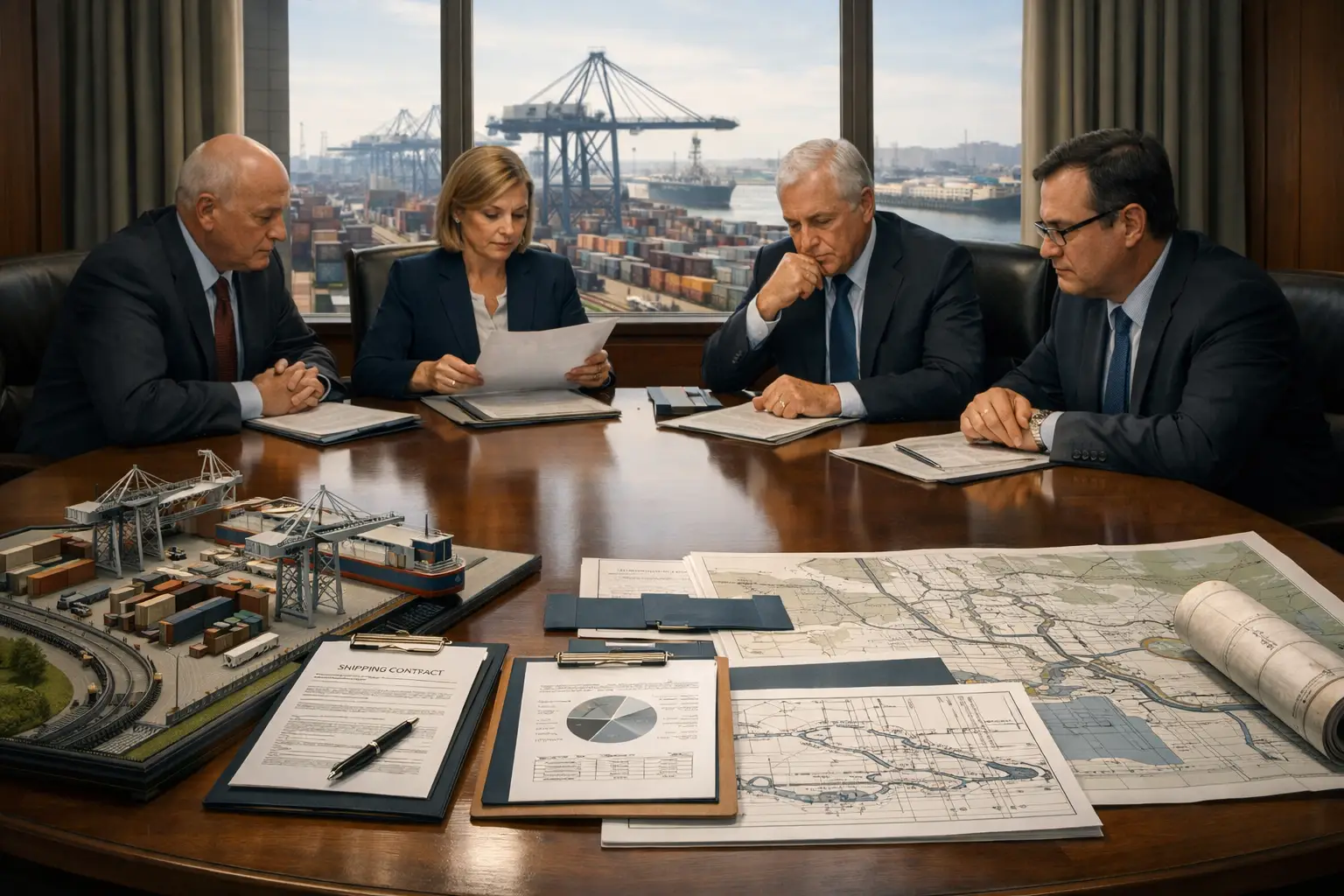
On February 20, 2026, the board of directors of DFC (U.S. International Development Finance Corporation—a government agency that supports private investment projects in developing countries) approved new investments in critical minerals, port infrastructure, and supply chains.
The decision marks the United States’ transition to direct competition with China for control over physical assets on which the defense industry, semiconductor sector, and energy transition depend.
The DFC portfolio limit has been expanded to $250 billion; in the FY2026 budget request, the administration proposed creating a $3 billion revolving equity fund.
The development finance agency is transforming into a quasi-sovereign investment tool aimed at countering China’s monopoly in the extraction, processing, and transshipment of critical resources.
The transformation of DFC is happening alongside a broader shift in the allocation of Chinese state reserves. Beijing has cut its holdings of U.S. Treasury securities, decreasing them from a peak of $1.3 trillion to around $760 billion.
The freed-up resources are now being redirected into physical assets, including lithium, cobalt, nickel, and rare-earth element deposits, as well as port and logistics infrastructure across Asia, Africa, and Latin America.
The freed-up resources are being channeled into building an infrastructure network that increases the dependence of third countries on Beijing.
With a $250 billion limit, DFC does not compete with the $1.5 trillion “Belt and Road” in volume. The logic is different — targeted investments in nodes where critical dependence of Western defense and technology sectors is concentrated.
Private capital does not enter rare-earth element mining in Congo or port expansions in Greece due to long payback horizons and regulatory risks. Chinese state capital enters and locks in the host countries’ dependence on Beijing.
DFC gives Washington a tool for presence in the same segments with the possibility of displacing or preempting Chinese positions.
The foundation for this decision is the concentration of critical supply chains in the PRC, which controls approximately 70% of lithium processing, up to 90% of rare-earth elements, and dominates cobalt and graphite processing.
In 2023, Beijing imposed restrictions on gallium and germanium exports to the United States, later on graphite, and in 2024 tightened control over certain rare-earth elements.
Given that Chinese companies dominate the processing of these materials, even targeted restrictions affect semiconductors, defense electronics, and renewable energy in the United States and other Western countries.
U.S. dependence on Chinese processing at 70–90% levels turns every Beijing export restriction into a direct threat to the American defense and technology sector.
The institutional architecture of DFC ensures coordination of investment decisions with foreign-policy priorities. Major deals require approval from the Treasury and the Export-Import Bank; the board of directors and Congress provide oversight.
DFC is not a traditional commercial investor but functions as a tool for directing capital into segments where the market is absent and strategic vulnerability is highest.
DFC has concluded agreements with Congolese Gécamines and Swiss Mercuria Energy Group for copper supplies—deliveries are contracted in advance and removed from Chinese trading influence.
Financing for the expansion of the Serra Verde deposit in Brazil and plans for Severniy Katpar in Kazakhstan distribute risks across regions. Through royalty, streaming, and minority-stake instruments, the United States secures a share in future resource flows without needing full operational control.
Control over extraction without control over transshipment does not guarantee physical access to resources in a crisis moment. DFC’s port and logistics investments are a direct continuation of the mineral strategy—without transport corridors, contracted minerals remain nominal assets.
COSCO in the Piraeus port gained access to data on Eastern Mediterranean cargo flows and the ability to influence ship-handling priorities, including military vessels.
Shanghai International Port Group in Haifa established itself in the port that serves the Israeli Navy and U.S. Sixth Fleet ships. In both cases, commercial presence created for Beijing a tool for intelligence collection and potential influence over the logistics of allied countries.
Greece and Israel initially welcomed Chinese capital—both countries had investment deficits in port infrastructure. Pressure from Washington in 2025–2026 exceeded the commercial benefits of cooperation with Beijing.
Greece blocked the privatization of the Alexandroupolis port with Chinese participation and brought in DFC as an alternative investor. Israel strengthened regulatory oversight over SIPG’s involvement in port assets.
In both cases, the availability of a financial alternative from DFC changed the calculus for host countries—they received capital without security risks, while the United States secured presence in critical logistics nodes.
Combining mineral and port investments in one institutional loop creates an effect that neither line provides separately. Contracted deposits in Congo, Brazil, and Kazakhstan provide raw materials.
Ports in Greece and Israel ensure their movement. DFC connects both segments and mobilizes private capital that avoided strategic projects with long horizons due to political turbulence.
For the defense industry, semiconductor sector, and energy transition, this means reducing dependence on Beijing’s decisions at every stage of the chain—from ore to port.
DFC actions create pinpoint pressure on Chinese positions in several nodes simultaneously. Agreements with Gécamines and Mercuria remove part of Congolese copper from Chinese trading control.
Blocking Chinese participation in Alexandroupolis and strengthening regulation in Haifa narrow Beijing’s opportunities to transform port ownership into intelligence and logistics leverage.
The DFC strategy has structural limitations. The $250 billion portfolio limit remains significantly smaller than the cumulative volume of Chinese investments through the “Belt and Road” ($1.5 trillion over a decade).
Implementation depends on the stability of budget financing and Congress’s position—both factors are subject to change with administration rotations.
The PRC annually expands its presence in 15–20 new mining and infrastructure projects in Africa and Latin America, and the current pace of DFC deal-making does not offset this dynamic.
Internal political vulnerability is heightened by the Supreme Court decision of February 20, 2026, which altered the operational context of foreign economic policy.
Restrictions on the executive branch’s tariff powers reduced the set of foreign economic influence tools that the administration can apply without Congress’s involvement.
DFC and OFAC sanctions mechanisms have become some of the few channels through which Washington retains autonomous capacity to project economic influence.
Beijing is simultaneously expanding its pressure toolkit. In 2023, the PRC restricted gallium and germanium exports; in 2024, graphite and certain rare-earth elements; by 2026, the list was supplemented with tungsten, bismuth, and molybdenum. Each of these items has direct applications in semiconductor production, defense electronics, or battery technologies.
At the same time, Chinese state and quasi-state companies continue to conclude concession agreements for extraction and processing in Congo, Zimbabwe, Chile, Argentina, and Indonesia. The strategic dependence of the United States on Chinese processing of critical minerals as of March 2026 remains structural.
DFC has created a mechanism for its gradual reduction in extraction and transshipment segments. Processing, where the main dependence is concentrated, remains under PRC control.
This means Beijing retains the ability at any moment to narrow access to processed materials for the American defense industry and semiconductor sector, even if the raw materials are formally contracted in favor of the United States.
As long as the processing segment remains under Chinese control, the strategy retains structural incompleteness, and Beijing holds the key leverage over the technological and defense potential of Washington and its allies.