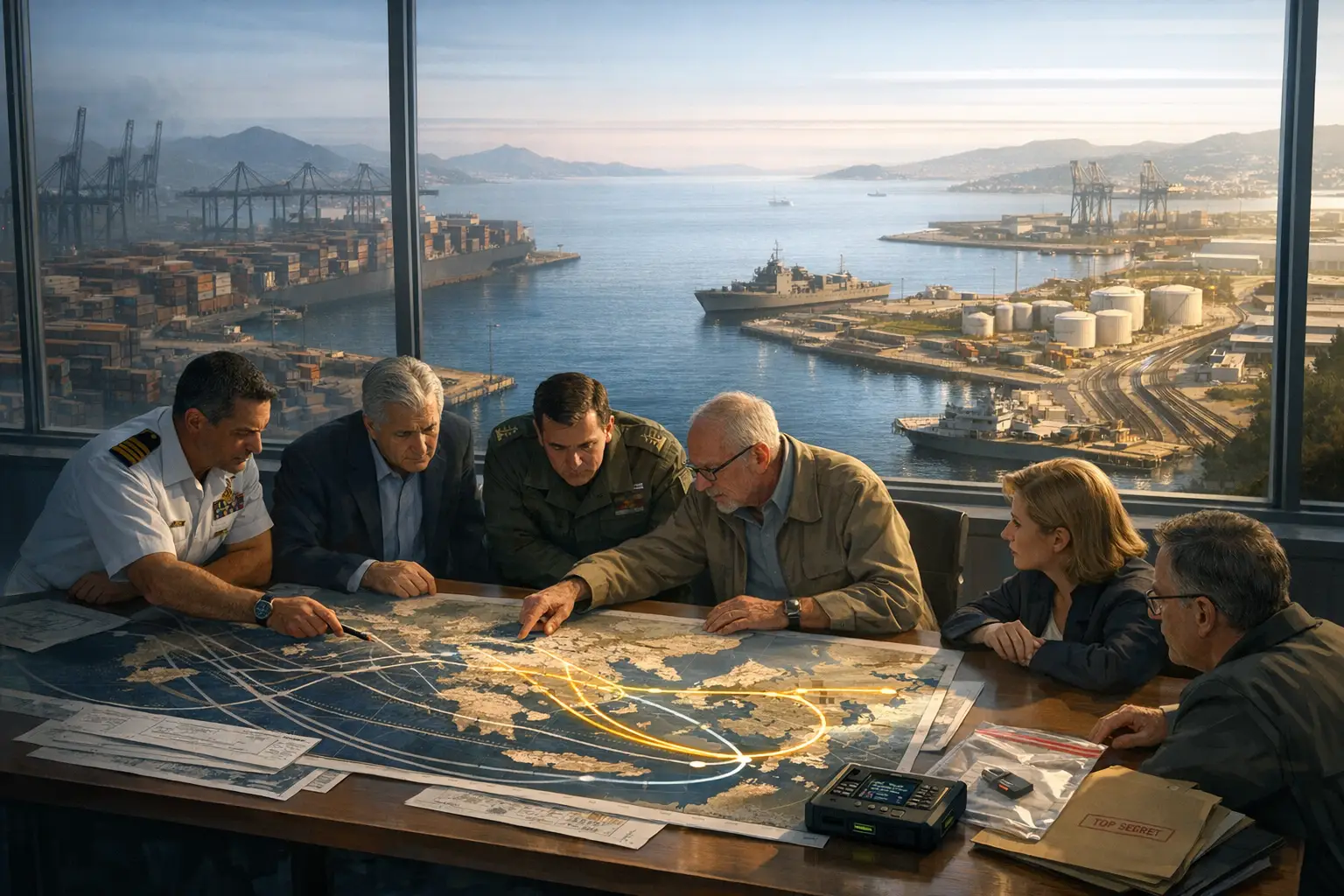
On February 5, 2026, the National Intelligence Service of Greece, in coordination with the U.S. Central Intelligence Agency, completed a four-month counterintelligence operation to neutralize a Chinese agent network aimed at undermining NATO security.
Within its framework, Colonel Christos Flessas of the Greek Air Force was detained; he had access to information on military developments and movements of U.S. aviation in the region, including from the airbase in Larissa—one of the key logistical hubs for supporting U.S. operations in Eastern Europe and the Middle East.
It is believed that in 2024, Flessas underwent espionage training during an undeclared trip to the PRC. Subsequently, he carried out the recording, encryption, and transmission of confidential materials to a special device issued by his Chinese handler.
According to the investigation, other military personnel from NATO countries could have been Flessas’s accomplices. At the same time, the senior coordinator of the Chinese network in Greece was a civilian woman who is currently wanted.
From a broader perspective, the Flessas case goes far beyond a single espionage scandal between NATO countries and the PRC.
The incident highlights the escalating structural confrontation between Washington and Beijing over control of the Eastern Mediterranean, a critical logistical bridgehead for two competing economic architectures.
On one side are China’s “Belt and Road” routes, linking Europe to China through Turkey and Greece, and on the other is the pro-American IMEC corridor (India-Middle East-Europe Economic Corridor), designed to connect India with Europe and the U.S.
Accordingly, it is about which model of economic and security integration will determine the strategic perspective of the region amid the increasing risk of the start of a global conflict.
Realizing the U.S. course toward displacing Chinese logistical infrastructure from Greece—a country that has been under significant financial and political influence from the PRC over the past decade—Beijing is activating tools of security and political interference to maintain control over critical Eastern Mediterranean nodes.
In this context, attempts to penetrate Greece’s defense system can be seen as part of a broader strategy to limit American influence in the Balkans and along the “Piraeus-Belgrade-Budapest” land-sea axis.
They also serve as a means to undermine the U.S. defense line in the Middle East, which is closely connected to the waters of Greece and Turkey.
It is indicative that the Flessas case unfolded six months after the arrest of a family of Chinese officials who were conducting photo and video recording of facilities at the Tanagra airbase and adjacent sites of Hellenic Aerospace Industry—the key Greek manufacturer of unmanned systems and defense components.
At that time, the object of heightened interest for Chinese intelligence services was the Dassault Rafale fighters—aircraft regarding which Beijing launched a disinformation campaign after the escalation of the Indian-Pakistani conflict, attempting to discredit their combat characteristics and export appeal.
In addition to the direct undermining of NATO security, the goal of the PRC in both cases could have been the deployment of the “Shield of Achilles” system—a large-scale Greek air defense initiative worth over $25 billion, launched in April 2025.
This program partially reproduces the logic of the T-Dome initiative—a multi-level air defense and missile defense system being developed in Taiwan to counter air threats from the PRC.
In both cases, the central partners are the United States and Israel, which are scaling and adapting the classic architecture of the Israeli “Iron Dome” to new strategic theaters.
The exposure of Christos Flessas’s espionage activities, which became the first high-profile security scandal in relations between Athens and Beijing, occurred amid a significant expansion of security relations between the Donald Trump administration and the government of Prime Minister Kyriakos Mitsotakis.
In particular, the United States accelerated the implementation of a regional strategy aimed at withdrawing Greece from the PRC’s logistical, financial, and political network by 2029.
The waters of the Eastern Mediterranean are viewed by the United States as one of the key logistical sections for implementing the policy of “strategic decoupling” from the PRC. This primarily concerns the waters of Greece, Cyprus, and Israel, which collectively form the central “gates” of the IMEC trade corridor.
Narratively, this project appeals to the recreation of the “Golden Path”—a route of exchanges between ancient Indian states, ancient Greece, and Rome.
In this logic, it is positioned as an alternative historical axis of globalization, competitive to the China-centric “Silk Road,” the conceptual dominance of which was largely shaped by European historiography at the end of the 19th century.
In the economic dimension, IMEC is intended to create a U.S.-controlled logistical network that will unite ports and railway infrastructure of India, the UAE, Saudi Arabia, Jordan, Israel, Cyprus, Greece, and Italy—bypassing the transport ecosystem of the “Belt and Road” initiative.
The criticality of this architecture lies in its resilience to potential military destabilization in the Pacific and the potential blockade of the Malacca Strait.
In addition to the political-economic dimension, IMEC has a deep security foundation. Its arteries are seen as a tool for forming a new energy model of interaction between the U.S. and participating states, within which Washington acts as the central “operator” of global gas and oil markets.
This involves both coordinating positions with Arabian Peninsula countries and strengthening the U.S. role as a key supplier of LNG and Venezuelan oil.
Under such conditions, Greece is to become a strategic node for redistributing energy resources to Eastern Europe and the Indian subcontinent; at the same time, this model is directly aimed at reducing Russia’s energy weight and, accordingly, limiting its ability to maintain a strategic symbiosis with the PRC.
Additionally, IMEC is seen as an institutional foundation for a new security architecture in the Middle East, where the defense lines of the EU and NATO, Israel, Saudi Arabia, and India are to be functionally interconnected.
This involves creating a system in which the aforementioned entities act in a consolidated manner to prevent escalation from Iran or Turkey, as any large-scale crisis in the Middle East would directly undermine the new, fundamental economic corridor.
Accordingly, the Donald Trump administration considers IMEC a mechanism for reducing military tension through the creation of mutual economic dependence—that is, one of the key long-term guarantees of regional security.
In this context, IMEC—and primarily Greece as its Mediterranean node—is also seen as a tool for containing revisionist tendencies in Turkey’s foreign policy, which continues to cause concern in Washington both due to its neo-Ottoman vector and the preservation of strategic ties between Ankara and Beijing.
This fits into the broader White House policy of intercepting influence over Caucasian states and Central Asian autocracies (Azerbaijan, Armenia, Kazakhstan), as well as Pakistan, which collectively form critical nodes of the “Belt and Road” program.
Realizing the defining importance of Greece as a future pillar of IMEC, President Trump appointed Kimberly Guilfoyle as the new U.S. Ambassador to Athens—the former fiancée of his son Donald Trump Jr., who is still considered part of the Trump family.
In addition to diplomatic work, her mission was to convey to the government of Prime Minister Mitsotakis the personal visions of the American President, including the need to displace the PRC as a defining factor in Greece’s economy.
Marking 100 days in office as U.S. Ambassador in mid-February 2026, Kimberly Guilfoyle emphasized that Washington had achieved several strategic breakthroughs in relations with Greece.
This primarily concerns energy integration—the conclusion of long-term agreements on the supply of American LNG, as well as the signing of the Declaration on Economic Security, which formalized cooperation in the field of critical technologies.
At the same time, Athens became a key node for transporting American energy resources to Ukraine, which strengthened Greece’s strategic role in the process of changing security dynamics in Eastern Europe.
She emphasized that the space for developing relations is unlimited, hinting at further agreements in the field of port logistics.
The key catalyst for further strengthening the American presence in Greece is to be the signing of a “grand deal” between the U.S. and India, expected in March 2026.
Reducing tariffs on Indian goods from 50% to 18% will unlock and intensify key security agreements between Donald Trump and Narendra Modi, among which are the further development of QUAD and IMEC.
Simultaneously, the creation of a free trade zone between India and the EU in January 2026 outlines the European dimension of this process.
Essentially, this is about transitioning IMEC from a declarative initiative to the status of an institutionalized European project, which significantly expands U.S. strategic interests in the Eastern Mediterranean and consolidates Greece’s position as a key transit node for American presence in the region.
Almost immediately after establishing strategic understanding between India and the U.S., Prime Minister Mitsotakis made a visit to New Delhi for economic talks with Narendra Modi.
In particular, they expressed readiness to project the strategic partnership formed in 2023 between the states onto broader security formats, meaning partnership within IMEC.
The main vector of American strategic advancement in Greece will continue to be port infrastructure. In particular, the Donald Trump administration will consistently increase pressure on Athens to limit Chinese control over critical facilities.
This primarily concerns the Port of Piraeus, which is majority-owned by the Chinese state logistics giant COSCO Shipping and is a key link in the land-sea corridor “Piraeus-Belgrade-Budapest” within the “Belt and Road” initiative.
In mid-November 2025, Ambassador Guilfoyle stated that the U.S. hopes to find ways to “bypass” the terms of the Greek-Chinese agreement regarding the Port of Piraeus, including the possibility of putting the facility up for sale.
So far, the government of Prime Minister Mitsotakis has evaded direct answers regarding such a prospect. However, the escalation of relations with Beijing amid the Christos Flessas case creates an additional political window of opportunity for revising Athens’ position.
An additional argument for the U.S. is their experience in restoring control over strategic logistics in the Panama Canal zone.
At the same time, Washington is promoting an alternative port architecture in Greece. This concerns the revitalization of the Elefsina infrastructure—a port 20 km from Piraeus, which is seen as one of the potential European “gates” of the IMEC program.
At the end of 2025, the Greek parliament began considering the issue of transforming Elefsina into a U.S.-supported multifunctional logistics center with the expansion of port, transport, energy, and defense infrastructure.
The financial basis for this was the U.S. government decision (U.S. International Development Finance Corporation) to provide $125 million for the restoration of the shipbuilding complex in Elefsina (2023).
Although the implementation of the project had been delayed until then, after Kimberly Guilfoyle’s arrival in Athens, the process accelerated.
It is expected that soon the Greek parliament will grant final permission to the American company ONEX to create a multifunctional port in Elefsina with the involvement of existing shipbuilding capacities and an additional 400 acres of adjacent territories.
According to the Donald Trump administration’s plan, the new hub will be able to service both military and commercial vessels (container and bulk shipments), as well as integrate the production of railway technologies.
In combination with the Thriasio freight center, this complex will form a structured alternative to Piraeus, while creating the groundwork for intercepting Chinese infrastructure in Greece for IMEC needs.
Another strategic direction for deepening American-Greek coordination is the scaling of the logistical infrastructure of the Port of Alexandroupolis, which is under Greek state control.
Located near the Turkish border, this node ensures the rapid transfer of forces and equipment to Bulgaria and Romania, essentially forming a land alternative to Black Sea routes and reducing dependence on Turkish-controlled straits.
After a review of the facility conducted in the U.S. in the summer of 2025, the government of Kyriakos Mitsotakis decided to accelerate the update of the master plan for the development of the Port of Alexandroupolis.
The document provides for deepening the water area to 12–14 meters, which will increase the capacity to accept heavier vessels, simultaneously strengthening NATO’s military mobility and expanding the commercial potential of Alexandroupolis as an element of the IMEC route.
A separate block provides for the expansion of territories for energy infrastructure—considering the location nearby of a floating storage regasification unit (FSRU).
The energy significance of the Alexandroupolis logistical corridors reflects the broader importance of Greece in the White House’s foreign policy plan.
Since 2025, the Donald Trump administration has demonstrated increased attention to the “Vertical Corridor”—a gas transportation initiative that from 2016–2024 united Greece, Bulgaria, Romania, Hungary, Ukraine, Moldova, and Slovakia into a single infrastructure axis.
The project involves transporting gas from the Eastern Mediterranean to Ukraine and Central European states via the Black Sea coast and bypassing Turkey.
In November 2025, ExxonMobil signed an agreement with the Greek government on the supply of American LNG to the EU and Ukraine using the “Vertical Corridor” infrastructure.
At the same time, the company Atlantic See—a subsidiary of the state-owned Depa Commercial SA and Aktor Group—signed a 20-year contract with the American Venture Global Inc. for the purchase of LNG starting from 2030.
The culmination of this trend was the signing on February 16, 2026, of four agreements on hydrocarbon exploration with Chevron, which essentially unlocked the development of significant offshore potential south of Crete and the Peloponnese—for the first time in the last four decades.
These steps have strategic logic. First, it is about the long-term recalibration of the global gas market in accordance with U.S. economic interests. Second—about the systematic displacement of Russia from its positions as a key gas supplier through the creation of alternative, politically reliable infrastructure.
It is indicative that the executive director of the National Council on Energy Dominance under the U.S. President’s administration, Jarrod Agen, directly linked the U.S. integration into the “Vertical Corridor” with Greece’s support to the toolkit for “achieving peace” in Ukraine.
In a broader sense, the coordination between the U.S. and Greece reflects a new strategic framework formalized by the Declaration on Economic Security (November 2025), which institutionalizes their partnership.
This framework is part of the restructuring of the Western economic architecture according to Donald Trump’s transactional worldview, a model in which democracies channel capital toward U.S. development rather than the PRC.
According to it, Athens guaranteed that it would support Washington in the process of forming alternative supply chains, protecting critical infrastructure and sensitive technologies, developing AI, and coordinating countermeasures against unfair practices of third countries (i.e., the PRC).
In addition to economic security, the U.S. is coordinating efforts with the government of Kyriakos Mitsotakis in the field of regional defense.
At the end of December 2025, Greece, Cyprus, and Israel approved a new framework to deepen defense cooperation in the Eastern Mediterranean.
The agreement includes enhanced joint naval and air exercises, closer security coordination, and collaboration on energy and infrastructure projects. Essentially, it is designed to provide security support for the European “gates” of IMEC.
Immediately after this, the Israeli government announced the functioning of the format in the “3+1” model with U.S. participation, which was confirmed by holding the corresponding forum in the Knesset in February 2026 with representatives from the four states.
At the same time, the “3+1” coalition directly declared its intention to contain both Iran and Turkey as a force destabilizing the situation in Syria, Iraq, Libya, Egypt, the Eastern Mediterranean, and the Horn of Africa. At the same time, they emphasized the importance of economic and security ties with India.
Collectively, such synchronization between Washington and Athens indicates Greece’s transition from the status of an inconspicuous southern flank of NATO to the role of a central node in the new American architecture of security and trade.
The exposure of the Chinese agent network became a catalyst for the political legitimation of this pivot, opening a window of opportunity for revising the PRC’s presence in the country’s strategic infrastructure for further advancement of IMEC.
At the same time, the political compromise regarding IMEC goes beyond the displacement of the “Belt and Road” program itself—in particular, it is an element of forming broader containment of the PRC in the Mediterranean, Russia on the global energy market, and Turkey as a regional revisionist.
Essentially, the U.S. is forming an interconnected belt of logistical, energy, and defense integration through the port modernization of Greece, the Americanization of the “Vertical Corridor,” and the branching of security initiatives in the “3+1” format.
Under such conditions, Greece loses its status as a state dependent on the PRC, transforming into a structural pillar of U.S. strategic presence. The further signing of the “grand deal” between the U.S. and India will accelerate this process, strengthening the institutional character of IMEC and the weight of Greece as geopolitical “gates” to Europe.