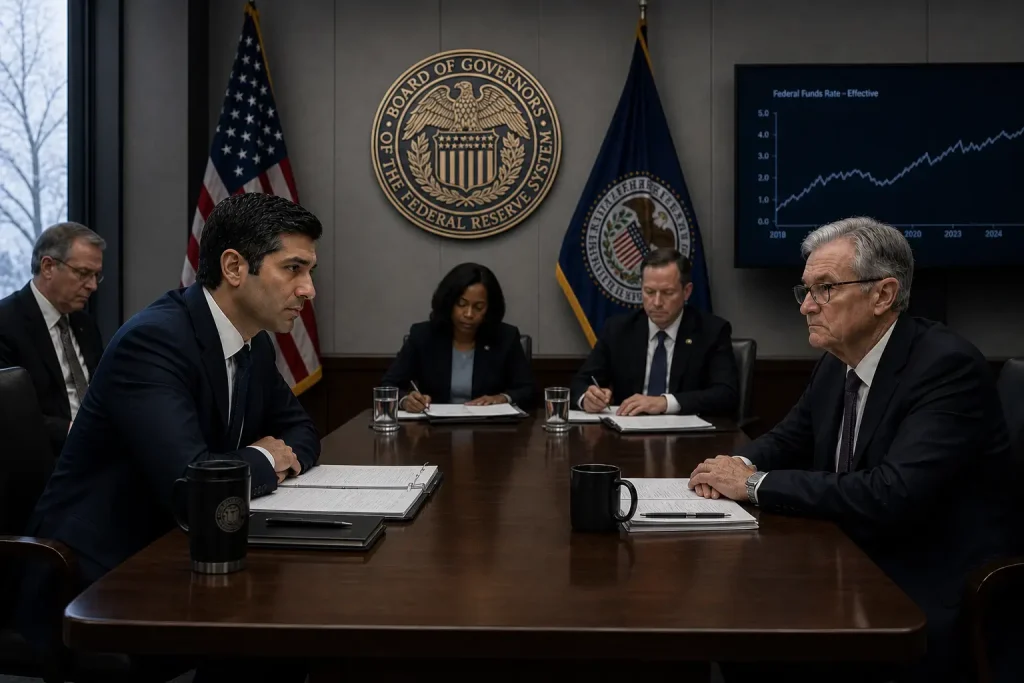
On January 30, 2026, Donald Trump announced his intention to appoint Kevin Warsh as Chair of the Federal Reserve System after Jerome Powell’s term ends in May 2026. This appointment occurs amid growing debate over the Fed’s independence and heightened criticism of Powell from the White House.
Warsh, a former member of the Fed’s Board of Governors and US representative to the G20, is known for his criticism of the Fed’s current policy and inclination toward rate cuts, which immediately places him at the center of the interaction between politics and finance.
Warsh’s key position is coordinating the Fed’s actions with the Treasury Department, aimed at containing risks in the US tech sector, particularly for Big Tech companies that have raised significant funds for data center construction and AI infrastructure development.
Maintaining high rates threatens their profitability, so lowering the discount rate creates the necessary “cheap fuel” for the investment cycle of tech companies.
Within this model, the Fed essentially becomes rear support for tech companies, allowing them to build AI infrastructure by attracting “cheaper money.”
Aggressive reduction of the Fed’s balance sheet from $9 trillion to $6.6 trillion removes excess liquidity from speculative markets, while providing opportunities for cheap loans to the real sector and supporting financial system stability.
After reaching a historical maximum at the end of January, the S&P 500 essentially lost most of its annual gains, and Nasdaq has been in negative territory since the beginning of 2026, signaling a reassessment of risks in the sector that until recently defined the dynamics of the entire market.
Investors are actively reallocating capital to safe assets, which is manifested in the decline in 10-year bond yields from 4.2% to 4.1% and record demand for $25 billion in 30-year bonds with minimal participation from primary dealers.
This means that markets are seeking protection from growing risks in the tech sector and currency volatility, preferring stable US government securities, which turns bonds into a “safe haven” and signals investor caution ahead of a potential correction in the financial system.
Appointing a new Fed chair in this phase of the cycle amplifies uncertainty, as potential rate cuts to stabilize the stock market could intensify devaluation pressure on the dollar and reduce demand for debt instruments.
At the same time, maintaining tighter financing conditions could deepen the correction in the tech sector and accelerate the revaluation of assets long supported by cheap liquidity.
As a result, Warsh’s strategy combines elements of “flexible” monetary policy with coordinated management of public debt and support for the tech sector, creating a balance between inflation control, financial market stabilization, and ensuring investment viability of key economic sectors.
The appointment of Kevin Warsh as Chair of the Federal Reserve System occurs at a moment when US monetary policy finds itself within a broader conflict between the administration’s political goals and the structural constraints of the financial system, shaped by years of cheap money and accumulated debt.
Accordingly, Washington is using the change in Fed leadership as an attempt to synchronize interest rate policy with the White House’s economic strategy, where tariff pressure, support for domestic production, and cheaper lending are seen as tools for maintaining growth rates ahead of the 2026 election cycle.
In this context, Warsh’s candidacy means a transition to a model in which the balance between fighting inflation and servicing public debt becomes a political decision, as the cost of budget financing is already approaching levels that limit the federal government’s fiscal space.
In this setup, appointing Kevin Warsh could lead to a sharp shift in monetary policy, with increased political influence on rate decisions, as the White House seeks to balance lower lending costs with stabilizing the debt burden amid rising budget spending.
At the same time, Warsh inherits a system with rapidly rising debt servicing costs, already taking up about a fifth of tax revenues and, according to current forecasts, potentially surpassing Medicare spending in the next decade. A large part of the 2025 debt issuance is in short-term instruments, increasing refinancing risks.
Efforts to extend the debt structure and stabilize yields through Treasury-Fed coordination create tension between controlling inflation and political pressure for rate cuts, while any sharp balance sheet reduction could push long-term debt yields higher and make deficit financing more expensive.
This means that Warsh’s and the White House’s monetary policy is under double pressure—to support economic growth and the tech sector while not allowing a jump in debt servicing costs.
The market assesses this uncertainty, and even a small mistake in balancing rates and liquidity could provoke a sharp increase in deficit financing costs and amplify US debt risks.
The situation is complicated by the dollar’s weakening, which is driven by contradictory market signals. Sharp movements in the dollar index in February 2026 reflect a revision of rate expectations, changes in global risk appetite, and a reassessment of positions ahead of key macroeconomic events.
While a weaker dollar temporarily supports stocks, commodity assets, and the crypto market, it also increases currency volatility and amplifies inflationary risks.
For the debt market, this creates additional tension, as devaluation expectations reduce the attractiveness of Treasury bonds for foreign investors, who are forced to demand higher yields to compensate for currency risk, which automatically increases the cost of US debt servicing.
Against this backdrop, the structural trend of reducing the dollar’s role in global reserves is strengthening, as central banks boost gold purchases, the dollar’s share in global currency reserves falls below 60%, and rising gold prices reflect a shift of some capital from debt instruments to tangible reserve assets.
The government bond market is responding with a gradual change in demand, as major external holders, including China and India, reduce their exposure and diversify reserves into gold and alternative assets amid growing geopolitical risks and precedents for sanctions.
Thus, China has reduced its holdings from over $1.3 trillion in the early 2010s to approximately $680–700 billion at the end of 2025, which is a minimum since 2008 and reflects strategic diversification of reserves amid trade conflicts and risks of asset freezing.
India has also reduced investments in long-term US bonds to $174 billion, which is 26% below the 2023 peak, bringing their share in reserves to a third and simultaneously increasing gold purchases.
These movements do not mean a momentary abandonment of the dollar, but they form an environment in which the stability of financing American debt increasingly depends on political decisions and the trust of allies.
Amid tariff threats and escalation of trade policy, even temporary cooling of interest in bonds could raise yields, amplify debt pressure, and turn the discussion about “Sell America” from targeted to systemic level.
Accordingly, the combination of a weaker dollar, political pressure on the discount rate, and declining demand for US bonds undermines the traditional role of the US as a global center of liquidity, turning it into an object of market reassessment.
In contrast, Warsh’s appointment accelerates the system’s adaptation to new conditions, but the speed of changes increases the risk of exacerbating imbalances accumulated through debt expansion and financial deregulation.
Moreover, the 2026 midterm elections add time pressure, as monetary policy begins to perform the function of stabilizing political expectations, and any market turbulence could quickly transform into a crisis of confidence in the administration’s economic course.
An additional risk for the White House is created by Warsh’s figure itself, whose name appears in the released Epstein case materials, turning the personnel decision into a potential domestic political vulnerability.
Even if the new Fed chair’s economic initiatives have sound macroeconomic logic, the time horizon for their implementation exceeds the electoral cycle—the results of monetary correction may not manifest in time for the midterm elections, while the reputational burden of the candidacy could work against the White House much faster.
As a consequence, the economy’s structural problems are now capable of manifesting faster than markets expect, as political and financial priorities overlay traditional Fed regulatory mechanisms.