On January 30, 2026, an executive order signed by Donald Trump entered into force, under which the President declared a national emergency due to threats to U.S. national security and foreign policy interests posed by the Cuban government.
The order establishes a mechanism for imposing additional tariffs on goods imported into the United States from countries that supply oil to Cuba.
Given that a change of power in Cuba through electoral means is considered impossible due to the governing monopoly of the Communist Party of Cuba, the United States is simultaneously applying sanctions, tariff, and diplomatic pressure on the island.
The architect and principal executor of this strategy is U.S. Secretary of State Marco Rubio, for whom the dismantling of the Cuban regime has become a central element of the “Donroe Doctrine” and, at the same time, a tool for converting regional foreign policy gains into electoral capital ahead of the 2028 election cycle.
The Secretary of State’s strategy toward Cuba is formulated as a package of three core demands directed at the Díaz-Canel regime, each serving a distinct function.
The first demand—the release of hundreds of political prisoners convicted for participation in the 2021 protests—is viewed by Secretary Rubio as a necessary precondition for initiating a managed political transition in Cuba.
Among the detainees are political activists and organizers of local networks who, once released, are expected to form the nucleus of a new governing elite and serve as a channel for legitimate political mobilization outside the monopoly of the Communist Party.
In coordination with diaspora structures, this group could develop durable “influence networks” and provide institutional preparation for a rotation of power, thereby reducing the risk of a governance vacuum following the weakening of the regime.
The second demand—strategic distancing from the People’s Republic of China and the Russian Federation—entails acceptance of U.S. terms of “assistance in exchange for alignment” and the dismantling of the regime’s external security guarantees.
This would lead to Cuba’s gradual entry into Washington’s sphere of influence through the lack of viable alternatives to Western financial and humanitarian frameworks and through the alignment of Cuban security behavior with U.S. priorities.
The third critical demand is the dismantling of Chinese military infrastructure in Cuba, including at least three intelligence facilities and twelve signals intelligence (SIGINT) sites deployed since 2019 to monitor twenty U.S. military bases in Florida. The removal of these facilities would neutralize a direct security threat to the southeastern coast of the United States.
Absent fulfillment of these conditions, no other instruments are expected to produce a managed reconstruction of power in Cuba or to neutralize the PRC’s intelligence foothold in the Caribbean basin.
The Cuban track provides Marco Rubio with an opportunity to combine tangible security outcomes with a symbolic “mission” for American Catholics—one of the largest electoral constituencies capable of influencing the outcome of the 2028 Republican nomination.
Catholics account for approximately 20–22% of U.S. voters (35–38 million, turnout-adjusted), with significant concentrations in key states: Pennsylvania (24–29% of the population), Wisconsin (25%), and Michigan (15%).
In the 2016–2024 electoral cycles, outcomes in Catholic-heavy districts in these states were decided by margins of just 0.6–1.7%. Latino Catholics—the fastest-growing segment (36–54% of all Catholics by 2025)—demonstrated moderate support for Republicans (45–50% in 2024).
Marco Rubio, a Catholic of Cuban descent, relies on Latino episcopal structures in the United States—including Archbishop of Miami Thomas Wenski and Cardinal Blase Cupich of Chicago—as well as on immigrant parishes of Cuban and Venezuelan origin, which perceive the struggle against communist regimes as an extension of a religious mission.
The 2.5-million-strong Cuban diaspora, shaped by successive waves of emigration from the 1959 revolution through the mass exodus of 2020–2025, has consistently supported the dismantling of the communist regime. Its electoral weight in Florida and other key states provides Rubio’s strategy with domestic political legitimacy.
Vice President Vance (also a Catholic convert since 2019) is competing for the same electoral segment but on a fundamentally different foundation.
In recent years, he has built a network of ties with the traditionalist wing of the American Catholic Church through Cardinal Raymond Burke and the Knights of Columbus (over 2.2 million members).
However, in Latin America and other regions where the Order operates, a significant share of its membership strongly rejects Vance’s isolationist principles, expressing support for Ukraine and criticizing U.S. withdrawal from its role as a responsible global leader.
Another pillar of Vice President Vance’s support is the Catholic post-liberal milieu—an intellectual circle centered around Patrick Deneen (University of Notre Dame) and the Napa Institute—which advocates for a stronger role of the state in protecting traditional values and opposes foreign interventions.
At the National Catholic Prayer Breakfast in February 2025, Vance explicitly linked this position to Catholic faith, stating that failed U.S. foreign policy interventions lead to the destruction of historic Christian communities worldwide—an argument reinforced by his personal experience as a U.S. Marine in Iraq, where the Christian population declined by 75%.
This position aligns with the strictest interpretation of just war doctrine and resonates with church circles skeptical of the United States’ role as a global arbiter.
Rubio’s and Vance’s positions thus rest on different segments of the Catholic institutional landscape in the United States and propose opposing foreign policy models.
For Rubio, the Latin American strategy—particularly the displacement of authoritarian regimes from the Western Hemisphere—represents a source of electoral capital that secures support among Latino voters.
Rubio’s advantage lies in the presence of concrete results in Latin America, which have made him the most influential figure in U.S. Latin American policy since Henry Kissinger.
Republican strategist Matthew Bartlett notes that the Secretary of State “is not just influencing but directing, leading truly remarkable work in our hemisphere, potentially creating a new order.”
In polling on the 2028 Republican nomination, Rubio ranks second among Republicans (9.3%), gradually narrowing the gap with Vance.
At the same time, the divergence between the cautious position of the Holy See and the Catholic Church in Cuba and the mobilizational stance of the Cuban Catholic diaspora and U.S.-based Catholic networks complicates the implementation of Rubio’s political strategy, creating challenges for its domestic legitimation among Catholic voters.
In a message dated January 31, 2026, the Cuban Conference of Catholic Bishops welcomed humanitarian assistance but warned against further escalation of sanctions, cautioning about a “real risk of social chaos and violence.”
In authoritarian states, the Catholic Church systematically adheres to a principle of institutional survival—avoiding direct confrontation with the regime in order to preserve access to parishes, educational programs, and humanitarian activity.
In Cuba, this dynamic is particularly pronounced: following the 1959 revolution, the Church lost nearly all of its infrastructure, and its partial recovery since the 1990s has depended on its willingness not to cross the regime’s red lines.
At the same time, the position of the Cuban bishops aligns with the official stance of the Holy See and with Vice President Vance’s arguments regarding the systemic risks of an interventionist course.
The Catholic Church within Cuba is not an effective agent of political transformation on the island—its institutional capacity has been constrained by decades of regime control.
The stance of the Cuban episcopate is also not representative of the Cuban Catholic community as a whole. For the 2.5-million-strong diaspora on which Rubio relies, sanctions pressure on Havana is viewed as a defense of religious freedom, systematically restricted by the Cuban regime for six decades.
The success of Rubio’s Cuba strategy directly affects his perception among Catholic voters in the United States.
The chosen course entails a risk that affects the consistency of Rubio’s actions. A prolonged humanitarian crisis without regime dismantlement would deprive the sanctions policy of tangible results and transform it into a source of criticism from the Secretary’s opponents within the party.
Cuban bishops are already warning of the threat of social chaos and violence, and this assessment—transmitted through the structures of the Holy See—could recalibrate perceptions of the strategy among U.S. Catholic voters in favor of Vice President Vance’s isolationist position.
The humanitarian crisis in Cuba deepened following Washington’s successful operation in Venezuela. Control over energy logistics in the Caribbean basin enabled the United States to sever oil supply routes between Venezuela and Cuba.
Venezuela had supplied more than one-third of Cuba’s oil imports. Mexico covered only 6–12% of the island’s needs, at a level of approximately 100,000 barrels per day.
The combined effect of intercepting Venezuelan exports, tariff pressure on Mexico, and the sanctions regime catalyzed the deepest crisis in Cuba since the “Special Period” of the 1990s, when Havana lost the financial support it had received from the Soviet Union.
Domestic electricity generation meets only one-third of national demand, while thermal power plants are in emergency condition due to shortages of spare parts and fuel.
In the eastern provinces, power outages last up to twelve hours per day. The University of Havana has shifted to remote instruction, and the public sector operates four days a week to reduce strain on the grid.
U.S. sanctions cost Cuba more than $5 billion in 2025 alone. Since 2020, approximately 2.7 million people—roughly one-quarter of Cuba’s total population—have left the island, creating a critical labor shortage.
The transportation system has effectively ground to a halt: in Havana, state-run buses operate only sporadically, and fuel is issued exclusively under special permits for ambulances.
Cuba’s energy isolation became possible through tariff pressure on Mexico—the island’s last remaining source of oil supply after the loss of the Venezuelan channel.
In January 2026, Petróleos Mexicanos (Pemex) removed fuel shipments to Cuba from its delivery schedule, although the administration of President Claudia Sheinbaum has sought to preserve minimal support for Havana by reclassifying subsequent fuel deliveries as humanitarian assistance.
The willingness of Mexico’s governing elite to support Havana is driven both by ideological sympathies within the left-wing factions of Morena and by electoral calculations: between 2010 and 2016, the Cuban diaspora in Mexico grew by 560 percent, becoming the country’s sixth-largest foreign community.
Coordination between Rubio and the Sheinbaum government led to the creation of a “high-level working group” that, alongside migration and fentanyl-related issues, focuses on halting fuel supplies to Cuba via Mexican ports.
The effectiveness of this pressure is rooted in Mexico’s structural dependency: more than 80 percent of its exports are destined for the United States, rendering tariff pressure a non-substitutable instrument.
The arrest of Nicolás Maduro constituted a psychological shock for Cuba’s elite. During the U.S. operation, 32 Cuban officers from the elite Avispas Negras (Black Wasps) unit—responsible for Maduro’s personal security—were killed.
This marked Cuba’s first such loss since the 1983 invasion of Grenada. The leadership in Havana was compelled to declare official mourning, further underscoring the regime’s vulnerability.
Morale within the officer corps of the Revolutionary Armed Forces (FAR) and the Ministry of the Interior (MININT) is described as depressed.
Amid the crisis, signs of internal destabilization are emerging, alongside intensified separate contacts between the U.S. administration and representatives of the Cuban state apparatus, who are being offered “off-ramps” in exchange for facilitating political transition on the island.
Generals controlling the military conglomerate GAESA—spanning tourism, banking, and retail—are witnessing the collapse of their business empire as a result of sanctions on financial transfers and the disappearance of tourism revenues.
Between January and February 2026, instances were recorded of family members of senior officials relocating to Europe and Latin America, indicating preparations for a potential regime collapse.
President Miguel Díaz-Canel’s regime has responded with repression and emergency measures. The ration card system has been expanded to cover previously unrestricted goods, while digital censorship has been intensified to suppress protest coordination.
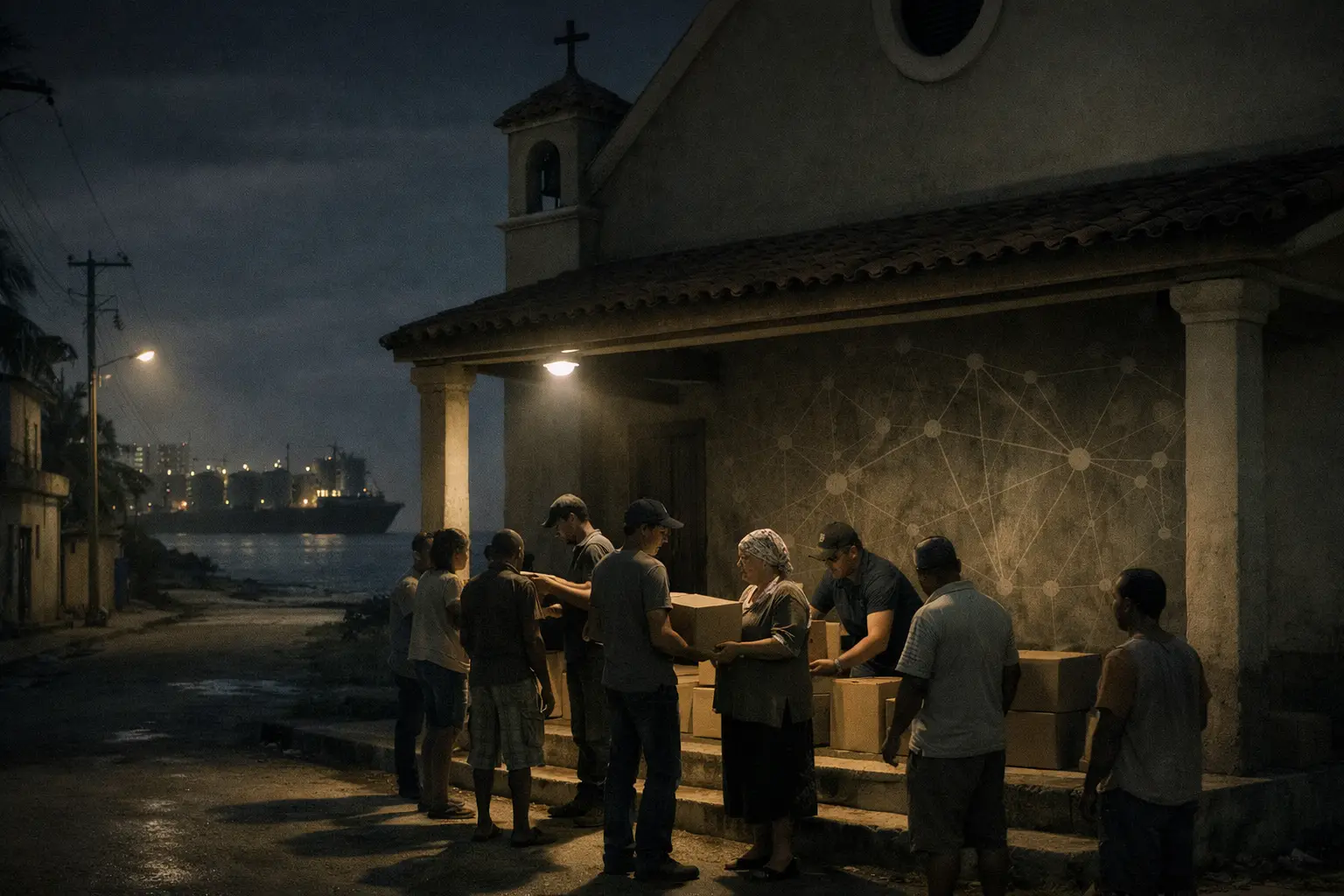
At the same time, fear of food riots has compelled the government not to block $50 million in U.S. humanitarian assistance, which is delivered directly through the Catholic Church and the charitable organization Caritas Cuba, bypassing state structures.
The engagement of Catholic organizations such as Caritas Cuba—through which the U.S. Department of State has channeled humanitarian assistance in two tranches ($3 million and $6 million)—provides immediate relief to the population and establishes an alternative distribution infrastructure beyond the control of the Communist Party of Cuba.
This creates a precedent for access to resources without demonstrations of regime loyalty.
Opposition groups, including the Christian Liberation Movement (Movimiento Cristiano Liberación, MCL), interpret this as a “breaking of the chains of enforced dependence” on the dictatorship.
Priests and active parishioners who acquire experience in managing humanitarian logistics amid state failure are forming a personnel reserve for a transitional administration.
Secretary Rubio seeks to construct an institutional foundation for political transition in Cuba. His long-term plan envisions transforming Cuba into a pro-American conservative state in which the Church regains a dominant role in education through a network of private Catholic schools, while the 2.5-million-strong diaspora becomes the driving force of the island’s economic transformation.
Marco Rubio is operating within a constrained time window, which shapes the logic behind the deployment of each instrument. Economic strangulation reduces the regime’s resource base for repression.
Collectively, these tools are intended to ensure the dismantling of the regime before the humanitarian consequences of the blockade become the primary argument against the Secretary of State.
U.S. engagement of Catholic structures and diaspora networks to build an alternative institutional presence in Cuba is also an element of competition with the People’s Republic of China for control over the island’s social and information space.
Beijing is constructing a multi-layered penetration network spanning several levels of Cuban society. In academia, it operates through “soft power” institutions such as the Confucius Institute at the University of Havana and scholarship programs.
In the provinces, it coordinates with local party cells; in the media space, through cooperation between Xinhua and Cuba’s Prensa Latina and via the Spanish-language channel CGTN-Español; in the business sector, through projects under the Belt and Road Initiative. These channels form part of a much broader Chinese influence infrastructure.
The presence of Huawei and ZTE in Cuba’s telecommunications infrastructure provides the regime with tools of digital control, demonstrated during the suppression of the 2021 protests—technologically blocking the civil society coordination on which Rubio’s strategy relies.
Cuba’s location just 90–100 miles from U.S. territory gives the security dimension a priority character. The “sonic attack” incidents against U.S. diplomats in 2016–2017 and the 2023 agreement between Beijing and Havana to establish a military training facility under “Project 141”—the PLA’s overseas base network—underscore a trend toward expanding China’s security footprint.
To prevent the immediate collapse of an ally, Beijing has launched an emergency assistance program. On January 20, 2026, the first shipment of 30,000 tons of rice arrived in Cuba (total planned volume: 60,000 tons), and PRC President Xi Jinping approved $100 million in financial assistance.
On February 6, Foreign Minister Wang Yi declared China’s “firm support for Cuba’s sovereignty.” However, Beijing is avoiding breaches of the energy blockade in order to avoid exposure to U.S. tariffs.
Cuba’s participation in the Belt and Road Initiative and its status as an associate member of BRICS institutionalize Chinese influence, allowing Havana to signal international backing outside Western financial institutions.
Russia is attempting to use Cuba as leverage against the United States, invoking the Primakov Doctrine—mirrored presence in Latin America in response to actions in Ukraine.
In 2025, a military cooperation agreement was signed, and in January 2026 delegations from Russia’s Ministry of Internal Affairs and Federal Penitentiary Service visited Havana for “experience exchange.”
The visit of Russian naval vessels in the summer of 2024 served as a signal to Washington; however, following the Venezuelan operation, the intensified U.S. naval presence around Cuba has made any repetition of such maneuvers by Russia increasingly risky.
The nature of these actions indicates that China and Russia have not abandoned efforts to use Cuba as a military outpost of the autocratic axis, a center of destabilization, and a channel for restoring influence in Latin America.
Washington’s policy of maximum pressure on Havana is designed to address this entire set of challenges. Following the successful transformation of power in Venezuela, the White House is using Cuba’s energy isolation to demonstrate to other regional governments that deepening strategic partnerships with China at the expense of U.S. interests will carry concrete negative consequences.
The Cuban track represents the final element of a sequence that, throughout 2025, encompassed Beijing’s principal regional partners.
The 2025 change of power in Bolivia culminated in the defeat of the Movimiento al Socialismo (MAS), the party founded by pro-China former president Evo Morales.
The victory of centrist Rodrigo Paz after the October 19 runoff opened the door for Washington to raise the issue of disengagement from Beijing and restrictions on Chinese access to Bolivian lithium reserves in exchange for IMF support and enhanced security cooperation.
Developments in Bolivia unfolded in parallel with a government crisis in Peru, which resulted in the impeachment of pro-China President Dina Boluarte by the national congress.
This weakened Beijing’s position in a country with $43.36 billion in trade turnover and more than $2.3 billion in investments in the extractive sector following Peru’s integration into the Belt and Road Initiative in 2019.
The outcome of the U.S. military operation in Venezuela and the transfer of power to former Vice President Delcy Rodríguez led to the restoration of diplomatic and economic relations between Caracas and Washington. This laid the groundwork for restructuring the governance of Venezuelan oil exports and severed Cuba’s energy supply logistics.
On January 29, 2026, Venezuela’s parliament opened the oil and gas sector to foreign companies, and Washington issued a general license for the export of Venezuelan oil to the U.S. market. Export revenues will be accumulated under U.S. Treasury oversight, granting Washington direct control over Caracas’s financial flows.
Following negotiations between Secretary Rubio and President José Raúl Mulino, Panama withdrew from the Belt and Road Initiative. On January 29, 2026, the country’s Supreme Court ruled unconstitutional the concession held by Hong Kong–based CK Hutchison Holdings over ports associated with the Panama Canal.
The dismantling of the Cuban regime would thus deprive Beijing of its closest foothold to U.S. territory. For Rubio, the Cuban track represents the culminating element of a strategy that has transformed him from the Republican hierarchy’s second-tier figure into the architect of a new order in the Western Hemisphere—strengthening his political standing in intra-party competition ahead of 2028.
At the Munich Security Conference, scheduled for February 13–15, 2026, Marco Rubio will lead the U.S. delegation (last year the delegation was headed by Vice President J.D. Vance).
This move signals that Rubio is emerging as one of America’s key strategists, synchronizing the broader China containment strategy with U.S. partners while accumulating political capital within the U.S. government and on the global stage.