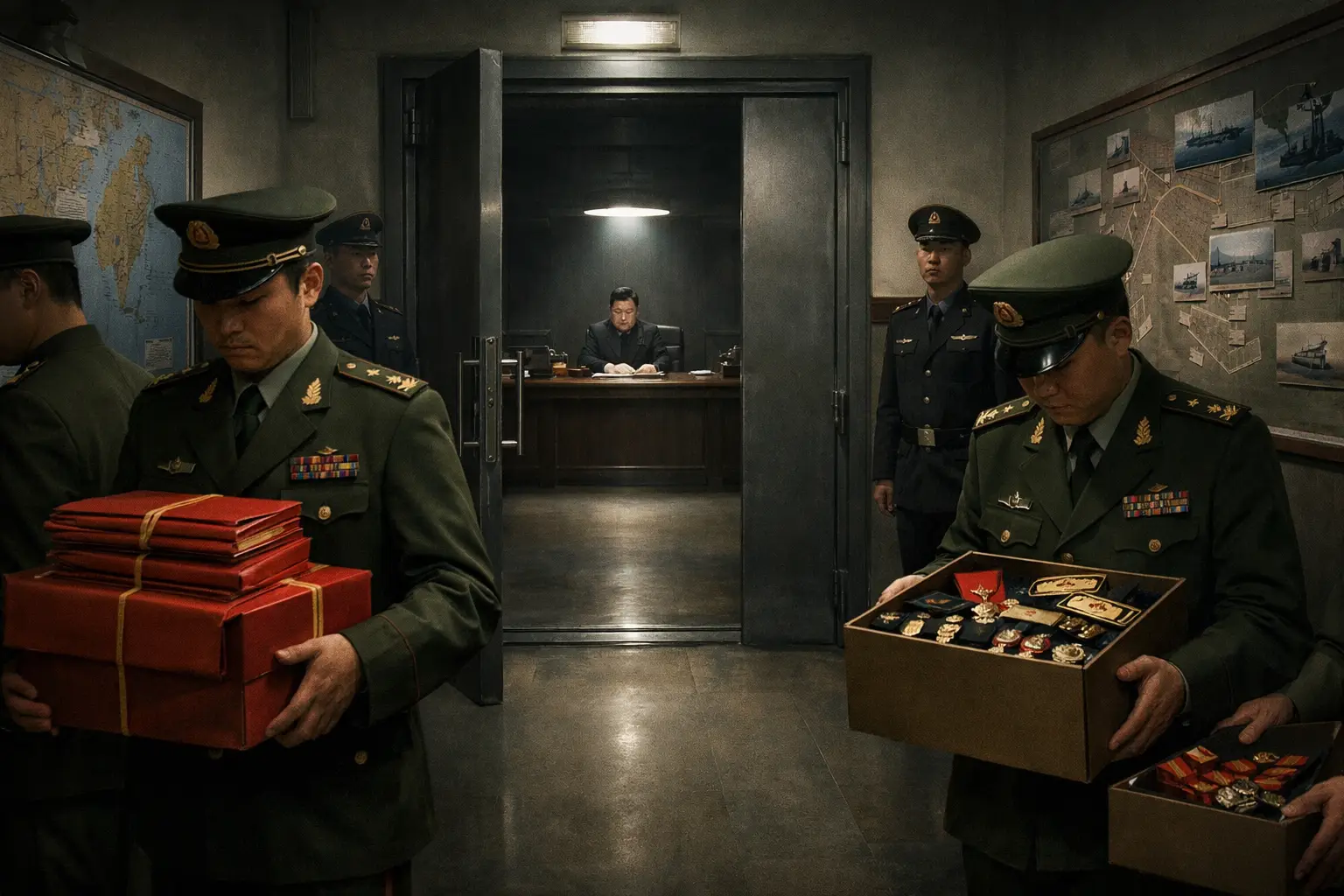
On January 24, 2026, China’s Ministry of National Defense announced the launch of an investigation into Zhang Youxia, Vice Chairman of the Central Military Commission (CMC) of the Chinese Communist Party (CCP) and one of the country’s most powerful generals.
Simultaneously, proceedings were initiated against Liu Zhenli, a member of the Central Military Commission and Chief of its Joint Staff Department. In both cases, Beijing officially cited “violations of Party discipline” as the grounds for investigation.
The conflict between the People’s Liberation Army (PLA) and the CCP Central Committee — personally involving Xi Jinping — unfolded throughout 2025, as Zhang Youxia’s public rhetoric increasingly diverged from Xi’s line.
General Zhang consistently emphasized the need to slow the pace of military preparations and to shift the horizon for achieving key capabilities closer to 2035.
Zhang Youxia and a group of generals aligned with him argued that the PLA should prioritize consolidating and expanding existing advantages, closing strategic gaps, and achieving a qualitative leap in operational capabilities.
The strategic pause advocated by part of China’s military leadership also reflected a political calculation.
The strengthening of Taiwan’s opposition Kuomintang (KMT) party created a window for Beijing to steer Taiwan toward a more China-aligned course through institutional compromises, economic interdependence, and elite-level political integration after 2028, when Taipei is scheduled to hold presidential and parliamentary elections.
Xi Jinping, by contrast, has insisted on full readiness for an operation against Taiwan as early as 2027. For Xi, the Taiwan issue constitutes the foundation of regime legitimacy and a central element of his political legacy as an autocratic leader.
Consequently, he has imposed a compressed timeline for coercive readiness, which Western intelligence assessments commonly anchor to the 2027 benchmark.
The divergence between Xi’s political directives and the position of segments of the senior military leadership ceased to be an internal debate and became a signal to other operational commands and the broader PLA officer corps—the institution tasked with implementing plans for a Taiwan Strait contingency.
The transmission of doubt and uncertainty within the PLA regarding the advisability of such plans creates risks for maintaining a unified and cohesive position within Chinese society.
The involvement of segments of the PLA’s senior general officer corps and their close networks in defense contracting and subcontracting chains has produced a persistent conflict of interest.
Delaying a force-based scenario beyond 2030 objectively extends procurement cycles, stabilizes contract flows, and preserves control over affiliated ecosystems of manufacturers, contractors, and intermediaries.
Once doubts voiced by the general officer corps began to be perceived by China’s top leadership as positions structurally driven by material interests, Xi Jinping opted to remove key figures within the PLA.
An additional motive behind this decision was the atypical pattern of international contacts and exchanges involving parts of the security establishment since 2023.
In particular, Zhang Youxia maintained working channels with representatives of the governments of Vietnam and Pakistan, countries that have traditionally served as intermediaries between the PLA and the United States.
Similarly, since 2023, the international profile of Liu Zhenli—a less influential member of the Central Military Commission—had grown, largely due to his responsibility for maintaining communication channels between the PLA and the defense establishments of the United States, Australia, and the United Kingdom.
The nature of the purges indicates a shift in the balance of power within the PLA’s senior leadership in favor of Xi Jinping’s personalistic control and cadre selection for the Central Military Commission based on personal loyalty.
The removal of generals capable of slowing or adjusting Xi’s political directives narrows the circle of genuine decision-makers and weakens internal safeguards through which the military had previously been able to restrain or reassess high-risk uses of force.
The Central Military Commission is the highest body of military-political leadership in China, overseeing both the Ministry of National Defense and the PLA. Its personal composition was last updated in October 2022.
Following the removal of Zhang Youxia and Liu Zhenli, only two of the Commission’s seven formal members remain: Xi Jinping and Zhang Shengmin, a lower-ranking official responsible for implementing the anti-corruption campaign.
The weakening of the PLA’s influence over decision-making at the highest levels of China’s political leadership represents a direct blow to the business architecture of China’s general officer circles.
In scale, the PLA constitutes one of China’s largest financial and organizational conglomerates and, in recent years, has evolved into an autonomous financial-economic power through which key defense-sector contract flows pass.
As China transitioned toward cycles of military preparation, the PLA became the institutional architect of the war economy—setting priorities, rules, and mechanisms for subordinating the broader economy, including shaping the development strategy of the Belt and Road Initiative.
Through personnel appointments, control over access to state defense procurement, and the determination of technical priorities, the PLA institutionally manages the allocation of resources and rent flows across a wide array of defense-industrial firms and adjacent contracting networks.
Since the 1990s, the PLA’s core economic power has shifted from direct ownership of enterprises to control over contract flows, access to procurement, subcontracting structures, state bank credit, and regimes governing access to technologies, licenses, and export opportunities.
The sectoral interests of the group represented by Zhang Youxia and the PLA’s senior command were concentrated in arms procurement and military components, aerospace and aviation manufacturing, military electronics and communications systems, shipbuilding and logistics, digital surveillance and data-processing systems, as well as raw-material supply chains critical to sustaining the defense industry.
The PLA’s economic perimeter encompasses both state-owned defense conglomerates and thousands of private companies embedded in supply chains, subcontracting networks, and dual-use technologies.
In the state-owned segment, control is exercised through Party–nomenklatura instruments, whereby Party committees take precedence over boards of directors and determine personnel and financial decisions.
In the private defense sector, externally imposed institutional mechanisms of political control operate through Party cells established within firms and integrated into corporate governance and human-resources procedures, ensuring manageability in line with the state’s mobilization logic.
As a result, the PLA achieves end-to-end control over assets and flows across the entire ecosystem, transforming the industrial-logistical base into an instrument of mobilization readiness.
Western institutions have increasingly documented that, within the Chinese model, the boundary between civilian business and mobilization infrastructure is largely nominal, and that the degree of corporate affiliation with PLA requirements manifests across logistics, data, and dual-use technologies.
It was precisely within this framework that, in January 2025, the U.S. DoD expanded its list of Chinese military companies to include not only weapons manufacturers but also mobilization infrastructure and dual-use technologies.
The most illustrative case is China COSCO Shipping Corporation, which was added to the list as a logistics actor capable of integration into PLA planning and of providing visibility into global supply chains as a military resource.
COSCO controls terminals in more than 100 ports worldwide, while its logistics platform LOGINK aggregates global maritime shipping data, providing Beijing with supply-chain visibility that, in a crisis, can be converted into a resource for mobilization and operational monitoring.
Within the Chinese model, civilian shipping and ferry operators are treated as a reserve of amphibious and transport capacity that can be rapidly mobilized for the movement of equipment and personnel.
Exercises involving civilian roll-on/roll-off (Ro-Ro) ferries—vessels structurally designed for rapid loading and unloading of equipment via ramps without crane infrastructure—demonstrate that mobilization planning explicitly incorporates commercial transport capacity, ports, schedules, and procedures.
In this configuration, private operators are effectively embedded into military logistics as subordinate resources, while economic assets become instruments for executing PLA operational tasks.
CATL holds approximately 38% of the global EV battery market and is simultaneously expanding production capacity in Europe, entrenching its presence in a critical segment of the EU’s future energy and transport systems. Within Beijing’s military-economic logic, this position carries dual significance.
It simultaneously creates dependency of European manufacturing chains on a Chinese supplier and enhances the resilience of China’s industrial base through production diversification, access to technological cooperation, and broader control over nodes essential to modern energy and mobility systems.
In the digital sector, integration is achieved through a model of guaranteed state demand, which forms the financial base for so-called national champions while institutionally binding them to the ecosystem of security-sector customers.
Here, the linkage to PLA leadership operates through three instruments: Party oversight in corporate governance, prioritization of security-sector technical requirements in public procurement, and data-access regimes.
Party committees and internal security units are embedded within the management structures of technology firms in such a way that state requirements for data access and routing are built in at the product design stage.
As a result, sensor data—including data from electric vehicles, commercial drones, and consumer devices—can, under normal operating conditions, be redirected for intelligence collection and situational awareness tasks.
This transforms the digital sector into an element of the coercive architecture and strengthens the role of the military-political leadership as the ultimate beneficiary of contracts.
In 2024, SenseTime increased revenue to ¥3.77 billion, while its generative AI solutions segment more than doubled, demonstrating the capacity of such firms to sustain investment momentum even under sanctions pressure through domestic contracts and political support.
Functionally, this means that civilian video analytics systems and Chinese social media platforms become components of situational awareness and internal control subordinated to military tasks.
4Paradigm has been involved in projects for military educational institutions, including the development of software for command decision-making and human–machine teaming.
According to SIPRI, the combined revenues of eight Chinese companies in the Top 100 fell by 10% in 2024, with NORINCO experiencing the steepest decline—31%—amid state inspections and contract delays linked to the anti-corruption campaign.
NORINCO’s revenue decline indicates that disruptions in PLA procurement processes are already translating into slower execution of orders. Under a short-horizon scenario, this represents a contraction of defense-industrial throughput at precisely the moment when acceleration is expected.
Thus, the so-called “pragmatism” of segments of the former PLA leadership functioned as an instrument for defending their own political-economic model.
This model rests on continuity of state procurement, preferential credit lines, regulatory privileges, and access to rent-generating regimes in adjacent sectors, enabling loyal groups to monetize the defense cycle in a stable manner.
A key indicator of this vulnerability is the divergence between the global rearmament cycle and the financial performance of segments of China’s defense industry.
In 2024, aggregate revenues of leading global defense companies increased by 5.9%, while several Chinese players recorded revenue declines—consistent with paralysis and decision delays in military procurement amid the PLA purges.
When anti-corruption purges penetrate the defense procurement system, administrative delays in contracting become an early indicator of a loss of system controllability, signaling erosion of the institutional inertia on which mobilization-driven buildup depends.
Forcing a Taiwan operation on a 2027 timeline under these conditions implies an accelerated transfer of political liability for defects, disruptions, and cost inflation.
In turn, this creates direct risk for the network of beneficiaries that converts budgetary programs into rents across strategic sectors under the cover of mobilization necessity.
In authoritarian systems, anti-corruption rhetoric functions as a universal legal wrapper for bureaucratic redistribution of influence. The removal of Zhang Youxia is illustrative in precisely this sense, given his exceptional weight within the military hierarchy.
Unlike most of Xi Jinping’s current inner circle, General Zhang belonged to a narrow cohort of senior officers with real combat experience, including participation in the 1979 Sino-Vietnamese War.
His legitimacy was established prior to Xi’s consolidation of power, making Zhang one of the few senior military figures able to rely on autonomous authority.
This status was further reinforced by longstanding personal ties to the Xi family and by the atypical preservation of his position despite informal age limits—rendering Zhang the last military heavyweight whose legitimacy was not fully derivative of Xi.
A separate dimension of Zhang Youxia’s exceptional role and influence within the PLA lay in his access to intelligence derived from the integration of heterogeneous data streams and their centralized processing through interagency collection, fusion, and analytics systems.
Between 2019 and 2024, China sharply expanded intelligence collection through civilian platforms and mass-sensor technologies.
Social services, unmanned systems, consumer devices, and electric vehicles generated intelligence-relevant datasets, including geolocation and movement data, behavioral profiles, network linkages, as well as audio and video streams and onboard system data. Of particular value were coordinates, routes, and navigation-module parameters.
DJI’s dominance of the global drone market meant that commercial unmanned platforms equipped with cameras and positioning systems effectively became a scalable sensor layer generating data in the state’s interest, even when formally operating as civilian products.
In 2024–2025, the United States and its partners shifted countermeasures against this model into a phase of systemic exclusion, reducing the presence of Chinese digital products and components in critical data and infrastructure segments.
The 2024 legislative mechanism mandating forced changes of control over TikTok codified an approach that treats mass consumer platforms as potential channels for data access and societal influence in Western countries.
In parallel, in 2024 the U.S. Department of Commerce launched a regulatory track to restrict Chinese software and hardware components in connected vehicles, citing risks associated with sensor data collection, onboard communications systems, and remote interference.
The result was a contraction of access to external data pools that had underpinned this intelligence depth, and a corresponding degradation of civilian channels that had previously provided the PLA with scalable advantages in intelligence acquisition.
Zhang Youxia’s position advocating a preparation horizon extending to 2035 was not rooted in information scarcity, but in his broader situational awareness, which allowed for a more realistic assessment of the balance between the PLA’s offensive potential and the countervailing capabilities of democratic allies.
Within this logic, a compressed 2027 deadline increases the risk of operational failure precisely because of technological asymmetry and the speed of the Western response cycle.
The West is already systematically constricting China’s data-collection channels that previously delivered low-cost, scalable intelligence depth through commercial ecosystems.
Tighter controls on Chinese social platforms, restrictions on Chinese software and components in connected vehicles, and more stringent regimes governing drones and consumer “sensor” devices reduce the external datasets on which portions of China’s assessments of U.S. and allied capabilities relied, while simultaneously narrowing avenues for technological reverse engineering.
From this followed Zhang Youxia’s emphasis on a controlled pause in relations with the West as an instrument for restoring access to data and technological signals—without which it is impossible to properly calibrate assessments of the U.S. and allied technological lead or to plan the substitution of critical gaps in China’s own industrial base.
For Zhang, the 2035 horizon was not an abstract “delay,” but an alignment with cycles for restoring intelligence-collection capabilities.
Separately, he viewed the expansion of trade-digital platforms such as Temu and Shein as auxiliary channels of structural intelligence, enabling reconstruction of behavioral patterns, demand geography, and logistics routes outside classical state collection frameworks.
At a practical level, transaction and delivery datasets from such marketplaces can be used for indirect verification of infrastructure patterns, including transport-mobility nodes and concentrations of demand near strategically significant sites.
Taken together, these arguments render Zhang Youxia’s demand for time and channels to reduce uncertainty prior to confrontation with the democratic bloc operationally grounded.
Recent U.S. operations against Iran in June 2025 and Venezuela in January 2026 further increased uncertainty within the PLA’s senior leadership regarding the scale of technological asymmetry between China and the United States. The PLA observed the U.S. ability to rapidly neutralize adversary air-defense systems at the outset of a campaign.
In the Iranian case, strikes against key facilities were accompanied by rapid suppression of air defenses and constraints on retaliatory options.
In practical terms, this demonstrated that traditional approaches to layered air-defense architecture do not guarantee resilience in the absence of a clear understanding of the functions performed by advanced U.S. systems for air-defense suppression and penetration.
In Venezuela, the United States rehearsed a model of rapid establishment of air control through sequential degradation of the adversary’s situational awareness—disabling radar assets, communications nodes, and command centers, after which the opponent loses the ability to employ air defenses in a coordinated manner.
In a Taiwan scenario, the application of similar tactics by democratic allies would raise the cost of error and render a rapid operation vulnerable to disruption through early loss of communications and coordination on the PLA side.
Against this backdrop, from 2025 onward Zhang Youxia’s public statements increasingly diverged from Xi Jinping’s position. Zhang emphasized sequencing, focus on eliminating structural deficiencies, and consolidation of existing advantages over the next 4–7 years, presenting 2035 objectives as the foundation for a qualitative leap following intermediate results.
The purges have exposed the core governance technology of China’s security apparatus, characteristic of authoritarian systems that inherited from the Soviet model the practice of managed corruption.
Under conditions of minimal institutional social guarantees and limited legal mechanisms for officials and generals to convert status into a full package of material security, the regime effectively tolerates systemic abuse of power as a compensatory mechanism.
Tolerance for such abuse is conditional and tied to political loyalty. Corruption thus functions as an element of social engineering and as a controlled instrument of discipline, elite management, and redistribution of influence.
When loyalty comes into question, the same mechanism is inverted instantaneously and transformed into a tool of repression. The formula of “violations of Party discipline” serves as a universal legal wrapper allowing the dismantling of personnel positions, financial flows, and control networks without publicly acknowledging a strategic dispute within the system.
A distinct effect of the purges is the neutralization of channels of resistance and internal critique. This reduces space for leaks and external contacts, but simultaneously renders the system more prone to self-deception and miscalculation, as the signal “do not doubt” displaces the signal “verify.”
Against this backdrop, the declared course by CIA Director John Ratcliffe to return intelligence management to a Cold War–era model reflects a bet on rebuilding agent networks and reliance on human sources rather than predominantly on cyber capabilities, technical collection, and satellite intelligence.
For this reason, contact channels within China’s security apparatus acquire greater importance for Washington. However, parallel purges within the PLA are shrinking this resource by removing officers and intermediaries through whom working relationships were maintained and prospective access points accumulated.
Against the backdrop of a prolonged degradation of U.S. human intelligence presence in China, this directly complicates the practical implementation of the announced shift.
This effect compounds the long-term erosion of U.S. agent networks in China dating back to the 2010s. Each new cycle of internal terror simultaneously reduces external visibility into PLA processes and increases the risk of assessment errors in both Beijing and Washington.
Almost in parallel with the wave of personnel decisions in the PLA, Chinese authorities announced the launch of an investigation into Wang Xiangxi, Minister of Emergency Management—a civilian official whose ministry, in crisis mode, is responsible for response, reserves, and resource coordination on the domestic theater.
This linkage between security-sector and civilian investigations signals that the purges are expanding from the level of military command into the state’s broader mobilization perimeter, bringing under control the institutions through which infrastructure and logistical readiness are activated.
Late December 2025 and January 2026 produced a set of public indicators that Beijing has shifted from background pressure to operations that simultaneously exert coercive effects on Taiwan and test regional response protocols of democratic allies in the western Pacific.
The pivotal event was a two-day large-scale exercise around the island dubbed Justice Mission 2025, which the PLA framed as a warning to “external forces” and separatism, while operationally rehearsing blockade logic through the establishment of zones encircling the island.
The symbolic and practical significance of this episode lies in its character as a demonstrative operation with a high political authorization threshold, requiring coordination across multiple services. The exercises involved more than 130 aircraft and 22 vessels, the activation of seven exercise zones, and simulation of a Taiwan blockade.
PLA activity in the second half of January 2026 demonstrates a shift to a mode of gradual escalation. On January 15, Taiwan recorded a “joint combat patrol” involving naval vessels and at least 18 aircraft that crossed the median line of the Taiwan Strait and entered Taiwan’s airspace from three directions.
The tempo did not abate thereafter. On January 28, 2026, a patrol involving five aircraft and five PLA vessels was recorded in the Taiwan Strait.
Additionally, increased activity observed in Fujian in late January—including preparatory measures in rear-area infrastructure—reinforces the interpretation that the political center is testing the mobilization fitness of combat platforms and enabling chains, which have traditionally been arenas of autonomy for interest groups within the security apparatus.
For democratic allies in the western Pacific, this constitutes a targeted signal: Beijing is simultaneously increasing coercive pressure on Taiwan while demonstrating that internal safeguards against accelerated escalation within the security sector have been weakened.
The medium-term risk around Taiwan is therefore rising, as personalization of decision-making and disciplinary terror simultaneously remove safeguards while increasing execution discipline.
In this configuration, Xi gains a faster preparation cycle and fewer internal constraints, thereby elevating the danger of a force-based scenario or strategic miscalculation.
This makes 2026 a period of heightened escalation dynamics in the Pacific, as Beijing will have incentives to compensate for managerial turbulence within the PLA by increasing the operational tempo. In strategic terms, this raises the probability of a coercive or force-based scenario vis-à-vis Taiwan.