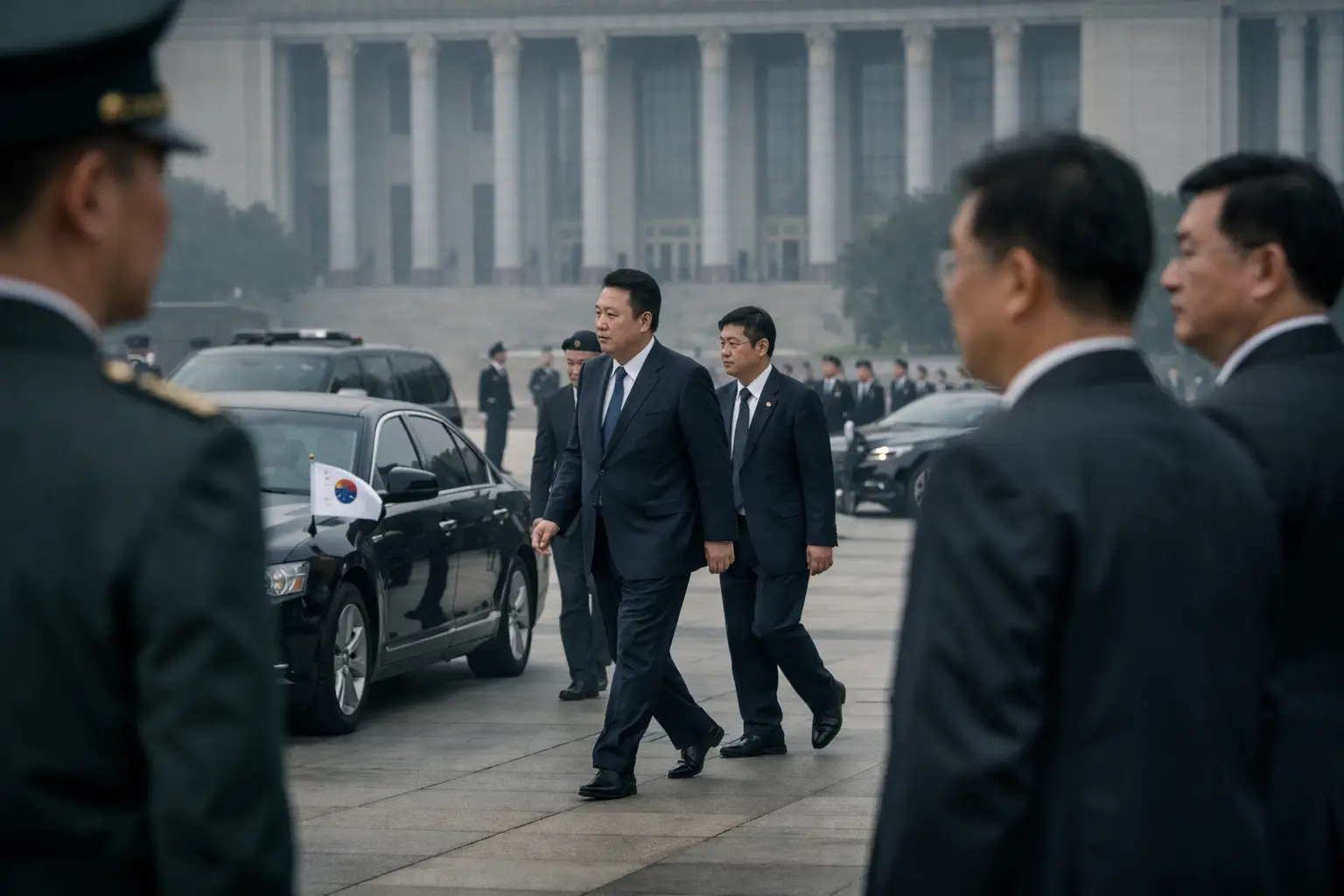
From January 4 to 7, 2026, South Korean President Lee Jae-myung made his first state visit to the PRC after taking office.
Within its framework, he held talks with Xi Jinping, following which South Korea and the PRC signed 14 memorandums of understanding on cooperation.
Although these agreements covered key economic areas—trade, industrial, and scientific-technical—their content was reduced to declaring intentions to maintain institutional ties. At the same time, no strategic agreements between the states were reached.
The main outcome of Lee Jae-myung’s trip ultimately became the clarification of the PRC’s updated North Korean strategy. In particular, Xi Jinping refused to discuss the denuclearization of the DPRK, emphasizing that Beijing is in search of “other creative ways” to establish peace on the Korean Peninsula.
This confirmed Beijing’s preparation to recognize the DPRK as a “nuclear state” with subsequent neutralization of the sanctions regime, despite Lee Jae-myung’s request to ensure “mediation” between the states regarding denuclearization.
The visit of the South Korean leader to Beijing, which was the first since 2019, was formally aimed at attempting to normalize relations between South Korea and the PRC.
Because of this, the key political message from Lee Jae-myung was the declaration of readiness for “full-scale restoration” of communication with the Chinese leadership after the systemic deterioration of bilateral relations during the presidency of Yoon Suk-yeol.
However, the practical implementation of this line remained limited by foreign policy frameworks—primarily the parameters of the “grand bargain” with the United States.
Under such conditions, the talks between Lee Jae-myung and Xi Jinping essentially reproduced the ineffectiveness of their previous meeting on the sidelines of the APEC summit in Gyeongju in November 2025.
From the perspective of the Donald Trump administration, the restoration of diplomatic contacts at the highest level between South Korea and the PRC does not pose an obstacle to US foreign policy strategy, according to which East Asian democracies must form a multi-level system of strict containment in the region.
This is based on the realization that Lee Jae-myung objectively cannot deviate from existing commitments without the risk of losing defense and trade preferences provided by the United States; this thesis was directly confirmed by President Lee.
Viewing South Korea’s actions as an element of coordinated diplomatic tactics, the White House seeks to engage these channels within the framework of preparations for the April talks between Donald Trump and Xi Jinping, directly related to the issues of the Korean Peninsula.
Lee Jae-myung’s own approaches, in turn, continue to be based on pragmatic-opportunistic principles. In response to tariff pressure from the US, his administration viewed the visit to Beijing as a tool to neutralize economic risks—primarily by restoring stable access to critically important industrial components (graphite, urea, etc.) and rare earth metals, the supply of which has been repeatedly used by Beijing as a lever of political pressure.
In parallel, Lee Jae-myung sought to prevent the spread of Chinese “punitive” export controls to South Korea—in light of Xi Jinping’s decision to restrict supplies of dual-use goods to Japan from January 6, formally motivated by the intention to “curb the development of military power” of the Self-Defense Forces.
Confirmation of this logic was the holding, prior to the talks with Xi Jinping, of a business forum with the participation of President Lee, which brought together key South Korean corporations (Samsung Electronics, Hyundai Motor Group, SK Group, LG Group) and Chinese companies (Sinopec, China Energy Engineering, Tencent, ZTE).
They, in particular, discussed the continuity of supplies of Chinese resources for the South Korean technology sector, which continues to maintain production facilities in the PRC.
Additionally, Lee Jae-myung decided to promote South Korea’s economic goals by agreeing to resume annual communication between the Ministries of Defense of South Korea and the PRC.
At the same time, Lee Jae-myung’s intentions to maintain a balance between expanding the alliance with the United States and Japan and preserving access to Chinese supplies collided with a number of challenges caused by asymmetric pressure from the White House.
First, Lee Jae-myung’s visit to Beijing took place in parallel with the American campaign to neutralize the Venezuelan regime of Nicolás Maduro, which significantly narrowed the space for maneuver in Chinese diplomacy.
Beyond purely resource and geopolitical dimensions, Venezuela has served for years as a testing ground for testing Chinese military technologies, as well as a key transit hub for North Korea’s “black” economy.
In particular, the destruction in Caracas of Chinese radar infrastructure—including the three-dimensional surveillance system JYL-1, the meter-range radar JY-27, and related elements of Russian air defense—along with the liquidation of defense facilities built by North Korean engineering units, had direct consequences for the negotiation dynamics in East Asia.
Realizing the loss of the central resource-logistics hub for the PRC, RF, and DPRK in Latin America, Xi Jinping was forced to revise the existing toolkit of foreign policy pressure.
Because of this, Beijing limited itself to a formal, pre-coordinated protocol for talks with Lee Jae-myung—following logic identical to their contact at the APEC summit, without attempts to expand the agenda or fix political commitments.
Second, the possibility of concluding a significant resource-technological agreement between South Korea and the PRC was essentially blocked by the US decision to publicly fix the preparation of American forces on the Korean Peninsula (USFK) for operations beyond the immediate zone of responsibility—primarily in the context of Taiwan’s defense.
In particular, on December 29, 2025, USFK Commander Xavier Brunson emphasized that his command would respond to threats that go beyond the defense of South Korea.
This statement became an element of the updated tactical configuration for the defense of the First Island Chain, presented by the US Navy in November, according to which the Korean Peninsula is considered a forward line of containment of the PRC in the event of escalation in the Taiwan Strait.
At the same time, this signal was integrated into the broader South Korean strategy of the White House, which included granting the Lee Jae-myung administration political permission to form its own nuclear submarine fleet—with a clear functional purpose of containing the PLA in the Yellow and East Seas.
Preparing for talks in Beijing, Xi Jinping expected to force Lee Jae-myung to provide political guarantees that South Korea would not act as an operational bridgehead for Taiwan’s defense and would not assist the US in building synchronization between the defense networks of East Asian democracies.
However, the publicly fixed position of USFK, voiced amid Japan’s growing readiness to join Taiwan’s defense and the White House’s decision to approve a defense package for Taipei worth over $11 billion, outlined the boundaries of the negotiation maneuver for the South Korean government.
Under such conditions, neither Lee Jae-myung nor Xi Jinping had space for compromise, which led to the absence of any politically significant agreements following the visit.
Third, the talks with Xi Jinping were significantly complicated by the need to simultaneously take into account US interests ahead of Lee Jae-myung’s visit to Nara for talks with Japanese Prime Minister Sanae Takaichi. This trip is scheduled for mid-January—that is, essentially immediately after his visit to Beijing.
Given that the deepening of defense and technological cooperation between Japan and South Korea is an informal part of their “grand bargains” with the United States, the Lee Jae-myung administration was not prepared to risk undermining the status quo formed following the consensus with the Takaichi government after the APEC summit.
At the same time, in Seoul, they realized that any signals of rapprochement with the PRC—including emphasizing indifference to escalation around Taiwan—could undermine the prospects of future agreements with Tokyo amid the growing Japanese-Chinese confrontation.
In the end, this factor became an additional reason why the talks with Xi Jinping were deliberately concluded at a declarative, rather than substantive, level.
Finally, the Lee Jae-myung administration is forced to take into account the change in public sentiments, which are increasingly leaning in favor of the US.
According to a January poll by the publication Chosun Ilbo, 57% of South Koreans express a negative attitude toward the PRC and, accordingly, toward the prospects of deepening ties with Beijing; 30% of respondents remain undecided; and only 13% show sympathy, primarily in the age group from 50 to 90 years. Even lower indicators are for the RF, which is supported by about 9% of respondents.
Given that anti-Chinese rhetoric is a key element of the policy of the opposition People Power Party (PPP), the Lee Jae-myung administration is trying to build a more balanced line in order not to allow political advantage to opponents ahead of the 2026 local elections.
Under these circumstances, one of the few practical agreements between Lee Jae-myung and Xi Jinping was reaching a preliminary agreement on reviewing the regime of border zones in the Yellow Sea, where since 2024 the PRC has consistently deployed dual-use infrastructure.
Despite Beijing’s official explanations of their “aquacultural” significance, Seoul views these objects as encroachments on its own maritime rights and an element of the tactic of managed hybrid escalation, tested by the PRC in the South China Sea against the Philippines.
In conditions of strengthened American containment and the critical need for the PRC to preserve access to South Korean investments and semiconductor technologies, Xi Jinping agreed to open a negotiation track on fixing a “clear median line” in the Yellow Sea with the prospect of relocating so-called aquacultural objects to the zone of Chinese jurisdiction.
However, given the overall degradation of the security environment in East Asia, this diplomatic maneuver does not transform into real security dividends for South Korea.
Regarding the North Korean direction, President Lee’s administration from the very beginning realized the limited ability to influence the new geopolitical conjuncture.
At the end of November 2025, the PRC for the first time in over two decades removed the mention of the need for the DPRK’s disarmament from its official defense doctrine. In parallel, in December 2025, the Donald Trump administration excluded the DPRK and the issue of its denuclearization from the new US National Security Strategy.
Collectively, this evidenced a structural change in the positions of two key external actors, within which Seoul lost the opportunity to lobby for sanctions pressure on Pyongyang in the nuclear context.
Under these conditions, Lee Jae-myung will bet not on revising approaches to the DPRK, but on reaching agreements with Xi Jinping on restoring public communication with Kim Jong-un—primarily as an element of domestic political discourse aimed at maintaining electoral advantage over the PPP, rather than a way to bypass the US.
In the strategic dimension, this means South Korea’s abandonment of forming an autonomous model of containing the DPRK and further tying its own approaches to the logic of the White House.
In particular, from the perspective of President Lee’s administration, the only realistic mechanism for influencing the North Korean conjuncture is potential direct talks between Donald Trump and Kim Jong-un, planned for spring 2026.
Accordingly, Seoul will rely on further White House decisions in this direction, expecting to strengthen its positions in accordance with the “grand bargain” with the United States.
At the same time, South Korea will continue systematic buildup of defense capabilities—primarily in the field of naval military industry, which is acquiring critical importance for the US amid the deficit of its own shipbuilding capacities.
This involves a deep symbiosis that consensually links South Korean and American elites; an illustrative example of this process was the appointment of Alex Wong—former deputy national security advisor Mike Waltz—as director of global strategies (CSO) at Hanwha Defense USA,—a South Korean defense company involved in the implementation of the MASGA program, which is simultaneously under sanctions pressure from the PRC.
Such ties ultimately serve as a guarantee that South Korea will not deviate from its commitments to the United States, despite unwillingness to participate in supporting Japan, Taiwan, and Ukraine.
Taking into account such dynamics, Lee Jae-myung’s first state visit to the PRC was limited to fixing the permissible maneuver of South Korean diplomacy in conditions of strengthened American containment and growing strategic competition in East Asia.
The key fact fixed during the talks between Lee Jae-myung and Xi Jinping was the final formation of a new configuration around the DPRK, under which Seoul is unable to achieve real de-escalation agreements due to the existence of a strategic compromise with the Donald Trump administration.
Under these conditions, attempts to restore inter-Korean communication with PRC mediation will perform rather a domestic political function than become an element of regional security architecture.
From a strategic perspective, this consolidates South Korea’s further integration into the multi-level containment architecture built by the United States in the Indo-Pacific.
Accordingly, Lee Jae-myung’s attempts to combine economic pragmatism in relations with the PRC with security commitments to the US and Japan were reduced to minimizing risks for its own production chains, avoiding Chinese export controls, and stabilizing sensitive maritime issues in the Yellow Sea—without crossing the boundaries of the “grand bargain.”
This means that South Korea will remain a stable element of the American containment strategy with limited space for autonomous decisions, but with ascending significance as a defense-industrial and naval hub in the region.