On January 9, 2026, Donald Trump held a meeting with the heads of U.S. and foreign oil companies, during which the President of the United States urged leading energy corporations to resume operations in Venezuela following the arrest and transfer to the United States of the country’s former leader, Nicolás Maduro.
The U.S. president assured participants that Washington would guarantee security conditions necessary for stable and predictable business operations in Venezuela and emphasized that agreements related to the extraction and sale of Venezuelan oil would be concluded by private companies directly with the United States.
Unexpectedly for Washington, the Venezuelan case generated effects extending beyond the original intent. Access to a resource base of this scale simultaneously creates strategic opportunities and imposes an obligation to protect it, requiring a reassessment of priorities and a readiness to increase defense spending.
In this context, Trump’s statement that the U.S. military budget for fiscal year 2027 would reach $1.5 trillion, compared with $901 billion approved by Congress for 2026, serves as a fiscal marker signaling Washington’s entry into a prolonged security-expenditure posture.
The U.S. operation in Venezuela and the return of American oil corporations to the Venezuelan market formalize Washington’s transition to a regime of direct control over access to critical resources and maritime routes, in which energy rents are generated through U.S. security presence, a sanctions framework, and jurisdictional enforcement.
First, Washington seeks to institutionalize political-legal protection and financial control over the world’s largest oil resource base, transforming it into a long-term source of strategic rent.
Second, the United States raises the cost base of China’s industrial model during a transitional period in which Beijing remains dependent on imported energy flows and maritime logistics.
The primary effect lies in the forced revaluation of Chinese assets and financial models, many of which were structured around assumptions of stable access to sanctioned raw materials and predictable maritime supply chains.
When access to the resource base becomes conditional and politically managed, the resource guarantee underpinning China’s investment cycles, credit expansion, and internal risk assessment erodes.
This shifts part of Chinese assets into a category of unverified expected cash flows, weakens their collateral quality, and raises the cost of capital for state banks, quasi-state corporations, and provincial financial systems.
If the access-restriction strategy persists, the compulsory reassessment of asset values undermines Beijing’s ability to validate economic calculations not only in foreign trade but also in domestic financial operations.
Third, the U.S. administration strengthens the dollar by subordinating Venezuelan energy rents to U.S. contractual, sanctions, judicial, and banking frameworks, thereby narrowing the scope for settlements outside the Western financial infrastructure.
This shift represents a response to China’s long-standing model of securing resource access in the Global South through lending, corruption-based instruments, and reliance on authoritarian elites as a low-cost mechanism for locking in contracts and logistics.
Beijing has systematically applied this logic for years, converting resource access into a concealed foundation for credit expansion, monetary issuance, and asset revaluation.
Within this framework, China embedded expectations of future rent from estimated resource bases into macroeconomic calculations and into parameters supporting the renminbi’s valuation, around which industrial cycles and external economic risks were scaled.
Washington is now responding with a mirror logic, shifting competition from covert penetration to overt coercion, where sanctions and resource pressure function as tools of forceful exclusion.
For China, a system in which democracies operated strictly within international legal proceduralism—voluntarily limiting coercive instruments capable of rapidly nullifying Chinese investment positions—was strategically advantageous.
The Venezuelan case demonstrates that Washington is adopting a comparable logic of exclusive access, but moving it from the realm of covert penetration into overt coercion.
Whereas China secured access through concealed political-economic penetration and elite corruption-based loyalty, the United States is making access control an explicit function of naval power and sanctions enforcement. This shift will contribute to the financial reconsolidation of U.S. hegemony.
Against the backdrop of the dollar’s share of official reserves continuing to decline in 2025—from 57.79 percent in the first quarter to 56.92 percent in the third quarter—the Trump administration is creating a regime in which Venezuelan energy rents are channeled through U.S. legal and financial circuits.
The U.S. Federal Reserve notes that despite a long-term trend toward reserve diversification, the dollar retains systemic dominance in global trade invoicing and international payments, making control over energy contracts a means of reinforcing the dollar through transaction-driven demand.
The Venezuelan case, structured as commercial agreements under U.S. political patronage, restores the logic of energy trade as a pillar of the dollar-based infrastructure and minimizes space for settlements in renminbi or through off-system mechanisms.
Maintaining current oil production levels in Venezuela will require approximately $53 billion in investment by 2040, while increasing output to 3 million barrels per day—comparable to levels seen in the 1990s—would require $183 billion in investment in the country’s energy sector over the next 15 years.
Venezuela’s strategic value to the United States does not lie in the ability to rapidly inject 3 million barrels per day into the market. Even under favorable conditions, returning to 1990s production levels requires a multi-year investment cycle, modernization of upgraders and pipelines, and the establishment of a comprehensive security framework.
Venezuela possesses the world’s largest proven crude oil reserves, estimated at approximately 303 billion barrels, with a critical share concentrated in the Orinoco Belt and characterized by extra-heavy oil.
In parallel, the U.S. Geological Survey (USGS) estimates mean technically recoverable heavy oil resources in the Orinoco region at 513 billion barrels, creating an additional resource horizon that could be converted into production under different technological and price conditions.
Even under accelerated recovery scenarios, monetization of this portfolio spans several decades. Consequently, the decisive factor is not the pace of incremental barrels in the near term, but whose legal, financial, and security architecture will define access to the resource.
The gap between the scale of the geological base and actual production capacity turns control over access to Venezuelan oil into a tool for long-term redistribution of energy flows and for influencing the resource foundation of the autocratic axis.
The Republican administration does not envisage financing Venezuela’s oil infrastructure with U.S. federal funds, instead advocating a model in which Washington avoids direct budgetary exposure while retaining political control over the restoration of Venezuelan exports.
The policy of returning Western capital to Venezuela’s oil sector is implemented in parallel with the establishment of control over maritime logistics and the suppression of illicit fuel-export channels.
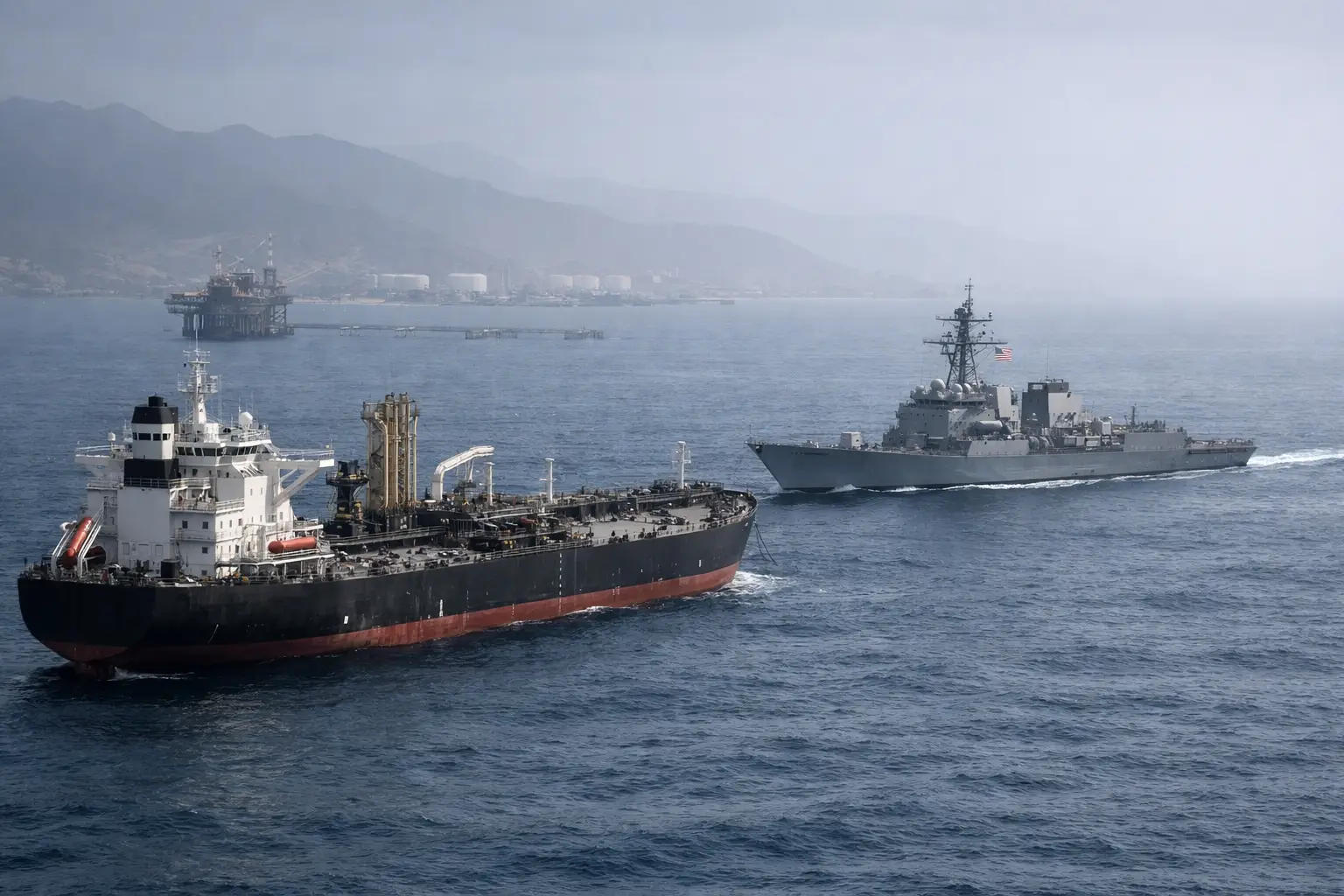
On January 9, 2026, the U.S. Coast Guard, U.S. Marines, and the U.S. armed forces task force Southern Spear detained the vessel Olina, the fifth tanker of the “shadow fleet” involved in transporting sanctioned fuel.
The interception of tankers linked to oil-supply schemes targeting major importers—primarily China—through late 2025 and early 2026 has become an organized U.S. strategy of energy pressure against the autocratic axis.
The objective of this approach is to establish a regime under which access to secure fuel supplies can be restored only with Washington’s consent and within rules defined by the United States.
This combination of sanctions pressure, maritime control, and the attraction of Western private investment into Venezuelan oil production constitutes a component of economic containment of China that the White House aims to implement within a compressed timeframe.
The U.S. administration recognizes that, over the medium term, Beijing will reduce its economy’s dependence on imported oil by transitioning to alternative energy sources.
Nevertheless, even under accelerated decarbonization scenarios, oil retains long-term strategic relevance due to incomplete substitution in heavy transport, aviation, and petrochemicals.
World Energy Outlook 2025, under the Stated Policies Scenario, projects a peak in global oil demand at around 102 million barrels per day circa 2030, while oil consumption in petrochemicals and aviation continues to grow in subsequent decades.
This leaves the United States with an operational corridor of energy coercion in which control over access to heavy crude and maritime transportation directly correlates with the competitiveness of China’s industrial model.
China’s expansion of fuel reserves, substitution of oil and gas in transport and power generation, and growth in domestic energy production reflect Beijing’s assessment of the risks arising from escalating confrontation between the autocratic axis and democratic states.
The U.S. operation in Venezuela and White House plans to establish control over the country’s oil production indicate that the evolution of U.S.–China confrontation will involve a new phase of Washington’s pressure on autocratic governments that serve as primary fuel suppliers to China. In 2025, China’s imports of Venezuelan oil stood at approximately 400,000–600,000 barrels per day.
Despite a 5.6 percent month-on-month decline in Russia’s oil exports to China in November 2025 compared with October, Russia remains Beijing’s largest oil supplier, providing around 2 million barrels per day and 91.5 million metric tons between January and November 2025.
Throughout 2025, the U.S. administration systematically reduced China’s ability to obtain fuel from autocratic bloc states. In October 2025, the Office of Foreign Assets Control (OFAC) imposed sanctions on Russia’s largest oil companies, Rosneft and Lukoil, blocking assets of entities in which these corporations hold more than a 50 percent stake and prohibiting all transactions involving their property within U.S. jurisdiction.
On December 7, 2025, Washington imposed a full blockade on all sanctioned oil tankers entering or departing Venezuelan ports.
Subsequently, Donald Trump endorsed a bill introduced in the Senate in 2025 by Republican Senator Lindsey Graham and Democratic Senator Richard Blumenthal that proposed a 500 percent tariff on imports from countries purchasing Russian oil, natural gas, petroleum products, and uranium.
While congressional support for the proposal would affect Brazilian and Indian trade with the United States, its primary target is China, which in November 2025 purchased roughly half of Russia’s crude oil exports.
Collectively, these measures are designed to create progressively more expensive and less predictable conditions for China’s energy imports from autocratic states.
By exploiting restricted access of sanctioned autocratic suppliers to Western markets, China previously secured lower oil import costs, enhancing the competitiveness of its industry and gaining an advantage relative to U.S. and European economies.
Intensified U.S. sanctions, trade, and logistical pressure constrains the economic viability of China’s energy-import model. Further restricting Beijing’s access to discounted fuel will erode advantages derived from cheap energy, raise industrial production costs, and reduce the competitiveness of the Chinese economy in external markets.
To mitigate these risks, Chinese leadership has pursued accelerated restructuring of the energy sector through the commissioning of new hydropower plants and energy-storage systems, increasing generation capacity. By the end of 2024, China had established the world’s largest national hydropower base, constructing more than 94,000 dams.
Total installed hydropower capacity reached 436 GW, with annual generation of approximately 1.42 trillion kWh. Of the 24.6 GW global increase in hydropower capacity in 2024, China accounted for 14.4 GW, more than half of which—7.75 GW—came from pumped-storage hydropower.
According to the International Hydropower Association, pumped-storage projects will provide around 130 GW of China’s power generation capacity by the late 2020s.
Amid rapid growth in wind and solar generation—adding 520 GW and 886.6 GW respectively—China is deploying battery energy-storage systems to stabilize the grid.
By June 2025, total installed energy-storage capacity in China reached 164.3 GW, up 59 percent year-on-year, while newly commissioned storage capacity exceeded 100 GW for the first time. In the first half of 2025 alone, new storage systems added 23.03 GW, with total new-project capacity increasing 32-fold between 2020 and 2025.
Alongside the expansion of alternative generation, transport electrification is accelerating, and costs of solar-panel components are declining. In December 2025, new energy vehicles (NEVs) accounted for 59.1 percent of retail car sales in China, with 1.34 million NEVs sold that month.
For the full year 2025, China produced 15.348 million NEVs, a 26.1 percent increase year-on-year. Although polysilicon production—one of the key inputs for solar panels—declined in 2025 for the first time in 12 years, China still accounts for over 90 percent of global polysilicon output.
Nine of the world’s ten largest producers are Chinese, with the top four—Tongwei, GCL Technology, Daqo New Energy, and Xinte Energy—controlling 65 percent of global supply.
In traditional energy sectors, Beijing is focusing on expanding natural gas and coal production, developing nuclear power, and increasing strategic fuel reserves through new storage facilities.
In the first half of 2025, China’s domestic natural gas production rose 5.8 percent year-on-year to 130.8 billion cubic meters, while coal and crude oil output reached 2.4 billion metric tons and 108.48 million metric tons, up 5.4 percent and 1.3 percent, respectively.
Accelerated shale gas production in Sichuan, Shaanxi, and Shanxi provinces—where output increased by a combined 11 billion cubic meters year-on-year—drove a 7.1 percent rise in gas production in November 2025.
Rapid shale development and the launch of a new segment of the Sichuan–East gas pipeline prompted analysts at Kpler Insight to revise their forecast for China’s gas production upward to 278.5 billion cubic meters in 2026. As of April 2024, China operated 58 nuclear power units with a combined capacity of 60.96 GW.
Including reactors in operation, under construction, and planned, China’s total nuclear fleet stands at 102 units with cumulative capacity of 113 GW. Between 2021 and 2025, Chinese authorities approved construction of at least ten new reactors annually, and nuclear power generation increased nearly 200-fold between 1995 and 2025.
The development of small modular reactors and fourth-generation nuclear technologies—utilizing alternative coolants instead of water—enables Beijing to design nuclear power plants in inland regions, further reducing reliance on imported fossil fuels.
Risks to China’s access to oil resources arising from expanded U.S. sanctions and logistical pressure on key autocratic exporters have prompted Beijing to increase strategic petroleum reserves and accelerate construction of new storage facilities. In 2025–2026, China’s state oil companies plan to commission new storage capacity at 11 sites, adding at least 169 million barrels.
By October 2025, storage capacity for 37 million barrels had been completed, equivalent to roughly two weeks of China’s crude oil imports. Beijing’s ultimate objective, however, is to build storage infrastructure on the scale of 1–2 billion barrels, equivalent to three to six months of imports.
Although the China Petroleum and Chemical Industry Federation has not specified a timeline, authorities aim to achieve this capacity by 2027, when China’s oil demand is expected to peak.
Implementing this plan would deliver multiple outcomes. On one hand, China’s integrated energy strategy seeks to reduce vulnerability to sanctions, shipping disruptions, and price volatility, allowing adaptation to external constraints without major reductions in industrial output or purchases at unfavorable prices.
On the other hand, reserve accumulation becomes a lever for influencing domestic energy markets and foreign trade conditions, enabling Beijing to sustain export competitiveness and engage sanctioned energy suppliers from a position of reduced dependence on market fluctuations.
In contrast to the depletion of U.S. reserves—which fell to 413 million barrels as of January 6, 2026—China’s stockpiling plans reduce the volume of oil available on global markets to other importers.
Restricting China’s access to discounted fuel will have short-term effects while consumption continues to rise and diversification remains incomplete.
However, stabilization of oil consumption and the attainment of a sustained demand plateau in the second half of the 2020s will reduce the effectiveness of U.S. pressure.
A central task for China’s leadership in building self-sufficiency in its energy sector is managing the transitional period over the next several years, until large-scale transformations in energy, transport, and industry reduce the share of imported fuel in the national economy.
At the same time, China’s approach to energy restructuring is based on its capacity to rapidly and efficiently channel resources into applied technologies, engineering and technical workforce training, and a large-scale research and development base, enabling transformation even under tariff and sanctions constraints.
Beijing’s concentration of funding in advanced technological sectors has positioned China as the world’s largest national investor in clean energy.
In 2025, Chinese capital accounted for 29 percent of global investment in this segment, forming a resilient production and technological base for scaling the energy transition and adjacent industries. This capital advantage is reinforced by the systematic expansion of human capital.
Since the late 2000s, China has consistently surpassed the United States in the number of graduates from STEM doctoral programs, and by the end of 2025 Beijing projected that it would train twice as many STEM PhD specialists as the United States.
In parallel, China remains the global leader in the total number of STEM graduates, producing approximately 3.57 million new engineers and technical specialists annually, compared with about 820,000 STEM graduates per year in the United States.
With more than 200 million students, China’s education system provides one of the world’s largest potential talent pools for research, development, and innovation.
An educational model offering rigorous curricula, well-trained teachers, and high academic standards has increased the share of employment in research and development (R&D). While in 2011 China employed 972 researchers per million citizens, by 2022 this figure had risen to 1,849.
The prioritization of technical education has resulted in China becoming the global leader in research across 90 percent of modern and emerging technologies by 2025, whereas at the beginning of the 21st century U.S. researchers held leadership positions in 90 percent of key technologies. During the first half of the 2020s, China’s R&D expenditures increased by 48 percent, reaching approximately $500 billion in 2024.
China’s rapid technological development and substantial financial and human capital base lead Beijing to view the temporary costs generated by U.S. sanctions, trade, and logistical pressure as acceptable during the transition toward reduced external dependence in energy, industry, and critical technologies.
Short-term, tactically effective instruments of economic pressure applied by Washington against autocracies are accelerating China’s adaptation; once this adaptation is complete, resource, trade, and political pressure on Beijing will lose much of its deterrent effect.
A critical constraint for Beijing is that accelerated autonomy does not eliminate the need for oil imports as a feedstock for petrochemicals and as an element of mobilization resilience in a conflict scenario; it merely alters the structure of dependence.
In this context, the U.S. objective is not to block China’s transition, but to raise its cost and reduce China’s competitive rent in external markets during the transition period, while control over maritime logistics, sanctions enforcement, and settlement infrastructure remains in the hands of the democratic bloc.
After minimizing its own energy vulnerability, Beijing expects to apply analogous instruments of pressure in its geopolitical and foreign economic strategy. U.S. special operations in Venezuela in January 2026 established a precedent that China is likely to invoke in implementing its own expansionary plans.
From the late 2020s onward, Beijing will adopt similar approaches to consolidating influence in regions of the Global South that it considers its primary sphere of influence.
As of early 2026, China lacks experience in conducting comparable special operations, as its previous strategy relied on expanding influence through other autocracies and their affiliated armed formations.
Under this approach, political destabilization of European transnational institutions was driven by Russia’s military threats and indirect influence, instability in the Middle East was sustained by proxy networks of the autocratic axis, and Russian–Chinese presence in Africa and Latin America was secured through the rise to power of autocracy-aligned forces across parts of the Global South.
Following the completion of China’s industrial, technological, and energy restructuring, Beijing is likely to scale a combination of economic pressure and limited kinetic operations at points most sensitive for the democratic bloc, primarily around Taiwan.
Internal political polarization on the island and its dependence on external logistics create opportunities for coercive and influence operations, which Beijing would legitimize by citing U.S. precedents.
Within this logic, Venezuela functions as a signal of the normalization of a system in which access control, maritime communications, and sanctions frameworks define the boundaries of acceptable geoeconomic power.
For Beijing, a key challenge is the erosion of the procedural filter that previously restrained the democratic bloc from deploying its most effective instruments. In this regard, Trump’s position articulated in an interview with The New York Times is indicative: he stated that he “does not need international law” and that his only constraint is “his own morality.”
As China will justify such a strategy by referencing prior U.S. actions, the current steps taken by the Republican administration have provided the democratic bloc with a short-term advantage over autocracies, but over the longer term have introduced risks that weaken Western positions in future competition.
The advantage of the U.S. approach demonstrated in Venezuela lies in its integration of two distinct geopolitical strategies employed by the Trump administration during its first year in office.
The balance achieved between the “America First” doctrine and the concept of “Peace Through Strength” has produced a strategy of targeted transformation of autocracies.
Developed by the State Department, this approach avoids narrowing U.S. foreign policy to purely domestic concerns and protects Washington from losing influence over core geopolitical processes.
This balance prevents chaos and power vacuums in countries where U.S. operations are conducted, while avoiding increased economic costs for the United States and preserving voter confidence by aligning with President Trump’s campaign promises to avoid protracted ground wars.
The targeted transformation model tested in Venezuela is based on removing from authoritarian governance systems those elements and political groups that have turned these countries into platforms for Chinese influence directed against the security interests of the democratic bloc.
Engagement with remaining elites and institutions continues through new arrangements offered via pressure, trade incentives, and security guarantees.
Under this model, the White House does not seek comprehensive regime transformation or integration into the democratic bloc. Instead, it temporarily insulates a country’s foreign policy from further systemic integration into the autocratic axis and neutralizes its resource and logistical role for China and other autocracies.
In Venezuela, the critical factor that turned the country into a forward operating platform against the United States and a key channel for autocratic influence in Latin America was Nicolás Maduro as the central figure of the power system.
Following the removal of this core element, the United States gained the ability to recalibrate relations with other influence groups within the regime, combining the threat of continued coercive pressure with potential economic incentives linked to oil trade.
Efforts to establish a new relationship model with political leaders who gained influence after Maduro’s removal began immediately following the U.S. military operation.
As early as January 9, 2026, U.S. State Department officials visited Caracas, and the Venezuelan government led by Delcy Rodríguez announced that it was holding preliminary talks on restoring diplomatic relations with Washington.
While processes aimed at restoring diplomatic missions and resuming oil production by U.S. companies will not integrate Venezuela into the democratic bloc, Caracas will cease to function as a tool for projecting Chinese influence into the Western Hemisphere and as a fuel and energy resource base for China.
Despite the short-term advantages of the targeted transformation strategy that currently encourage the White House to apply it to other states, the Venezuelan model is not sustainable for long-term U.S. foreign policy planning.
It delivers rapid tactical outcomes by removing leaders most deeply integrated into ties with China and redistributing resource flows, but it does not address the root causes of socio-political and economic crises in the Global South. Over time, these unresolved issues reproduce instability and recreate conditions for renewed autocratic influence.
By focusing on replacing national leadership with more loyal representatives of ruling elites and constructing new interaction models with them, modernization of political institutions, societal transformation, and the creation of alternative incentives for local elites to align with Washington become secondary priorities.
Some Latin American governments will use the U.S. operation as grounds for sovereignty- and international-law–based rhetoric, but this will not translate into a systemic strategic shift toward China.
Beijing does not provide security guarantees or demonstrate willingness to bear the costs of real protection for partners in crisis, and the Venezuelan precedent increases the risk premium for pro-China configurations in the Western Hemisphere.
Within this framework, diversification of ties with China remains tactical, while access to stable energy flows and financing for Venezuela’s recovery depends on coordination with Washington and the dollar-based system, constraining the scope of Chinese economic expansion.
At the same time, partial distancing from Washington has emerged among some Latin American governments, reflected in the reactions of leaders from Brazil, Mexico, Colombia, and current Chilean President Gabriel Boric to the Venezuelan operation. These leaders characterized U.S. military actions as aggression against Caracas’ sovereignty and a violation of international law.
By contrast, public opinion in most South American countries does not align with these leaders. Instead, majorities concur with the positions of Argentine President Javier Milei and Chile’s president-elect José Antonio Kast (who has not yet assumed office), both of whom welcomed the U.S. operation.
Polls conducted in Costa Rica, Colombia, Panama, Peru, Argentina, Ecuador, Chile, and Uruguay showed that between 52 percent and 87 percent of respondents supported Maduro’s removal.
This public sentiment reflects pragmatic considerations, as countries neighboring Venezuela have borne the direct consequences of its political and economic crisis.
Since 2018, approximately 85 percent of nearly 8 million Venezuelans who left the country migrated to Latin America and the Caribbean.
These migration flows have contributed to rising organized crime, increased drug trafficking, and other challenges that regional societies associate with Maduro’s policies.
The United States’ unwillingness to oversee the formation of new rules governing relations between the government in Caracas and Venezuelan society, or to pursue comprehensive political transformation, leaves Venezuela a source of uncontrolled migration, economic strain, and criminal activity in the region.
Over time, Venezuelan and broader Latin American publics are likely to assign political responsibility for the lack of stabilization to Washington, as the actor that initiated the removal of the previous leader.
This shift in public attitudes has increased the popularity of political forces skeptical of U.S. actions, enabling China to once again present itself as an alternative external partner for the Global South.
An additional long-term risk of the targeted transformation strategy is the difficulty of applying the Venezuelan model to more resilient autocracies. States forming the political, military, and energy core of the autocratic axis possess more complex governance structures and therefore greater regime resilience and elite self-reproduction capacity.
The Venezuelan operation demonstrated the effectiveness of short-term, limited military intervention in countries where authoritarian regimes lack entrenched institutions and rely on personalized centers of power.
In states with collective governance models, tightly integrated security verticals, and formally independent paramilitary networks abroad, removing one or several leaders does not alter the regime’s strategic course and merely redistributes influence among institutions aligned with the autocratic axis.
By early 2026, the Trump administration had thus formed two parallel models for countering autocracies. The first—targeted removal of key governance elements followed by reengagement with remaining elites on new terms—is effective in the short term.
Over the long term, however, it faces risks of public distrust and dissatisfaction, as leadership change and even gradual restoration of trade do not resolve the underlying socio-political and economic crises that sustain autocratic influence.
Without fully abandoning targeted transformation, the United States is likely to increasingly rely on comprehensive pressure against authoritarian regimes, a slower but more durable approach to dismantling authoritarian systems. U.S. counter-autocracy strategies can disrupt energy supply chains within the autocratic axis, limiting the ability of these regimes to provide China with discounted energy.
Although Beijing expects to minimize dependence on foreign energy resources in the coming years, the Trump administration plans through the late 2020s to slow China’s industrial and technological development via targeted coercive pressure on authoritarian regimes, particularly in sectors where Chinese growth currently outpaces that of the United States.
The White House’s intent to erode China’s current economic advantages defines Washington’s priorities. Primary targets of U.S. pressure will be resource-rich autocracies that provide Beijing with additional oil and gas supplies.
China is systematically reducing dependence on imported oil and gas through transport electrification, rapid expansion of low-carbon generation, deployment of energy storage systems, scaling of nuclear power, and accumulation of strategic reserves.
As this trajectory consolidates, the medium-term effectiveness of U.S. resource pressure will decline as the share of sanction-vulnerable imported energy narrows.
The U.S. operation in Venezuela is thus an indicator of a shift in the global competition regime. For decades, China expanded under an international order in which access to resources and logistics was largely secured through financing, contracting, and political-economic penetration.
The Venezuelan operation marks a change in the operational logic of containing the autocratic axis: access to resource bases is increasingly defined by control over maritime communications, sanctions regimes, and U.S. extraterritorial jurisdiction, enabling Washington to manage supply chains and transform energy rents into a function of its own coercive and legal architecture.
For China, this represents a transition from predictable imports to conditional access, in which the core parameters of resource rent and logistical security are determined by political decisions of the United States and its allies.
The result is a breakdown of the model under which China’s economic growth and technological scaling relied on discounted autocratic energy and concealed access mechanisms embedded in asset valuations and credit cycles.
Changing access rules triggers forced revaluation of parts of China’s financial models and compresses industrial rents during the transition period. Beijing will be compelled to accelerate energy and technological autonomy while developing its own access-control instruments at critical resource and logistics nodes across the Global South.
Ultimately, the Venezuelan case illustrates the emergence of a global competition model in which acquiring and retaining access to resources and energy increasingly occurs outside international legal frameworks, as reputational and normative arguments give way to direct geopolitical power.