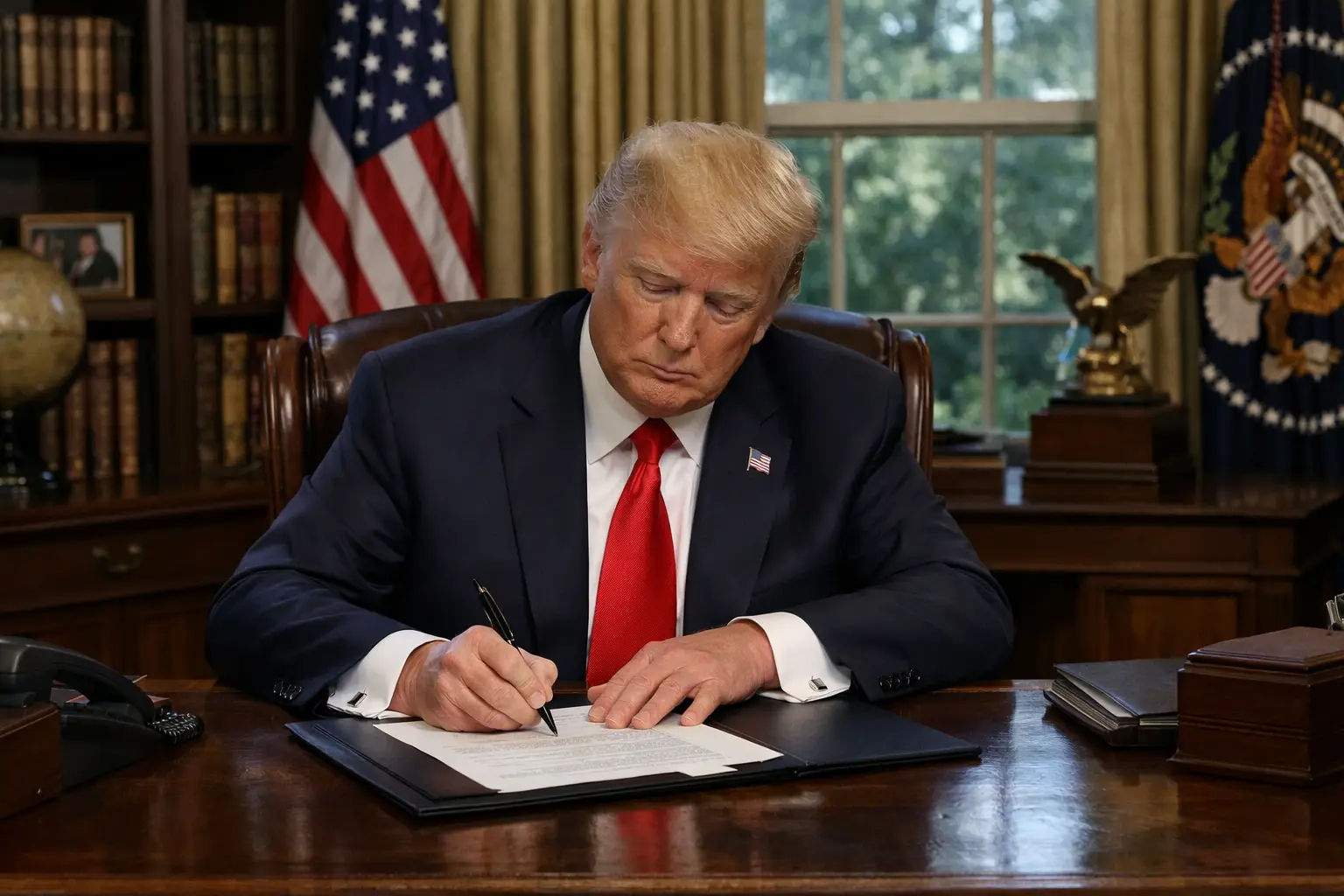
On December 12, 2025, President Donald Trump signed an executive order aimed at obstructing the regulation of artificial intelligence, instructing the U.S. Attorney General to create an “AI Litigation Task Force” to challenge state AI laws that contradict this order.
The order also directs the Secretary of Commerce to publish an assessment of existing state AI laws and issue a notice specifying the conditions under which states can retain eligibility for funding under the $42 billion Broadband Equity, Access, and Deployment (BEAD) Program.
Deregulation of AI requirements at the state level through the “One Rule Executive Order” eliminates regulatory fragmentation that hindered the scaling of models, data centers, and computing infrastructure within states, creating conditions for the industry’s transition to a new stage of industrial deployment.
Washington is applying the executive order as a tool to unify the rules of the game, removing divergent state requirements and shifting AI development into a centralized regulatory framework, where the speed of investments, capacity launches, and commercial implementation is the determining factor.
The creation of the “AI Litigation Task Force” in the DoJ, which will challenge every state-level act that contradicts Trump’s order, shifts the conflict around regulation into the judicial plane, where federal authority gains the ability to systematically dismantle any state attempts to restrict the development of models, infrastructure, and applied solutions.
Linking access to $42 billion under the High-Speed Internet BEAD Program to states’ loyalty to the federal Trump framework turns infrastructure funding into a lever of political pressure that incentivizes deregulation without directly revising local legislation.
This approach forms a vertical management structure for AI, in which the state ceases to be an arbiter between risks and innovations and becomes the main entity, providing companies with a predictable environment for long investment cycles.
Politically, this means concentrating AI management at the federal level by eliminating states as autonomous regulatory entities, which provokes opposition from Democrats and some Republicans who view the order as an expansion of executive power at the expense of federal balance.
States that have already implemented their own AI regulatory regimes, particularly in areas of algorithmic accountability, consumer protection, or content control, find themselves facing a choice between judicial conflicts with federal authority and loss of access to critical infrastructure funding.
Geopolitically, “One Rule” reproduces the logic of centralized management characteristic of China, where companies operate within a single national permissive framework, rather than facing fragmented procedures as was the case in the U.S. before 2025.
Trump publicly ties AI deregulation to global competition with Beijing, interpreting regulatory fragmentation as a direct strategic risk that slows the deployment of infrastructure, models, and applied solutions in critical sectors.
In this sense, the order serves as an element of a broader strategy to contain China, as accelerating internal AI development allows the U.S. to maintain a technological gap without symmetric escalation of restrictions or international agreements.
By adopting the order, the U.S. acknowledges that in competition with China, institutional speed becomes the decisive factor, not normative ethics, and therefore shifts from a liberal model of restraining regulation to a mobilization model of managing critical technology.
Deregulation at the national level facilitates the integration of AI into military doctrines, management systems, intelligence, and autonomous platforms, increasing the pace of AI militarization and shortening the cycle from development to combat application.
Centralization of AI regulation signals to allies that Washington is no longer willing to adapt to the European logic of “preemptive control” like the AI Act, but instead forms its own standard oriented toward scaling, defense integration, and industrial application.
The order creates preconditions for externalizing U.S. AI norms through trade agreements, defense contracts, and digital alliances, where market access, cloud infrastructure, or joint projects will be tied to acceptance of the U.S. federal framework.
Trump’s rhetoric about “ONE RULE” reflects the demand from big tech capital to remove transaction costs that arise from the need to go through up to a dozen different approval procedures for each large-scale project.
The position of Nvidia, Google, OpenAI, and cloud giants in this context boils down to the main argument: in the context of AI development by autocratic axis countries, regulatory fragmentation in the U.S. turns into a strategic disadvantage that consumes time and capital.
The statement by Jensen Huang, founder and CEO of NVIDIA, about the U.S. shortcomings in the “five-layer cake” of AI, which includes energy, chips, infrastructure, models, and applications, shows that regulation at one layer automatically hinders development at another.
Deregulation of the energy layer under Trump’s order opens the possibility for faster construction of data centers and generation, which is critical for the U.S. amid China’s advantage in installed capacities and centralized permits.
The infrastructure layer receives direct impetus through the High-Speed Internet Program, as unification of rules allows building AI capacities and communication networks under uniform standards, reducing commissioning timelines.
At the model level, Trump’s deregulation means reducing legal risks for large-scale training and commercialization, especially in areas where states tried to impose their own restrictions on data or liability.
The application layer receives impetus through accelerated product launches, as companies gain the ability to enter the entire U.S. domestic market simultaneously without adapting to local regulatory regimes.
The political dimension of the order goes beyond technology, as deregulation becomes part of Trump’s broader doctrine to stimulate the economy through lowering barriers to corporate investment ahead of the new election cycle in 2026.
The administration essentially chooses a “speed over consensus” model, where security and ethics risks are pushed to the background compared to the need to maintain global U.S. leadership in dual technologies.
Comparison with China is fundamental here: unification of rules allows the U.S. to partially replicate the advantage of centralized decisions without changing the political system, but by altering the logic of state intervention.
In the longer term, this order fixes a new norm in Trump’s economic policy, where deregulation serves as an applied tool for mobilizing capital, infrastructure, and technologies in a strategic industry.
The order also, at the chip infrastructure level, allows reducing regulatory uncertainty and strengthens the effect of federal procurements and defense contracts, creating stable long-term demand for Nvidia and AMD without regional restrictions.
In parallel, the administration grants permission for Nvidia to supply H200 chips to China with a 25% tariff, which becomes part of the White House logic, where exports are controlled through fiscal levers and an “approved customers” system, rather than through a complete ban, which previously only stimulated bypass channels and shadow supply chains for the PRC.
For Washington, this decision serves as a tool for deliberately disrupting China’s strategy of domestic AI chip production, as Nvidia’s return to the market reduces the motivation for accelerated scaling of the PRC’s own semiconductor industry.
China’s response demonstrates that this logic is read correctly, as Beijing is simultaneously discussing internal restrictions on access to H200, implementing permitting procedures and requiring proof of national manufacturers’ inability to meet customer needs.
For Chinese giants like Alibaba, ByteDance, and Tencent, this means deepening the technological gap between basic AI functions, which can still be serviced by local chips, and advanced models, where without official Nvidia imports, critical efficiency losses persisted.
The facts of using banned Nvidia chips by the company DeepSeek only underscore that even the most aggressive regulatory barriers do not eliminate dependence, and merely change its form and increase transaction costs.
Thus, even partial return of American chips to China is used by PRC regulators as a pretext to strengthen the internal import substitution campaign, including possible bans for the state sector and additional subsidies for data centers operating on local solutions—chips from Huawei and Cambricon.
The Trump administration proceeds from the fact that such a reaction from Beijing creates a strategic trap, where China is forced to simultaneously restrain Nvidia imports and spend resources on supporting less efficient internal alternatives, slowing the commercial return on AI investments.
Indicatively, even under the conditions of a formal ban from the previous administration, Nvidia chips continued to reach China through third countries, data center disassembly, and smuggling chains, which undermined the very idea of export control.
The Trump model replaces the ban with controlled dependence, where American technology remains the performance standard, and any attempt by China to abandon it requires significantly greater costs.
In this context, U.S. deregulation shifts the competition into the plane of economic exhaustion of the adversary, where China is forced to finance parallel technological trajectories.
In parallel, the White House consolidates the internal contour of advantage, where uniform federal rules allow faster scaling of production, placement of data centers, and integration of chips into critical infrastructure without state-level delays.
In the long horizon, this forms an asymmetry where American companies operate in a rapid product cycle mode, while China’s industry spends years achieving acceptable parity.