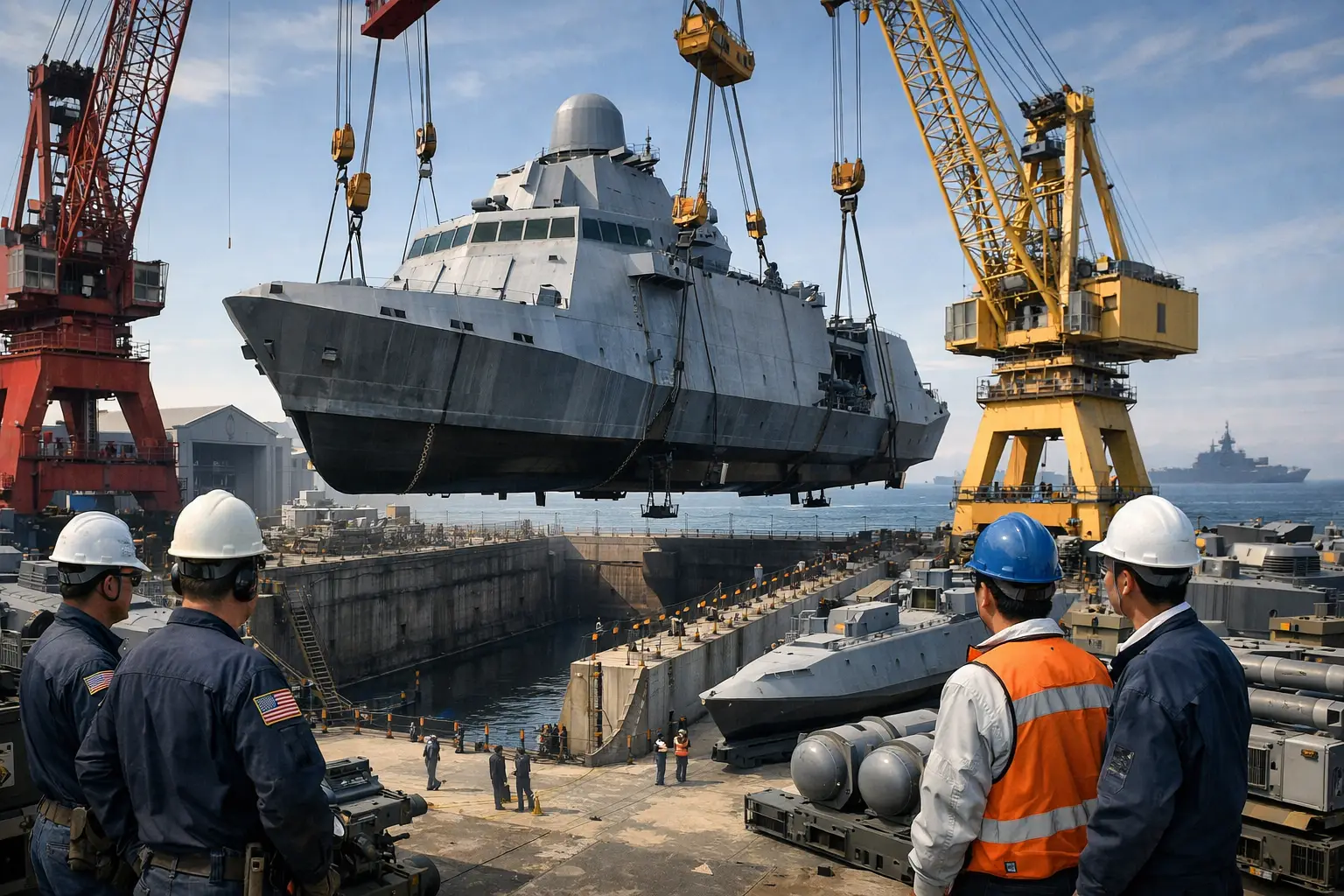
On December 7, 2025, it became known that President Donald Trump gave the green light to a plan to build a new “Golden Fleet” for the U.S. Navy, which will include a new frigate to replace the Constellation-class ships (a generation of large multi-purpose missile frigates).
In addition to the existing list of contracts for building destroyers and submarines, the Navy plans to involve “new, non-traditional partners in the American shipbuilding ecosystem,” who will design and build new classes of unmanned vessels “to expand combat capabilities.”
Washington is using the “Golden Fleet” concept as a tool to transform the American shipbuilding ecosystem, in which technological platforms for unmanned vessels are integrated into the naval structure as systematically as carrier strike groups were decades ago.
The decision to launch a new large frigate, at Trump’s request, along with mass production of autonomous surface platforms as the key idea of the new model, forms a diversified environment for the U.S. Navy’s maritime presence, combining large-scale ships with autonomous weapon carriers capable of performing extended strike zone functions.
The Trump administration is betting on vertically integrated suppliers, including Saronic from Louisiana, a fast-growing private defense-tech company that builds autonomous surface vessels (drones) for maritime defense, valued at $1 billion after a $600 million funding round in early 2025.
It is such companies that can reduce production cycles and increase modularity, and significantly decrease the U.S. DoD’s dependence on orders from the five largest companies (such as Boeing, Lockheed Martin, etc.), which is important for creating a fleet that responds to the dynamics of threats, neutralizing inertial procurement processes.
The expansion of Saronic’s shipyard in Louisiana serves as a system test for the American industry, demonstrating whether the country can quickly replicate production chains in sectors where it previously relied on imports and decade-long construction cycles.
Indeed, the U.S. has become so import-oriented in shipbuilding that its share of the global shipbuilding market has fallen to 0.4%, while China’s has grown to 34.8%, Korea’s to 30.9%, and Japan’s to 25.8%, and the potential to close the gap with China in shipbuilding is estimated at 12 years.
Saronic’s capital investments of over $300 million create conditions for increasing production space, launching an assembly line for large autonomous vessels, and expanding the workforce, enabling the formation of a critical mass of competencies in a region that historically has not been a core of the shipbuilding ecosystem.
Trump’s MASGA (Make American Shipbuilding Great Again) strategy, of which the “Golden Fleet” is a part, forms a system in which autonomous platforms are the basic element for building up forces, as unmanned vessels can create significant strikes using low-cost products, fundamentally changing the structure of anti-ship deterrence.
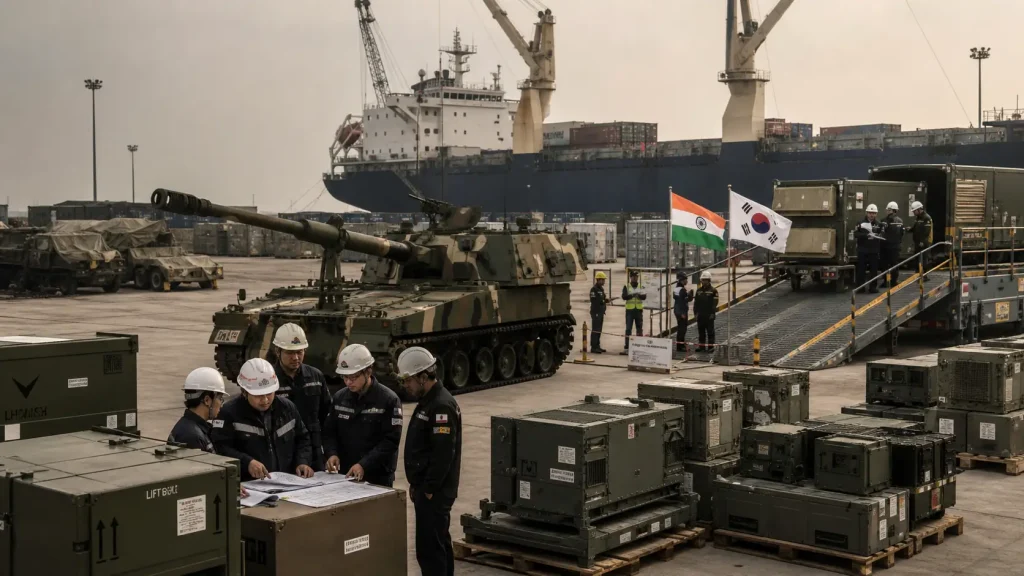
At the same time, Washington is forming an external component for fleet revitalization, in which partnership with South Korea is shifting from outsourcing production capacities to a mechanism for transforming American shipyards through the import of technological standards and management models.
The Philly Shipyard, selected by President Donald Trump as a site for potential nuclear submarine construction, demonstrates the scale of the task and dependence on foreign companies.
However, currently, the two dry docks at Philly Shipyard can barely accommodate medium-sized container ships with a capacity of 6,000 twenty-foot equivalents, as it is completely unsuitable for servicing high-value liquefied natural gas tankers, which Washington desires.
The Philly Shipyard case shows that the strategic gap between the U.S. technical potential and South Korea’s capabilities in building complex platforms has reached a level that requires not piecemeal modernizations, but joint infrastructure and production logistics reboots.
Meanwhile, the Korean company Hanwha’s plan to build two new docks, three piers, and a large block assembly shop with automated systems in the U.S. confirms that U.S.-Korean cooperation is becoming an element of a larger architecture, in which Korea acts as a catalyst for growth, reducing the time gap from concept to hull launch.
Accordingly, Washington views this cooperation as a way to create a two-layered ecosystem, where key combat units remain American in design and management, while technological solutions in heavy shipbuilding are drawn through partnerships with industries that have proven loyalty and efficiency.
Hanwha Group also announced at the end of November 2025 its intention to invest about 1 trillion Korean won ($681 million) in the U.S.-based company Hanwha FutureProof, which serves as an investment platform for scaling American shipbuilding projects.
Moreover, Hanwha Solutions, Hanwha Ocean, and Hanwha Systems have disclosed plans to fund Hanwha FutureProof through acquisitions of stakes in the American subsidiaries Hanwha Q CELLS America Holdings, Hanwha Systems USA, and HS USA Holdings.
This allows the group to reorient capital within its own corporate structure and direct it toward M&A and development of new directions in the U.S.
However, this strengthening of Hanwha’s American track immediately became a target for Beijing—China imposed sanctions on five American subsidiaries of Hanwha Ocean Co in October 2025, threatening further actions against the shipbuilding and logistics infrastructure used by the group in the U.S.
This also signaled readiness to expand economic pressure in response to the active involvement of South Korean business in American shipbuilding recovery programs.
These actions by the PRC, which were later suspended for 1 year, fit into a broader picture of escalating competitive struggle for control over global maritime logistics chains, as shipping, which handles about 80% of world trade, continues to be one of the central fronts in the confrontation between Washington and Beijing.
In this situation, Beijing recognizes the critical need to cut off points of contact between the U.S. and South Korea in shipbuilding through sanctions restrictions on Seoul from Beijing.
Without cooperation between the States and Korea, closing the PRC’s lead in shipbuilding for America will become complicated due to, among other things, internal limitations in the States.
The reason for this situation is that the industry in the U.S. faces legal and personnel challenges, as the lack of ready mechanisms for workforce integration and agreed norms for technology transfer creates delays that nullify all current capital investments and reduce modernization paces.
The MASGA concept requires state participation, as the volume of investments needed to modernize American shipyards, amounting to more than $150 billion, approaches a sum that exceeds the market capitalization of leading Korean companies, and therefore private investors are unable to provide full financial coverage for this transformation.
Mechanisms of state guarantees, credit programs, and insurance support allow the U.S. government to create conditions in which defense contracts become an industrial multiplier, transforming them from a purely expenditure part of the budget into long-term demand for infrastructure and engineering competencies.
The modernization of the Jones Act, which stipulated that vessels carrying cargo between U.S. ports must be built in the U.S., owned by U.S. citizens, sail under the U.S. flag, and have crews consisting of U.S. citizens, and other regulatory barriers, is becoming a key necessity.
Without this American shipbuilding will remain fragmented and unable to form serial projects that match the scale of strategic tasks in the Pacific region.
While the U.S. changes this bureaucratic framework, China has a completely pragmatic military-logistical goal in expanding shipbuilding, as Beijing is preparing a large army of civilian shadow fleet capable of landing on Taiwan in quantities that exceed the scale of Operation Overlord during World War II.
The People’s Liberation Army of China can transport only about 20,000 troops in the first wave of assault, while for real capture of the island, 300,000 to a million soldiers are needed.
It is precisely for transporting troops via maritime platforms that China is actively preparing commercial vessels for dual use—including converting deck cargo ships into platforms capable of unloading equipment directly onto the beach, which was confirmed by summer exercises during which over 100 civilian vessels were first recorded in real landing operations.
Taiwan’s Ministry of National Defense notes that these trainings are part of systematic rehearsal of a sudden strike scenario, which could begin under the guise of routine maneuvers, when civilian and military ships simultaneously cross the strait to catch Taipei and its allies in a state of operational shock.
Beijing’s approach logically explains China’s motivation for aggressive shipbuilding expansion: the country needs a controlled, scalable invasion logistics infrastructure that creates the basis for rapid force accumulation on the Taiwan direction and ensuring long-term supply of the grouping during combat operations.
Accordingly, to deter these ambitions, Washington is accelerating fleet growth through the creation of a network of autonomous combat platforms that expand the range of large ships and ensure high operational tempo in an environment where the number of enemy strike assets exceeds traditional defense capabilities.
In such a configuration, new American frigates, autonomous ships, and a potential “large combat ship” ordered by Trump as part of the “Golden Fleet” form a triune structure.
In this structure, the flexibility of unmanned systems compensates for the limitations of complex combat platforms, while large ships serve as carriers for long-range precision weapons to deter the combat forces of the PRC and RF.
Discussions within the Trump administration focused on a combat ship with a displacement of 15-20 thousand tons, which is approximately twice the size of an Arleigh Burke-class destroyer.
The additional space can be used to carry long-range weapons, such as Conventional Prompt Strike (CPS)—a hypersonic missile system designed to counter new classes of weapons from China and Russia.
Partnership with South Korea strengthens this architecture, as it allows the U.S. to combine its own strategic control over the fleet with access to production speed that determines competitiveness in the global market.
In the end, this dynamic forms an asymmetry that will determine the intensity of U.S.-PRC confrontation in the 2030s. China views shipbuilding as a tool for quickly creating an invasion logistics resource, enabling the scaling of an operation on the Taiwan direction without lengthy military-industrial pauses.
Washington responds by building a system in which autonomous platforms, large combat ships, and allied production capacities create a cumulative barrier that increases the cost of any offensive operation by the People’s Liberation Army of China.
Thus, it is about a competition between two models—the Chinese one, oriented toward mass and mobilization speed, and the American one, built on a combination of technological range, strike potential, and coalition resources from South Korea with the U.S.
It is this competition that will define the limits of what is possible for Beijing in the question of a force scenario regarding Taiwan and will become a key test for the new U.S. maritime strategy.