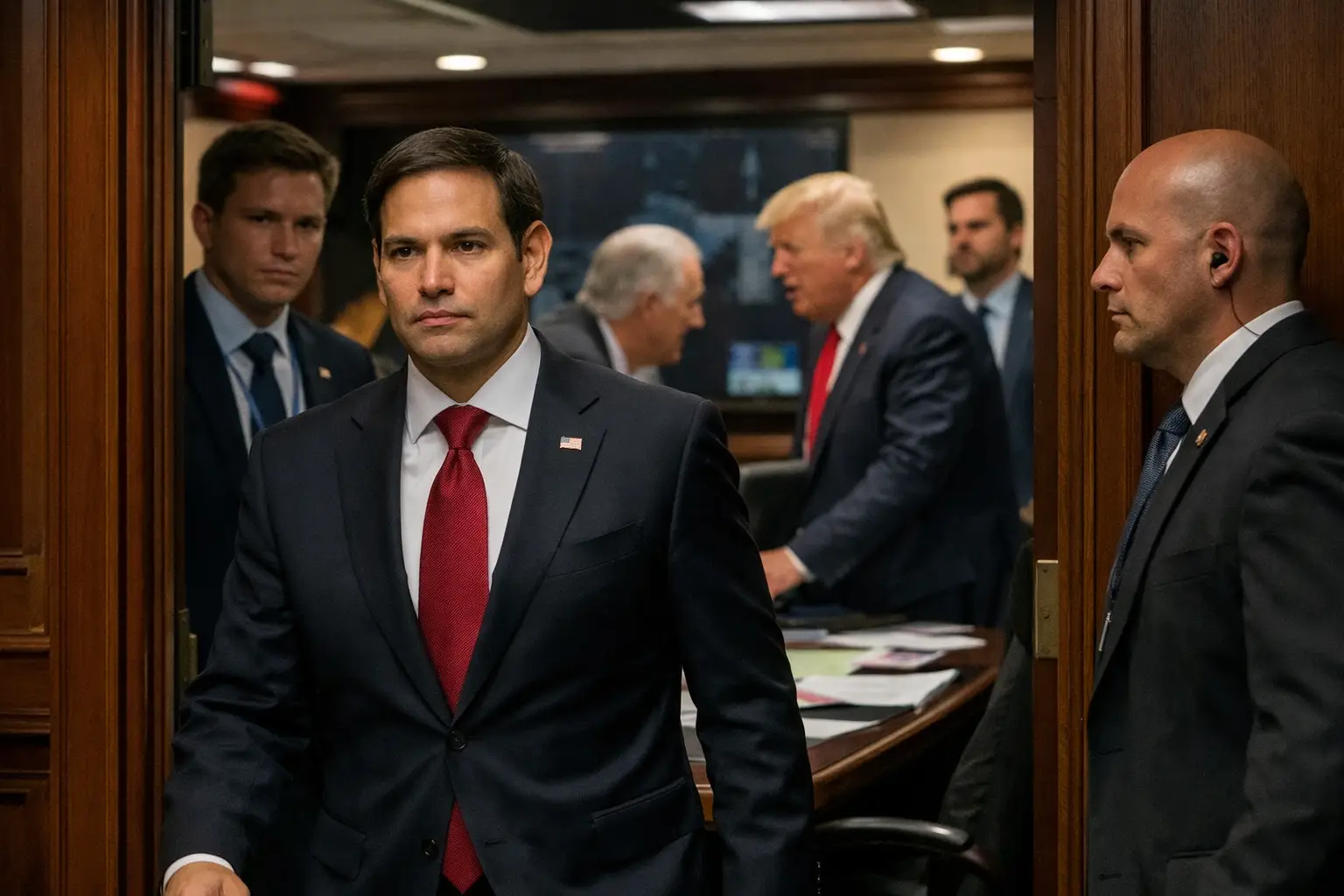
On March 9, 2026, in Doral, Donald Trump held his first press conference since the start of the U.S.–Israeli operation against Iran.
In addition to statements about the successful destruction by the U.S. Armed Forces of key elements of the Iranian regime’s defense-industrial base, the President also shared projections regarding the further course of Operation “Epic Fury.”
He further publicly outlined differences in the approaches of two key representatives of the Republican administration to conducting military operations against Iran.
Trump described Vice President J. D. Vance as “philosophically somewhat different” from himself on active U.S. measures against the axis of autocracies, noting that Vance was less enthusiastic about military action. He also highlighted the role of Secretary of State Marco Rubio in preparing and advocating for the operation against Tehran
Additional evidence of Trump’s positive assessment of Rubio’s performance was the President’s plan to appoint the Secretary of State to oversee the further transformation of Miguel Díaz-Canel’s regime in Cuba.
This effort is expected to become a foreign policy priority for the White House following the conclusion of active combat operations in the Middle East.
The White House’s successful use of coercive diplomacy toward countries in the Western Hemisphere, along with Rubio’s steadily rising popularity among Republican voters, has driven growing support for the Secretary of State among U.S. financial and economic elites.
During a discussion between Donald Trump and 25 major Republican donors held at Mar-a-Lago on February 28, 2026—focused on potential successors to Trump in a future presidential campaign—the overwhelming majority of financial backers favored Rubio over Vance.
Rubio’s performance as Secretary of State, along with a combination of factors attracting the attention of Republican investors and political elites, has shifted forecasts on Polymarket.
Although Vance’s nomination for the presidency remains the most likely scenario for the 2028 campaign, Rubio is demonstrating the strongest upward momentum among all contenders.
From December 2025 through March 2026, estimates of Rubio’s chances of securing the Republican presidential nomination have tripled and currently stand at 26%.
Although only a minority of Republican voters currently support Rubio’s nomination, his level of backing as a potential 2028 nominee has been steadily increasing.
In absolute terms, Rubio’s support lags behind Vance and Donald Trump Jr.; however, at an early stage of the primaries, this metric is less informative than the dynamics and structure of negative ratings.
Vance’s support has been steadily declining—from 46% in November 2025 to 45% in March 2026—a marginal shift, but one consistently reproduced across successive measurements, indicating a trend rather than statistical noise.
A more decisive metric is the disapproval rating, which directly limits a candidate’s electoral ceiling. Rubio’s stands at 41%—the lowest among all considered contenders. By comparison, Vance’s is 49%, Gavin Newsom’s is 45%, and Kamala Harris’s is 51%.
A low disapproval rating indicates the presence of an electoral reserve—a segment of undecided voters who remain open to persuasion. Rubio maintains this advantage through consistent and disciplined communication: his public positioning does not generate new opposition.
This makes the Secretary of State the least polarizing figure among voters compared to the other politicians mentioned—a result of a coherent foreign policy line backed by verifiable operational outcomes.
The tactic of coercive diplomacy has become the basis for transforming Nicolás Maduro’s regime in Venezuela. It is the first modern case in which coordinated pressure on a government’s economic and military foundations changed the balance of power in the Western Hemisphere without the use of ground forces.
However, the Iranian threat is much larger. Iran remains a center of instability in the Middle East and a main channel for spreading autocratic influence through the Shiite “axis of resistance.” Dealing with this would require removing the ayatollah regime and establishing a U.S. military presence in Iran.
The current effects of military action against Tehran—primarily the destruction of ballistic missile arsenals and the Iranian navy—are sufficient only to temporarily degrade the regime’s military capabilities.
These capabilities can be restored through oil revenues from exports to China, as well as through technological and intelligence support from other autocratic states.
In 2024, Iran exported approximately 528 million barrels of crude oil to China; in 2025, 520 million barrels. China consistently absorbs more than 90% of Iran’s oil exports, providing the ayatollah regime with over $30 billion in annual revenue.
Between February 28 and March 12, at least 11–12 million barrels of Iranian crude passed through the Strait of Hormuz—exclusively to Chinese ports, which account for more than 80% of Iranian exports.
This uninterrupted flow of oil revenue into the regime’s budget, despite active bombing, creates the financial basis for restoring its defense-industrial complex and nuclear program after hostilities conclude.
Kharg Island—a small coral island 25 kilometers off Iran’s coast—is the single hub through which roughly 90% of this export passes. Without it, the regime loses not just a port, but its entire mechanism for converting oil into budgetary revenue.
On March 13, U.S. forces destroyed more than 90 military targets on the island—including a runway, naval base, mine depots, and missile positions—deliberately avoiding oil infrastructure. The destruction of these facilities is consistent with preparations for an amphibious operation.
Trump publicly confirmed that if Iran continues to block the Strait of Hormuz, the island’s oil infrastructure will be destroyed—or seized. Establishing U.S. control over Kharg would deprive the regime of its sole source of recovery financing regardless of negotiation outcomes.
However, financial resources are only one dimension of Iran’s resilience. The regime also relies on military-technical integration with the autocratic axis, which provides an independent capacity to restore combat effectiveness.
In 2022, a joint Russia–Iran project enabled the regime to launch the “Khayyam” satellite into low Earth orbit, allowing Tehran to monitor U.S. and Israeli bases in the Middle East.
In early 2026, Russia began delivering 48 Su-35 “Flanker-E” fighter jets equipped with Khibiny-M electronic warfare systems and Irbis-E radars, having previously transferred S-400 air defense systems and Rezonans-NE radar systems to Iran.
Geospatial positioning of Iranian military platforms is conducted via China’s BeiDou navigation system and Russia’s GLONASS, while intelligence support is provided through China’s satellite constellation of more than 500 spacecraft.
Deliveries of Chinese YLC-8B radars and agreements to supply CM-302 supersonic missiles confirm that Iran’s integration with key autocratic states ensures a rapid restoration of its military capabilities.
Iran’s ability to rebuild its combat potential preserves its leverage over transit through the Strait of Hormuz—already transformed into an instrument of asymmetric pressure by the autocratic axis.
Control over the Strait is further complicated by Houthi interference in the Bab el-Mandeb Strait, leaving global energy market stability directly dependent on the actions of the ayatollah regime.
Despite statements by Dan Caine that Iranian ballistic missile launches decreased by 86% in the first week of the operation, even a limited missile arsenal within a 100–200 km radius of the Strait continues to threaten all tanker traffic.
For commercial shipping, the mere existence of strike capabilities and Tehran’s willingness to use them is decisive; thus, global energy markets remain under sustained pressure as long as Iran controls the Persian Gulf coastline.
A second unresolved risk is the continued operation of the global Shiite “axis of resistance.” Oil revenues enable the regime to expand its proxy network’s influence across much of the Islamic world.
While the war in Gaza has weakened Hamas, and Israel has intensified operations against Hezbollah since March 2026, targeting individual proxy elements will not eliminate the systemic threat as long as Iran retains the capacity to fund and coordinate the network.
The regime’s nuclear program remains a key instrument of pressure and has not been fully destroyed by U.S.–Israeli strikes. According to U.S. Special Envoy Steve Witkoff, prior to Operation “Epic Fury,” Tehran possessed enough enriched uranium for 11 nuclear weapons.
The challenge is compounded by the lack of reliable data on the location of significant portions of nuclear stockpiles and the inability to monitor enrichment levels, as IAEA inspectors have not been present in Iran since summer 2025.
U.S. airstrikes during the Twelve-Day War on Fordow, Natanz, and Isfahan demonstrated that airpower alone cannot eliminate Iran’s nuclear capabilities, as the country partially restored damaged infrastructure in the second half of 2025.
With Tehran relocating parts of its uranium stockpiles beyond primary nuclear facilities, a ground operation on Iranian territory has become the only means of verifying and physically securing enriched uranium.
The “coercive diplomacy” strategy advocated by Secretary Rubio could achieve its objectives by ensuring the dismantlement of Iran’s nuclear program, elimination of its ballistic arsenal, and full cessation of support for the “axis of resistance.”
Any outcome short of the complete dismantlement of the Iranian regime would allow Tehran to retain the capacity to rebuild its military capabilities.
It would also signal to the leadership of China and Russia that the Republican administration lacks sufficient public support, political resolve, and internal consensus to achieve its strategic objectives.
If Iran retains its military-political and economic potential following the operation, China will frame this as a geopolitical success for the autocratic axis.
It would signal to Beijing’s adversaries that the bloc can withstand U.S. pressure and maintain influence in key regions even under direct U.S. military intervention.
The persistence of the ayatollah regime constrains Washington’s ability to refocus on priorities in the Western Hemisphere. Halting military operations before achieving regime change would amount to an acknowledgment of failure to meet stated objectives.
The deaths of 13 U.S. service members, more than $11.3 billion in first-week operational costs, and a 30% increase in oil prices have created public demand for results proportional to these costs.
The elimination of Ali Khamenei and several dozen senior Iranian officials, along with partial degradation of military capabilities, does not meet White House objectives or voter expectations.
Extending the operation to achieve all its goals pushes Washington into political decisions that lack strong public support. This deepens the crisis of voter trust and raises the chances that Republicans could lose their congressional majority in fall 2026.
Republican electoral dynamics ahead of the November 2026 elections indicate declining internal cohesion and signal to voters, donors, and political elites that the administration’s strategic course is losing public support.
This trend was confirmed by two electoral signals in March 2026. In the March 10 special election in Georgia’s 14th district, Democrat Sean Harris placed first in the initial round with 37.3%, ahead of Trump-backed Republican Clayton Fuller at 34.9%—an unprecedented result in a heavily Republican district long dominated by Marjorie Taylor Greene.
Simultaneously, the March 3 Texas primaries recorded a surge in Democratic turnout: 2.3 million voters participated in Democratic primaries versus 2.16 million in Republican contests—despite Democrats not winning statewide elections in Texas for over 30 years. A similar pattern was observed in North Carolina.
Republican strategists note a clear trend: Democrats are becoming more competitive in districts previously considered safely Republican. Declining presidential approval ratings are creating the structural conditions for this shift. Prolonged military operations against Iran without achieving stated objectives will further erode support.
As a result, cooperation between the White House and Congress in the second half of Trump’s term will become harder. To keep decision-making fast and effective amid rising geopolitical challenges, the administration will have to make more concessions to the Democratic Party, which will weaken the focus of Trump’s political agenda.
According to RealClear Polling, Trump’s approval rating has declined from 50.5% at the start of his term to 42.9%. Whereas migration and socioeconomic policy initially drove public criticism, since the launch of Operation “Epic Fury,” the armed conflict itself has become the primary factor accelerating the decline in presidential approval.
According to a Marist Poll survey conducted in early March 2026, 56% of American respondents reported disapproval of U.S. involvement in the Middle East operation.
The White House’s assumption that, amid escalating geopolitical confrontation, public opinion would consolidate around the President’s course and significantly boost trust in Donald Trump has only been partially validated.
While 84% of Republicans emphasize their support for the campaign against Iran, more than 60% of independent voters—whose preferences will determine the outcome of the fall 2026 elections—oppose the military operation.
Statements by U.S. military and political leadership highlighting interim successes have failed to generate public confidence in a swift and effective conclusion to the conflict.
According to a YouGov poll conducted March 6–9, 2026, 47% of Americans expect the Iran operation to last from one month to one year, while 32% anticipate a duration exceeding one year.
Amid persistent public skepticism, the administration requires a public communicator capable of sustaining support for the operation. Marco Rubio has fulfilled this role from the first day of the campaign, shaping the informational framework for both domestic and international audiences.
Operation “Epic Fury” reinforces the strategy he has consistently advocated and strengthens his position in intraparty competition with J. D. Vance.
U.S. geopolitical strategy has reached a level of global engagement that objectively requires American society to set aside part of its internal divisions as an operational condition for maintaining strategic coherence. Only the consistent execution of this course can deliver a strategic outcome for Operation “Epic Fury.”
The isolationist faction remains a minority within the Republican Party; however, it systematically undermines this condition by fostering skepticism among part of the Republican electorate regarding the necessity of preempting autocratic strategies and by eroding trust in U.S. foreign policy more broadly.
It is precisely within this divide—between the isolationist and interventionist wings—that intraparty competition over defining the post-Trump Republican course is unfolding.
The strategic objective of the isolationist wing’s leader, J. D. Vance, is to retain his status as the leading candidate to succeed Trump ahead of the 2028 presidential campaign.
To achieve this, Vance—responsible for the 2026 electoral campaign—must calibrate his rhetoric to the expectations of two electoral groups with opposing views on U.S. foreign policy.
Despite his consistent support for the “America First” concept during his first year as Vice President, openly distancing himself from Operation “Epic Fury” is currently politically risky.
First, criticism of the military campaign against Iran would create a public conflict with the President’s foreign policy vision—an outcome incompatible with Vance’s claim to be Trump’s political successor.
Second, the fact that a majority of Republican voters support U.S. participation in the Middle East operation and view the Iranian regime as a national security threat compels the Vice President to avoid adopting a fully isolationist stance.
Unconditional support for the campaign weakens Vance’s standing—and that of the broader Republican leadership—among the isolationist segment of the MAGA movement, which accounted for 15–20% of Trump’s 2024 electorate.
U.S. operations in the Caribbean and Latin America, along with Washington’s intervention in the Middle East crisis, have already generated disillusionment among isolationist voters, leading to reduced turnout among the most conservative electorate in competitive districts during the 2026 congressional elections.
This electoral demobilization among MAGA isolationists increases the risk of Republicans losing their majority in the next House of Representatives—a development for which responsibility is likely to be attributed to the Vice President.
However, Vance’s attempt to balance formal support for the Iran campaign with a reluctance to actively advocate for it has not produced the desired results.
His calculation—that endorsing the operation while simultaneously distancing himself from it would preserve support across the Republican electorate—fails to account for internal shifts within the party’s isolationist faction.
During Trump’s first year in office, a group of opinion leaders independent of the presidential team has emerged among MAGA isolationists.
Prominent MAGA voices—including Tucker Carlson, Candace Owens, Marjorie Taylor Greene, Alex Jones, and Nick Fuentes—no longer demonstrate loyalty to White House decisions and focus their criticism primarily on the administration’s foreign policy initiatives.
The positions of these figures, grounded in a literal interpretation of “America First,” are broadcast to audiences numbering in the tens of millions.
Tucker Carlson’s combined following across X (formerly Twitter) and YouTube exceeds 20 million, while the total audience of conservative commentator Candace Owens across major media platforms reached 24.5 million as of March 2025.
The broad reach of these speakers transforms internal debate within the isolationist movement into a decisive factor shaping Republican outcomes in the 2026 midterm elections and the trajectory of the next presidential campaign.
The most systematic and consistent criticism of Operation “Epic Fury” has been articulated by Tucker Carlson. Prior to the campaign against Iran, the commentator held personal meetings with Donald Trump, during which he urged the President to avoid U.S. entry into hostilities.
Since March 2026, Carlson has intensified his public isolationist rhetoric, consistently framing the Middle East operation as one that serves Israel’s objectives without delivering strategic benefits for the United States.
Like other MAGA-aligned voices, Carlson has argued that U.S. defense resources are being depleted in favor of Jerusalem’s interests and has questioned the motivations publicly presented by the White House.
His rhetoric—combining claims that the joint U.S.–Israeli operation advances Israel’s geopolitical position with conspiratorial assertions about the campaign’s religious motivations—has directly contributed to rising polarization and intensifying social conflict within the United States.
According to the American Jewish security organization Secure Community Network (SCN), within the first five days of Operation “Epic Fury,” the number of aggressive antisemitic online posts increased from 2,211 to 4,322 incidents.
Although the primary target of MAGA commentators’ criticism is the President’s decision to launch the Iran campaign, their rhetoric has contributed to an overall decline in Trump’s approval ratings.
A study by Public Religion Research Institute found that from late 2025 to February 2026, Trump’s approval among Republicans declined from 85% to 81%.
Support among a key Republican group—white Protestants—has fallen quickly. Between May 2025 and February 2026, support from white evangelical voters dropped from 76% to 69%, and approval among non-evangelical Protestants fell by 10 points. This decline goes beyond the polls, making it harder for the administration to stay united in Congress.
By early 2026, the share of Republicans who do not believe conservative members of Congress are obligated to support White House initiatives increased from 55% to 61%.
Although overall unfavorable views of the Democratic Party remain higher than those of Republicans, 53% of voters prefer a Democratic majority in the next Congress, viewing it as a necessary check on the administration’s course.
Thus, domestic political fragmentation simultaneously weakens the Republican Party ahead of elections and undermines Washington’s ability to act as a unified actor during escalating global confrontation.
China and Russia are closely monitoring the administration’s ability to maintain a coherent foreign policy and to implement coercive diplomacy across multiple geopolitical theaters.
Internal conflict within the Republican Party and recurring political crises in the United States signal to Beijing and Moscow that, despite partial successes of Operation “Epic Fury,” Washington’s capacity to sustain a comprehensive strategy to preempt autocratic expansion remains constrained.
Bringing the U.S. campaign against Iran to its logical conclusion is becoming more difficult amid declining support for the Republican administration, internal divisions between isolationists and proponents of the “peace through strength” approach, and the risk of losing the Republican majority in Congress.
Halting hostilities without dismantling the ayatollah regime and eliminating the full spectrum of threats posed by Iran would confirm the limitations of U.S. foreign policy tools and enable autocratic states to portray the regime’s survival as a geopolitical victory.
Conversely, continuing the operation amid significant public dissatisfaction would deepen domestic opposition to White House policy, further polarize society, and increase the likelihood of Republicans losing control of Congress in fall 2026.
The absence of synchronized coordination between the executive branch and Capitol Hill weakens Washington’s ability to achieve a strategic outcome in Iran—yet withdrawing mid-course is not a viable option.
The scale of military resources used and losses incurred means that preserving the ayatollah regime would effectively reduce U.S. and Israeli capabilities by the amount already committed. These resources may be needed in a wider global confrontation, which becomes more likely just as they are being depleted.
In theaters where the United States has engaged in prolonged campaigns without clearly defined objectives, it has failed; where strategy was rapid and goal-oriented—such as in the Persian Gulf in 1991—success was achieved.
Iranian society is structurally distinct from most countries in the region: it includes a substantial Westernized liberal segment that could serve as an internal agent of regime transformation—unlike in Iraq or Afghanistan.
This makes a swift and consistent operation against the ayatollah regime the only approach aligned with both U.S. strategic interests and Iran’s internal realities.
This logic underpins the growing demand among segments of Republican elites and party donors for a political figure capable of both continuing Trump’s policy course and intensifying the implementation of a “peace through strength” strategy.
Conservative elites increasingly recognize the roots of the current crisis and are advancing a concrete response: positioning Marco Rubio as a successor capable of preserving Trump’s agenda while offering a more assertive approach to global confrontation.
Rubio’s growing advantage over J. D. Vance in intraparty competition reflects the belief among party leadership and segments of economic elites that the “America First” strategy championed by the Vice President is no longer sufficient to address the challenges facing the United States at this stage of global confrontation.
As they define the future direction of both the Republican Party and the United States, an increasing number of conservative power centers are developing new criteria for selecting Donald Trump’s political successor.
From the perspective of political and financial elites, avoiding post-term internal crises requires identifying and preparing a figure capable of maintaining intraparty consensus while delivering a comprehensive response to autocratic threats.
The simultaneous escalation of global confrontation and domestic political fragmentation has prompted Republican elites to reassess priorities and reconsider their earlier consolidation around Vance as Trump’s successor.
The nature of the competition between Rubio and Vance is determined by the geopolitical context: the expansion of global confrontation with autocracies strengthens the case for coercive diplomacy and reinforces Rubio’s position as its most consistent advocate.
Vance’s higher office and formal status do not offset the demand among Republican elites for strategic foresight under conditions of active conflict—a prerequisite for preserving U.S. geopolitical standing.