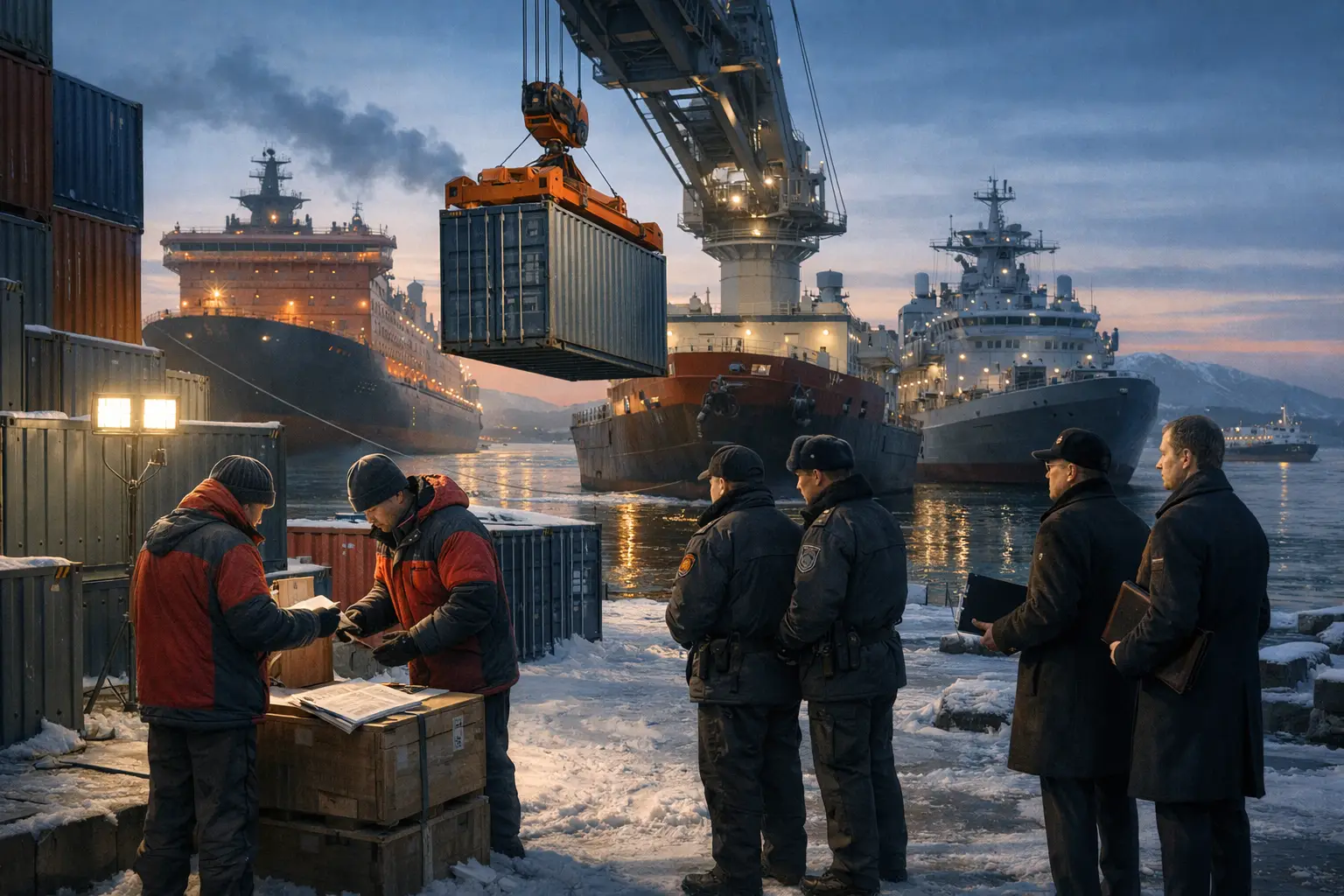
On March 2, 2026, the governor of the Murmansk region, Andrey Chibis, officially confirmed the launch of a regular container line between PRC ports and Murmansk in the summer of the current year.
The unprecedented nature of this project lies in the fact that the route will undergo testing as a fully autonomous logistics direction, not integrated into the traditional navigation scheme through Arkhangelsk or St. Petersburg.
This decision was the result of an agreement concluded at the end of 2025 between the government of the Russian Federation and the Chinese logistics operator NewNew Shipping Line.
The goal of the initiative is stated as improving the conditions for supplying Russian products to Asian markets under a strict sanctions regime, as well as forming a stable alternative to trade routes that are experiencing destabilization—particularly due to the security crisis in the Red Sea waters.
Andrey Chibis’s statement was made during negotiations with Alexander Lukashenko regarding the construction of a Belarusian terminal in the port of Murmansk—an object aimed at replacing blocked European transit corridors with new supply channels to the PRC.
The launch of these facilities is expected in 2028. The subject of the conversation itself was a consequence of a series of negotiations between Chibis and representatives of the PRC.
The launch of a direct logistics corridor between the PRC and Murmansk is an element of broader competition between Beijing and Washington for influence over Russian elites.
The Trump administration is trying to intercept control over the Russian Arctic through targeted investment agreements with Russian business elites in exchange for distancing from the PRC.
Beijing responds with forced penetration into strategic infrastructure, securing its positions with legal guarantees that make the presence irreversible regardless of the further dynamics of U.S.-Russian relations.
Murmansk is the largest ice-free port in the Arctic, the base of the nuclear fleet and icebreaking infrastructure of the Russian Federation, located less than 200 km from the borders of Finland and Norway. The port controls access to Europe’s northern sea communications and remains a key node for projecting Russian power in the Arctic.
Beyond logistics and shipbuilding functionality, the Murmansk region possesses strategic resource and raw material potential. In particular, the Kola Peninsula concentrates critically important reserves of nickel, lithium, and rare earth metals, which form the resource base for the development of high-tech industries.
The complex of geopolitical and geoeconomic advantages of Murmansk determines the strategic interest of the PRC. Beijing views the Kola Peninsula as an integral part of its expansionist strategy in the Arctic.
It is focused on long-term consolidation in the port of Murmansk, which promises significant logistical and military-political dividends without major financial costs.
For Beijing, Murmansk serves several strategic functions at once. The port is a critical node of the “Polar Silk Road,” a transit corridor that can reduce delivery times to European markets to just 10 days.
It also helps diversify the risks associated with shipping disruptions in the Middle East, a concern that has become much more pressing since the start of Operation “Epic Fury.”
At the same time, the region provides the PRC with access to Russian technologies in nuclear shipbuilding and the icebreaker fleet—one of the few segments where the Russian Federation maintains an advantage.
Geographical proximity to Finland, a country with advanced capabilities for conducting combat operations in Arctic conditions and the main competitor of the PRC in the field of implementing 5G and 6G technologies, creates an additional dimension for Beijing—intelligence access to NATO borders.
Similarly to port and military infrastructure, the resource sector is the object of systemic expansion. Currently, Beijing is investing in the development of the Kolmozerskoye deposit in the Murmansk region; the project operators are subsidiaries of China Metallurgical Group Corporation, Norilsk Nickel, and Rosatom.
According to the approved schedules for bringing the object to the stage of industrial exploitation in 2030, it will ensure the extraction and enrichment of over 2 million tons of lithium raw materials annually.
Murmansk acquires critical importance in the context of the global strategic confrontation between the PRC and the United States for monopolizing influence over the Russian Federation.
The administration of Donald Trump is attempting to implement a strategy to intercept influence over the Kremlin by offering Russian elites large-scale investment packages for the development of the Russian Arctic and potential easing of the sanctions regime.
These incentives are conditional on the Russian Federation agreeing to reduce cooperation with the PRC and to end the war in Ukraine.
A specific manifestation of this strategy was the agreement of Texas investor Gentry Beach—close to the Trump family—with the Russian Novatek on the use of a mobile LNG production plant being built in the Murmansk region.
Beach is one of the few American businessmen who have retained operational access to the Russian energy sector after 2022, and his agreement with Novatek signals the administration’s readiness to use private channels to intercept Arctic assets claimed by Beijing.
Realizing the risks of such a scenario, Beijing resorts to forced economic and technological penetration into the strategic infrastructure of the Russian Federation.
After Donald Trump’s assumption of the presidency, the PRC has intensified the provision of comprehensive military-industrial, macroeconomic, and financial support, which, unlike American conditions, guarantees the preservation of the Kremlin’s current foreign policy course without any concessions.
Accordingly, the buildup of Chinese infrastructure presence in Murmansk is a component of the broader PRC strategy for irreversible consolidation in the Russian Arctic.
This expansion is synchronized with other instruments of geoeconomic absorption, which include the formal entry of Chinese state and quasi-state capital into the shareholder structure of key Russian energy megaprojects, such as Yamal LNG and Arctic LNG-2, as well as providing public guarantees of long-term investment.
Significant evidence of this was the entry into force in December 2025 of a new investment protection agreement between the PRC and the Russian Federation.
This refers to a document signed in May of the same year by Xi Jinping and Vladimir Putin to replace the outdated 2006 agreement; negotiations on it began in 2022—shortly after the start of the Russian Federation’s full-scale invasion of Ukraine.
The new investment agreement introduces significant guarantees for the PRC, essentially depriving the Kremlin of the ability to manipulate working conditions for Chinese capital.
The Russian Federation has formally committed to providing Chinese companies with conditions no worse than those granted to its own state corporations or oligarchs, a principle known as “national treatment.”
It has also promised to extend to them all privileges previously granted to other foreign partners, referred to as “most favored nation treatment,” and to guarantee full protection against expropriation, including the nationalization of Chinese assets.
Additionally, the Russian Federation has agreed to ensure that investors have the right to challenge its actions in international arbitration under UNCITRAL rules, including new arbitration mechanisms within BRICS that bypass Russian courts.
From Beijing’s perspective, this agreement creates indisputable legal grounds for non-competitive absorption of Russian strategic infrastructure in the Arctic and other regions.
In addition, it insures Chinese assets against possible unpredictable steps by the Kremlin amid risks of intervention by the Donald Trump administration.
In February 2026, the Russian Federation ratified the agreement on Sino-Russian cooperation in the development of Yamal LNG. This decision aims to stimulate the influx of Chinese capital into the Arctic region of the Russian Federation and guarantee a stable increase in liquefied gas supplies to the PRC.
Today, Beijing already controls nearly 30% of the project through the state corporation CNPC (20%) and the Silk Road Fund (9.9%). In parallel, it is strengthening positions in the Arctic LNG-2 project, located on the opposite bank of the Ob Bay; there, the PRC accounts for 20% control through its energy giants CNPC and CNOOC.
Additionally, from January to February 2026, the Russian Federation made decisions to adapt 32 construction standards of the PRC.
The scale of Chinese presence in the economy of the Russian Arctic confirms this dynamic. According to a study by the American center Strider Technologies, at least 234 companies with Chinese capital were registered in the Russian Arctic zone between January 2022 and June 2023.
This represents an 87% increase compared to the previous two years. The trend continues to deepen, including through the strengthening of the PRC’s positions in Murmansk.
From 2021 to 2025, trade between the Murmansk region and the PRC grew by 7.2%. Russian exports are mainly nickel products and iron ore concentrate, while China supplies key equipment and microelectronics.
This dynamic is reinforced by the constant activity of delegations from NewNew Shipping Line—a subsidiary of the Chinese company Torgmoll, which acts as a proxy tool of the PRC government to strengthen presence in the Arctic.
In November 2025, representatives of NewNew Shipping Line expressed readiness to invest in Murmansk’s port infrastructure to ensure the stability of their trade routes.
In parallel, the Russian government began expanding joint shipbuilding programs in Murmansk. The project involves the joint design and construction of Arctic-class vessels, ranging from standard transport ships to icebreakers.
This includes work within the Northern Sea Route Shipping Line, a joint venture of NewNew Shipping Line and Rosatom created in 2025 to build Arc7 ice-class container ships.
In addition to the United States, the rapid intensification of Sino-Russian cooperation causes deep concern in Finland.
Against the backdrop of the expansion of the PRC’s presence on the Kola Peninsula, the Finnish Security and Intelligence Service (Supo) has begun searching for specialists fluent in Chinese.
This move served as an operational response to the uncovering of a large-scale PRC spy network in Greece, another EU and NATO member with critical importance for energy security and U.S. defense interests. For Helsinki, the case sent a clear signal of the need to strengthen counterintelligence measures along the Alliance’s northern borders.
An additional stimulus for mobilizing Finnish special services was the statement by Finland’s Minister of Defense Antti Häkkänen in November 2025.
Then he directly accused Beijing of “large-scale feeding” the Russian military-industrial complex through the transfer of components for weapons production and the activation of military exchanges in the Arctic.
Notably, the voicing of this position coincided in time with the finalization of negotiations between Murmansk region governor Andrey Chibis and the delegation of NewNew Shipping Line regarding the launch of regular container shipments and expansion of investments.
Finland’s response shows that the Kola Peninsula is becoming a zone where PRC and NATO interests overlap. For Washington, Finland offers a way to limit Chinese influence in the north, as its Arctic capabilities and intelligence activities provide a counterbalance that the Trump administration can use to pressure Beijing.
Helsinki does not rule out the prospect of covert involvement of PLA units under the guise of contractors for the construction of infrastructure objects.
The basis for such forecasts is the systemic buildup of the PRC’s presence in Belarus, which Beijing is already successfully using as another “window” for hybrid pressure on NATO borders.
Under such conditions, the activation of Chinese presence in Murmansk indicates Beijing’s readiness to accelerate strategic consolidation in the Russian Arctic by increasing funding and more openly disregarding the American sanctions regime.
This is driven by pressure from the Donald Trump administration, which is trying to consolidate influence over the Russian Federation through targeted agreements with Russian business elites less loyal to the PRC.
Infrastructure investments, legal protections for Chinese capital, involvement in energy megaprojects, and access to the resource sector create a long-term dependence. Under this model, the Kremlin will increasingly lose the ability to independently shape the development of the Arctic region.
In this configuration, Murmansk becomes a key hub for Chinese logistics and technological expansion in northern Europe. Over the long term, this sets the stage for the Russian Arctic to evolve into a zone of Chinese geoeconomic dominance.
Such a shift would directly affect the security interests of the USA and NATO, including by increasing the risk of destabilizing trade routes in the Middle East.