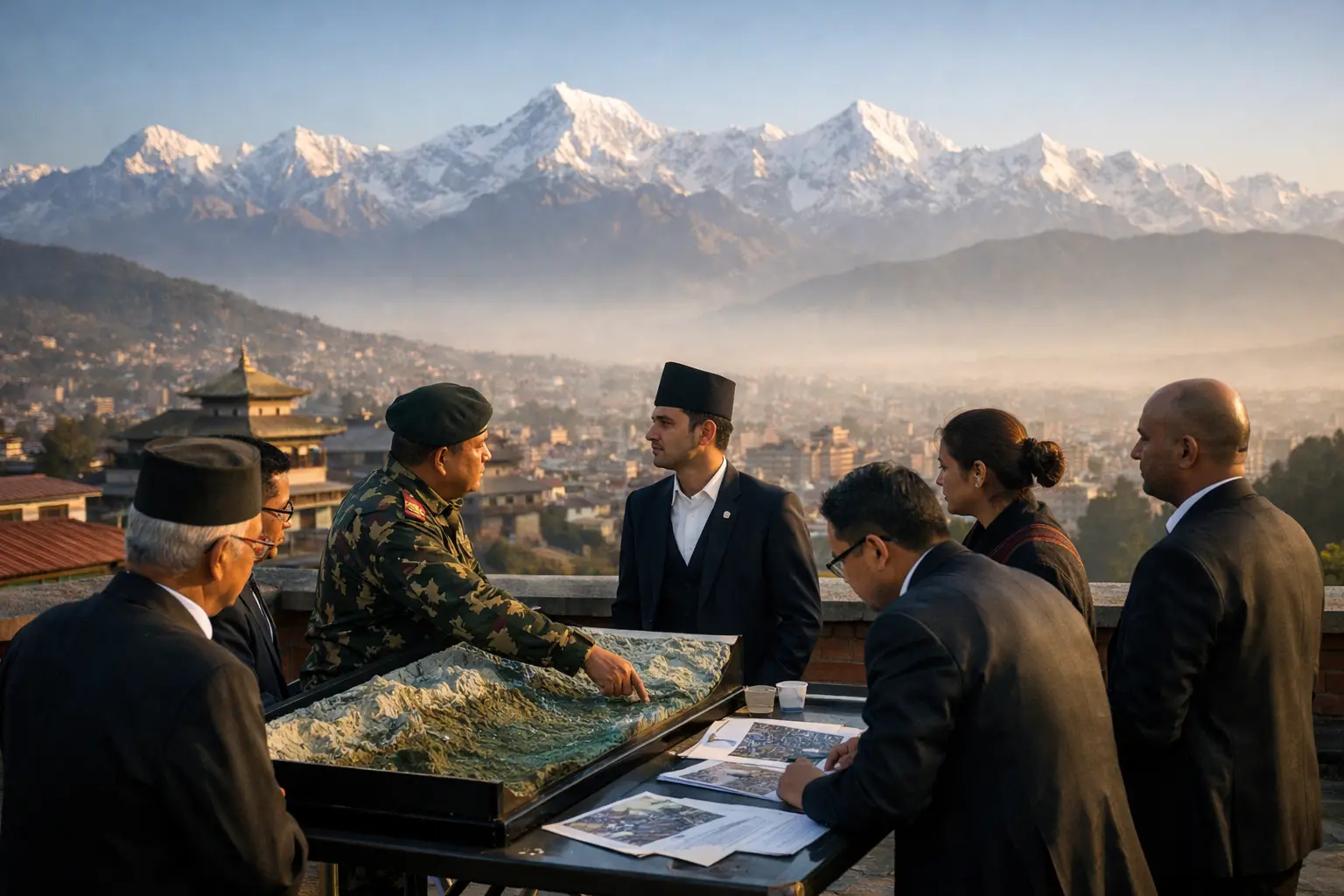
On March 5, 2026, early elections to the lower house of parliament were held in Nepal, resulting from mass anti-communist protests in September 2025. According to the voting results, the centrist party “Rastriya Swatantra” secured victory, winning 182 seats out of 275 possible.
This distribution of forces allows, for the first time in 27 years, the formation of a single-party government with a mandate sufficient to initiate fundamental constitutional changes.
The results of the post-protest elections also demonstrate a large-scale degradation of the influence of Nepal’s traditional political forces—in particular, the communist (pro-Chinese) and conservative (pro-Indian) blocs.
Immediately after the announcement of the results, the “Rastriya Swatantra” party nominated 35-year-old protest movement leader Balen Shah for the position of Prime Minister.
The former rapper and mayor of Kathmandu gained popularity through uncompromising anti-corruption rhetoric and reliance on direct democracy mechanisms, such as decision-making via social networks.
Such an atypical consolidation of power for Nepal by a new political force—whose core consists of politicians aged 25-45—became the consequence of a prolonged and multi-level socio-political crisis.
Unlike Bangladesh, Thailand, and Indonesia—other Indian Ocean countries that faced large youth protests—Nepal has far deeper economic problems, including record youth unemployment, stagnant production, and a neo-feudal system fueled by corruption and cronyism. Nepal has a young population: 56% of its 30 million people are under 30.
This creates a structural societal demand for radical transformation—up to radical sentiments regarding the physical elimination of corrupt elites.
Given the record victory of the “Rastriya Swatantra” party, the government of Balen Shah will be forced to respond to this challenge. Accordingly, it will involve large-scale reformatting of Nepal’s entire legislative, financial, and economic model, including the development of a new foreign policy strategy.
Seeing these changes as inevitable, the Donald Trump administration views the victory of “Rastriya Swatantra” as a reason to rethink its strategy toward Nepal, which from 2012 to 2025 treated Kathmandu as a buffer between India and the PRC. The White House aims to use Nepal’s security potential in a new approach to contain the PRC.
Despite the lack of sea access, the impossibility of integration into the IMEC transport corridor without direct Indian participation, and insufficient demographic resources to become an alternative production hub, Nepal’s geopolitical weight is determined by its unique location in the Himalayas.
The Himalayan range forms a natural, almost insurmountable physical barrier that has historically made large-scale military maneuvers between the Tibetan Plateau and the Indian subcontinent impossible.
For New Delhi, these mountains serve as a strategic “shield” protecting the northern borders from direct overland invasion by the PRC and, therefore, indirectly guaranteeing the security of American and allied investments in the Indian economy.
At the same time, the high-mountain regions of Nepal open unprecedented opportunities for intelligence gathering and monitoring of PRC activity in Tibet and East Turkestan.
Control over dominant heights allows the deployment of signals intelligence (SIGINT) systems, early warning systems, and visual surveillance of Chinese missile bases and military airfields on the plateau.
In addition, Nepal’s relative geographical proximity to the Chinese nuclear test site Lop Nur makes it an ideal location for seismic monitoring.
This issue became especially important after February statements by Deputy Secretary of State Thomas DiNanno and Assistant Secretary Christopher Yeaw, who said Beijing is increasingly using “decoupling”—hiding underground military tests in large artificial cavities to secretly expand its nuclear arsenal.
Since the massive granite base of the Nepalese Himalayas provides exceptional seismic wave conductivity with minimal signal distortion, highly sensitive sensors can clearly differentiate low-yield underground nuclear explosions (even in the hundreds of tons) from background seismic activity.
Under these conditions, the expansion of U.S. strategic presence in Nepal acquires critically important significance for monitoring the hidden activity of the People’s Liberation Army (PLA).
Moreover, this is not a distant prospect but a window of opportunity in 2026-2027—that is, during the period that will be decisive for implementing the “strategic rupture” with the PRC.
Gaining control over this intelligence area will help the U.S. curb Beijing’s secret nuclear expansion and limit its political flexibility amid rising tensions in the Indo-Pacific. It will also strengthen U.S. independence from India, which remains the main security player in the Himalayas.
An additional aspect of the Donald Trump administration’s strategic interest is Nepal’s still unrealized potential as a supplier of critically important raw materials and rare earth elements.
This direction directly correlates with the overall U.S. doctrine of diversifying supply chains and reducing dependence on the PRC’s monopoly position in the extractive sector.
According to data from Nepal’s Department of Mining and Geology, more than 85 types of minerals may be located on the country’s territory, including iron, copper, zinc, lead and cobalt, high-purity quartz, graphite, limestone, and dolomite.
Deposits of uranium and potential hydrocarbon basins could have particular geopolitical significance; if industrially developed, they would be capable of altering the region’s energy balance.
Until now, exploration of these resources has been hampered by the ideological engagement of previous communist governments and their orientation toward closed agreements with Beijing.
The victory of “Rastriya Swatantra,” allows the U.S. to expand investments, offer Balen Shah’s government an alternative to Chinese and Indian loans, and support the promised economic growth. This trajectory aligns with positions voiced by representatives of the Donald Trump administration ahead of Nepal’s electoral cycle.
In mid-February 2026, U.S. Assistant Secretary of State for South and Central Asia Paul Kapur highlighted Washington and New Delhi’s shared interest in shifting the political balance in Nepal and Bangladesh to curb the PRC’s expansion. He also said the White House is ready for faster engagement with the new Nepalese government.
The subtext of this approach is the updated U.S. paradigm, according to which Nepal’s political reboot is viewed as an integral part of the broader strategic confrontation in South Asia.
According to Paul Kapoor’s assessments, such “small” states of the region as Nepal, Bangladesh, Maldives, Sri Lanka, and Bhutan possess disproportionately large geostrategic weight while remaining vulnerable to Chinese economic coercion.
To change this situation, the White House plans to expand trade relations in the region, make targeted investments in critical infrastructure, and strengthen cooperation in the defense sector.
In addition, the Donald Trump administration intends to provide Nepal with consolidated diplomatic support for building sovereign strategic potential outside Chinese and Indian contexts.
For the practical implementation of this plan, Washington initiated the rotation of its diplomatic representation in Kathmandu. It is expected that the United States will appoint an envoy capable of acting in close coordination with Sergio Gor—the new U.S. Ambassador to India and a figure close to Donald Trump.
The priority task of the new mission head will be to capitalize on pro-American sentiments among Nepalese youth and to institutionalize support for the new political leadership.
The basis of such planning is a deeper calculation. The White House recognizes that the United States possesses a tangible asymmetric advantage over the PRC in engaging with Nepal’s new political generation.
During 2012-2025, American government agencies (in particular USAID) and affiliated structures carried out large-scale investments in good governance programs, youth leadership initiatives, and the development of Nepalese civil society.
The result of this long-term incubation is that a significant portion of the newly elected parliamentarians from the “Rastriya Swatantra” party come from the ranks of public figures shaped within the framework of American development programs.
Synchronously with American efforts, India is also acting, adapting its traditional toolkit of influence to Nepal’s new political reality.
After the communist government of Sharma Oli was overthrown, Indian diplomats started unofficial but steady contacts with young political and public figures in Nepal—the same demographic that supported Balen Shah’s protest and electoral victories.
The public consolidation of this tacit diplomacy was Prime Minister of India Narendra Modi’s prompt congratulations on the successful elections in Nepal, which essentially legitimized “Rastriya Swatantra” as a new structural player in South Asia.
The PRC, which in recent years served as Nepal’s key infrastructure creditor, is also attempting to adapt to the new political realities in Kathmandu.
In February 2026, Beijing began a diplomatic rotation by naming Ministry of Foreign Affairs official Zhang Maoming as ambassador. In his first speech, he expressed Beijing’s intention to keep providing Kathmandu with broad support, especially through the “Belt and Road” program.
However, given that Nepalese society firmly associates the PRC with support for the previous cabinet of Sharma Oli, such Beijing initiatives will inevitably face resistance from the leadership of “Rastriya Swatantra.”
Although Nepal’s new government officially claims a balanced approach with Beijing, New Delhi, and Washington, it will clearly aim to reduce its asymmetric dependence on the PRC to gain greater economic and security benefits from the U.S. and India.
A practical indicator of this shift was Balen Shah’s demonstrative decision to remove from the political program any mention of developing the Sino-Nepalese friendship industrial park (Damak Clean Industrial Park).
This flagship geoeconomic project of Beijing, located near the Indian Siliguri corridor (a strategically vulnerable section known as the “chicken’s neck”), is regarded by Nepal’s new leadership as an obstacle to establishing transactional communication with India and the United States.
Taken together, these processes create a unique window of opportunity for the United States. For the first time in decades, a deep political transformation in Nepal is occurring synchronously with the transition of local generations and elites, creating favorable preconditions for the systemic reorientation of Kathmandu’s foreign policy.
With prompt diplomatic and investment engagement, Washington will have the chance to solidify its strategic positions in South Asia without having to rely solely on agreements with India.
For the PRC the realization of such a scenario would mean the prospect of losing control over one of the critical sections of the Tibetan Plateau. In particular, it concerns the PRC’s geographical advantage that allows the covert buildup of offensive and nuclear capabilities of the PLA in Tibet and East Turkestan.
The convincing victory of the “Rastriya Swatantra” party and the political consolidation of Balen Shah’s government, in turn, go far beyond a purely internal Nepalese democratic transition.
From a broader geopolitical perspective, these developments act as a catalyst for reshaping the balance of power in South Asia, reaffirming the trend that relatively small Indo-Pacific states are playing an increasingly significant role in the U.S.–China rivalry.