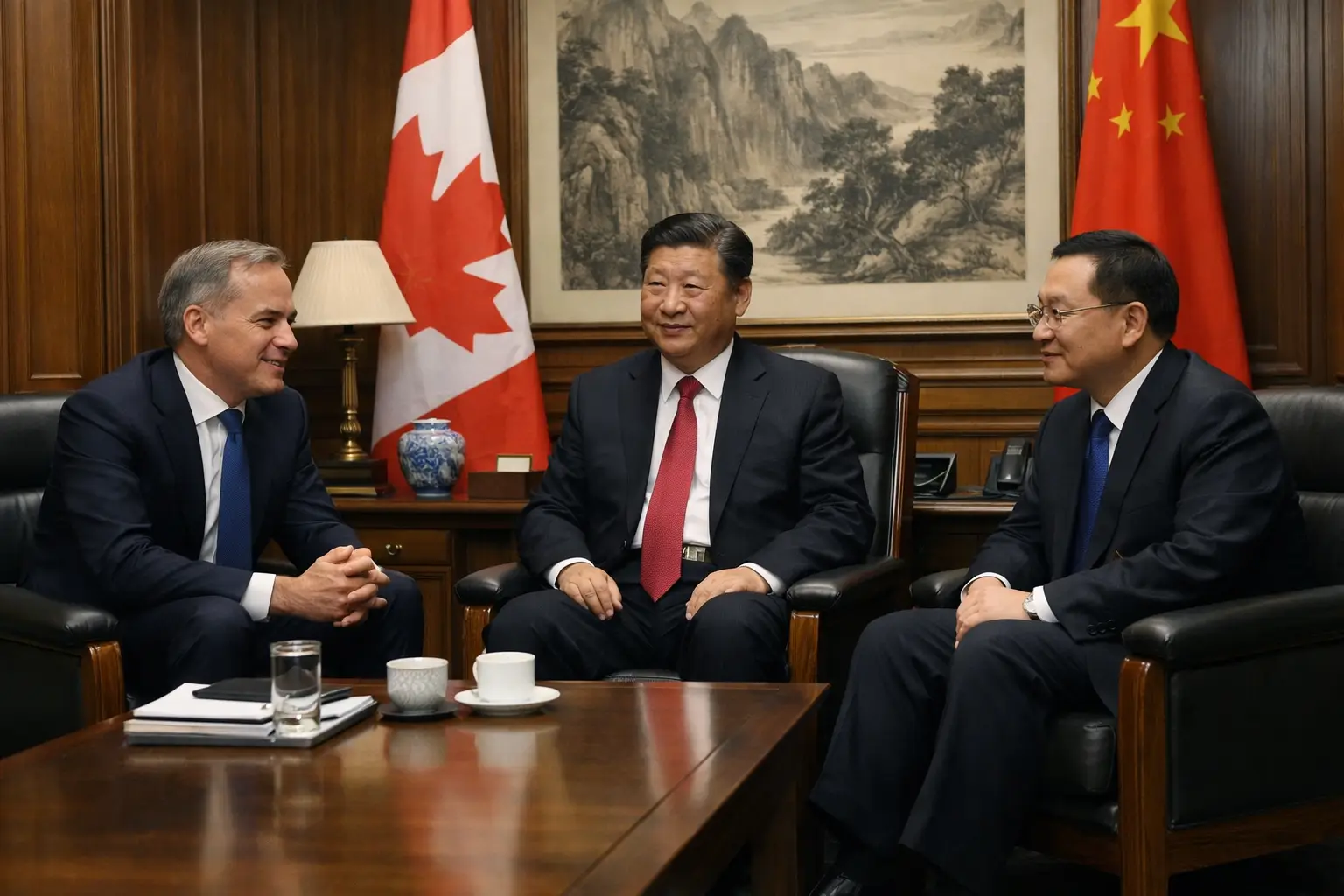
From January 14 to 17, 2026, Canadian Prime Minister Mark Carney made an official visit to the People’s Republic of China; the last such trip took place in 2017.
During the visit, he held talks with Xi Jinping, Li Qiang, and other high-ranking Chinese officials on expanding cooperation in the areas of trade, energy, agriculture, and international security.
In particular, following these meetings, Canada and the PRC agreed to revitalize energy interaction by invigorating trade in resources (oil, LNG, and CNG) and initiating regular ministerial consultations on energy issues, which will be held every 12-18 months. Overall, eight agreements and memorandums were signed during the visit.
A key outcome of these negotiations was the decision to mutually lift some customs restrictions. The Canadian government announced its readiness to reduce 100% tariffs on Chinese electric vehicles to 6.1%, while setting a quota for imports under the preferential regime of no more than 49,000 vehicles per year.
For its part, the PRC committed to reducing tariffs on Canadian canola oil—a critically important export commodity—from 85% to 15%. Additional liberalization will also affect supplies of Canadian lobsters, crabs, and peas.
Although Prime Minister Mark Carney publicly characterized the unblocking of trade, which had essentially been frozen since 2024, as the “beginning of a new era” in relations with the PRC, he emphasized the preservation of clear “red lines” in interactions with Beijing. This primarily concerns issues of human rights, democracy, and national security.
Mark Carney’s trip to China, which runs counter to the White House’s foreign policy goals, reflects the complexity of Canada’s domestic political situation following the 2025 federal elections.
After Donald Trump’s victory in the November 2024 presidential elections, the United States launched a campaign of intense pressure on Ottawa aimed at reshaping Canadian political dynamics.
In particular, circles close to the current President hoped to weaken the positions of the Liberal Party of Canada, which was already in a state of deep crisis due to declining public trust in Justin Trudeau and his conflict with Chrystia Freeland.
This strategy had a multifaceted goal: to facilitate the rise to power of right-wing forces that would share the new U.S. geopolitical and cultural agenda and be ready for unprecedented increases in defense spending.
The latter is of particular importance to the Donald Trump administration in the context of building a defense architecture along the American Arctic arc—from Alaska to Greenland.
At the same time, the White House’s overly confrontational approach had the opposite effect. Outraged by its rhetoric, Canadian society consolidated around the Liberal Party, essentially ensuring its retention of power as a form of protest against U.S. pressure.
A similar trend manifested in Australia, where the electoral balance shifted dramatically in favor of the Labor Party, outlining a clearly expressed anti-Trump choice by voters.
In this sense, it represents a tactical failure for the White House: after the elections in Canada and Australia, Washington abandoned radical attempts to interfere in electoral processes in the global Anglophone world.
From a broader perspective, the aforementioned American campaign directly contributed to Mark Carney’s career ascent to the position of Prime Minister—an influential financier who had not previously held government positions.
Unlike Justin Trudeau, whose period of governance (2015-2025) was marked by the formation of a “toxic” reputation due to corruption scandals and a left-ideological drift, Carney positions himself as a moderate “classical liberal” focused on pragmatic economic and social solutions. This has allowed for partial stabilization of the domestic political situation in Canada.
Despite a series of successful negotiations between Mark Carney and Donald Trump in 2025, the United States imposed tariffs on Canada of 35% (up to 45% for certain categories of goods), demanding a review of trade rules in the resource, food, and media sectors.
In response, Ottawa applied restrictive measures against American imports. At the same time, as of early 2026, further tariff negotiations between the two countries remain stalled due to fundamental differences in approaches.
This situation prompted Prime Minister Carney’s government to begin a systematic search for new export markets, essentially abandoning the trade status quo that had dominated from 1986 to 2024.
In particular, Canada has set a goal to double export volumes outside the U.S. by 2035, which currently account for about 70% of Canadian sales.
To implement this strategy, Ottawa has intensified negotiations with the European Union, India, and other democratic states that are also facing tariff pressure from the Donald Trump administration.
At the same time, a key feature of Mark Carney’s approach to market diversification has been a rethinking of relations with the PRC.
In particular, Canadian Industry Minister Mélanie Joly stated that Ottawa now considers the PRC a more “predictable and stable” partner than the United States. As a result, Beijing has taken a central place in Canada’s new export strategy.
Heading into talks with Xi Jinping—the second after their meeting on the sidelines of the APEC summit in Gyeongju—Mark Carney sought to unblock strategic interaction between Canada and the PRC, which had been frozen since 2017.
This refers to a series of crisis incidents that unfolded after the arrest of Huawei founder’s daughter Meng Wanzhou at Vancouver Airport for extradition to the U.S.
The culmination of this confrontation was Justin Trudeau’s personal accusation against Xi Jinping of interfering in Canadian state processes and systematic violations of international norms.
Unlike the U.S. anti-China policy, which primarily relies on security considerations, the corresponding Canadian dynamics are driven by domestic electoral calculations.
In particular, Ottawa engaged in open confrontation with Beijing after the unfolding of a 2016 political scandal related to the involvement of Chinese finances in the political orbit of the Trudeau family; a tougher line toward the PRC was necessary for the Liberal Party to mobilize support ahead of the 2019 federal elections.
Similarly, the Trudeau faction intensified containment of the PRC ahead of the 2021 elections, counting on political approval and coordination with the Joe Biden administration.
However, the context of 2025 led to the opposite trend: pro-liberal voter sentiments were focused not on countering Chinese influence or protecting the rules-based international order, but on opposing Donald Trump’s policies.
As a result, Canadian society increasingly perceives Ottawa’s rapprochement with Beijing as a form of political “response” to the U.S., which is ultimately taken into account by the Liberal Party ahead of a series of important regional elections (British Columbia, Nova Scotia, etc.).
This correlates with the results of a January Ipsos poll, according to which 54% of Canadians support strengthening trade ties with the PRC. An additional factor is demographics: about 5% of Canada’s population is of Chinese origin.
Such a configuration is extremely advantageous for Xi Jinping, who has gained a unique opportunity to weaken the northern flank of American security through the restoration of Chinese influence in Canada.
In line with this logic, Beijing hopes to use Ottawa’s desire for trade diversification to return Chinese investments to the Canadian Arctic, as well as to gradually penetrate Chinese technological and agent tools capable of creating pressure points on the U.S.
The PRC’s main tactical priority in this strategy is the possibility of concluding long-term agreements with Canada in the energy sector.
In particular, Beijing seeks to secure an alternative channel for oil and gas supplies after losing control over Venezuelan supplies.
Historically, Canada has exported the vast majority of its oil to the United States—for both political and logistical reasons. The U.S. accounted for about 96% of Canadian oil exports, while the PRC accounted for only 2%.
However, the launch of the expanded Trans Mountain Pipeline (Trans Mountain Expansion Project) in 2024 gave Ottawa the ability to significantly increase supplies to the Indo-Pacific. In this context, the agreements reached between Mark Carney and Xi Jinping could cause a real shift in the region’s energy-trade situation.
Although the described processes do not meet the expectations of the Donald Trump administration, in a broader strategic perspective, it does not perceive the pro-Chinese maneuvers of Prime Minister Carney’s government as a serious threat to American interests.
This is confirmed by President Trump’s statement on January 16, according to which the U.S. sees no problem in signing a trade agreement between Canada and the PRC.
First and foremost, the White House is satisfied with the overall results of its pressure on Ottawa, which has already led to Canada’s decision to increase its defense budget to 5% of GDP by 2035, essentially tripling it to $900 billion in total volume.
This course involves substantial increases in spending on military equipment with an emphasis on destroyers, submarines, and air defense systems; large-scale modernization of infrastructure—from Arctic seaports and northern logistics hubs to telecommunications and electrical networks; as well as revitalization of the Canadian military-industrial complex.
A telling example of this transformation was Ottawa’s decision to purchase the Australian over-the-horizon radar JORN for $6.5 billion to enhance protection of northern and border territories.
For Washington, this means that Canada will take significantly greater responsibility for Arctic security than in any previous period of its history.
In addition, the Donald Trump administration understands that the current campaign of tough tariff confrontation with Canada is temporary and will end with the conclusion of a new trade agreement, taking into account changes in the global situation in Latin America, the Middle East, and Eastern Europe.
In this sense, the White House assumes that Canada will remain a key strategic partner of the U.S., despite the current tactical confrontation.
A telling confirmation of this approach was Donald Trump’s decision to invite Ottawa to participate in the new American technological coalition Pax Silica, the goal of which is to ensure the security of global supply chains for the development of advanced technologies—from the automotive industry to the smartphone and artificial intelligence sectors.
On December 12, 2025, Japan, South Korea, Singapore, Australia, Israel, and the United Kingdom had already joined this initiative; meanwhile, the accession of the EU, India, and Taiwan is expected.
Finally, the White House views potential energy agreements between Canada and the PRC as an element of its own strategy to form Beijing’s structural dependence on “pro-democratic” oil.
In particular, the Donald Trump administration seeks to limit the PRC’s access to oil resources from autocratic partners—primarily Venezuela and Iran.
This approach would allow the U.S. to neutralize the problem of Chinese dominance in the rare earth metals sector: according to this logic, Beijing would not be able to effectively use restrictions on their supplies as a tool of pressure, since Washington and its allies would control the PRC’s access to key oil and gas markets.
This energy foundation is seen in the U.S. as a potential basis for the gradual restoration of proper interaction between Washington and Ottawa on a transactional basis.
From a deeper perspective, the tactic of “reconciliation” with the PRC chosen by Mark Carney to create additional pressure on the U.S. may turn into negative consequences for Ottawa—not least non-American ones.
According to former Canadian Ambassador to the PRC David Mulroney (2008-2012), Prime Minister Carney has chosen a tactic of “lazy thinking” that could lead to significant domestic political upheavals.
This refers to abandoning complex but necessary structural diversification of the economy in favor of a quick pivot to Beijing, despite accumulated evidence of Chinese political interference, economic coercion, and the PRC’s systemic strategy to weaken Canada’s ties with its traditional allies.
In practice, this mediates several parallel risks for Canada. First, increased economic dependence on the PRC will make Ottawa vulnerable to trade blackmail.
Second, openness to Chinese electric vehicles and investments could undermine Canada’s industrial base and initiatives in supply chain diversification.
Finally, renewing strategic ties with the PRC under the current geopolitical situation will lead to tolerating further instances of Chinese interference in domestic politics, which could result in significant risks for all of North America.
According to the 2024 report from the Communications Security Establishment Canada (CSE), the PRC has systematically used state hacking operations against Canada over the past five years.
In particular, Chinese cyber groups breached access to 20 networks of Canadian government agencies, including federal departments and agencies.
The CSE assesses that the goal of these operations was to gain political and economic advantages in bilateral negotiations with Ottawa and access to sensitive state information.
At the same time, former officials of the Canadian Security Intelligence Service (CSIS)—including former China programs head Dan Stanton and former head of the Asia-Pacific division Michel Juneau-Katsuya—stated that CSIS has systematically warned the Canadian government about Chinese election interference for 30 years, but all cabinets—from Brian Mulroney to Justin Trudeau—have not responded adequately.
Under such conditions, the return of Mark Carney’s government to compromise interaction with the PRC may be accompanied by the activation of multi-level Chinese influence on the Canadian public sector, including weakening the effectiveness of security institutions.
From a geopolitical perspective, Prime Minister Carney’s approach to Beijing is closely linked to the line of France, which traditionally influences Ottawa’s political culture.
Canadian leadership largely orients itself toward the autonomist maneuvers of Emmanuel Macron—one of the few European leaders who consistently advocates a model of selective interaction with the PRC and the broader Indo-Pacific region.
Mark Carney’s visit to the PRC had a particularly negative impact on relations with Japan, which is currently in a state of acute political and economic confrontation with Beijing.
From the perspective of Japan’s Liberal Democratic Party, the Canadian Prime Minister ignored the opportunity to conduct a full-fledged tour of East Asia, thereby weakening the positions of democratic partners (outside the U.S.) and Canada’s own negotiating positions regarding the PRC.
In particular, Sanae Takaichi’s government is convinced that without prior consolidation of positions with Japan and South Korea before negotiations in Beijing, Mark Carney lost two key prerequisites for effective diplomacy—the presence of convincing alternatives that restrain Chinese pressure, and coordination with allies that strengthens Canada’s weight.
Additionally, this negativity is underscored by the contrast with the parallel Asian tour of Italian Prime Minister Giorgia Meloni, which covered Oman, Japan, and South Korea and concluded with a series of strategic agreements between Tokyo and Rome on developing anti-Chinese economic, trade, and defense cooperation.
The totality of these steps ultimately outlines the deepest problem of Canada’s foreign policy strategy—the absence of systemic, qualitative, and long-term planning, as well as the conviction that Ottawa can distance itself from the global confrontation between the U.S. and the PRC.
This reflects a “peripheral” type of geopolitical thinking, shaped by decades of dependence on American strategic orientations as the main compass for its own foreign policy.
The consequence of these processes may be the loss of trust from Japan—Canada’s fifth-largest trading partner, which shares with the United States a course toward “strategic decoupling” from the PRC.
Under such a complex of circumstances, Mark Carney’s visit to the PRC is a manifestation of the transformation of Canadian foreign policy, driven by a combination of domestic political pressure and strategic uncertainty.
Ottawa is attempting simultaneously to soften the economic shock from the tariff confrontation with the U.S., satisfy anti-Trump sentiments in its society, and demonstrate autonomy from Washington—but it is doing so at the cost of weakening its own security positions and eroding the trust of allies.
The strategic paradox lies in the fact that the course toward “balancing” between the U.S. and the PRC essentially pushes Canada toward asymmetric dependence on Beijing.
In the short term, this may bring economic dividends—primarily in the energy and agricultural sectors. However, in the medium term, it creates significant risks for both national and global security situations.
At the same time, the Donald Trump administration views Prime Minister Carney’s current maneuver more as a temporary deviation rather than a strategic split in relations.
For the U.S., the key outcome remains the militarization of the Canadian Arctic and the creation of the PRC’s dependence on the American energy base, which will facilitate the renewal of proper interaction between Washington and Ottawa.
Ultimately, Canada’s main defeat from the chosen course will not be pressure from the White House, but the loss of position in the Indo-Pacific.
The absence of coordination with Japan and South Korea before negotiations with Beijing has weakened the trust of key democratic partners and exposed the lack of long-term strategic thinking in Prime Minister Carney’s government.
If this trend continues, Canada risks finding itself in destructive positions—with political tension in relations with key allies and strategic dependence on the political will of Xi Jinping.