On January 10, 2026, Japanese Finance Minister Satsuki Katayama stated Tokyo’s intention to initiate the formation of a market for rare earth metals separate from the PRC, involving the U.S., EU, and other democratic partners, in order to limit Beijing’s expansionist capabilities.
In particular, she emphasized that if democracies do not deprive the PRC of the means to monopolize and weaponize critical resources, this will create a critical threat to civilian industries and inevitably lead to a deep structural crisis in the long term.
Thus, this context became key on the Japanese agenda during the G7 Finance Ministers’ meeting, which took place on January 12 in Washington. Representatives from South Korea, Australia, India, Mexico, and the European Union also joined consultations on forming a pro-democratic market for critical resources.
The Japanese government under Sanae Takaichi’s tough anti-Chinese statement came against the backdrop of the PRC’s decision on January 6 to expand export controls on dual-use goods to Japan, including rare earth metals (dysprosium, magnets, etc.).
The restrictions apply to both defense and civilian companies; moreover, the specific list of entities will be determined on a case-by-case basis. This step became part of a broader Chinese campaign to “punish” Japan for its willingness to join the defense of Taiwan, encompassing military, financial, and information provocations.
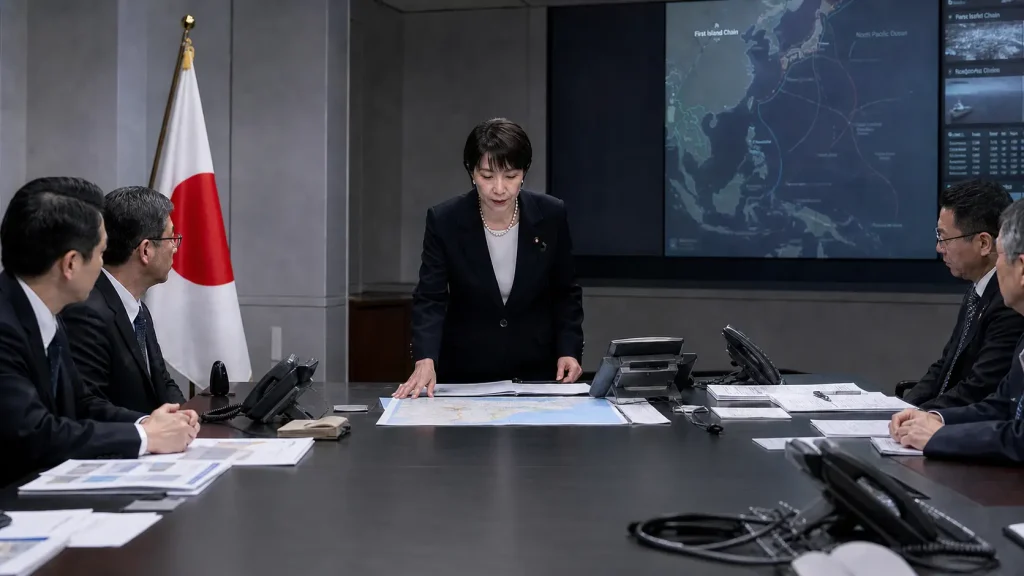
In addition, its announcement coincided with negotiations between Prime Minister Takaichi and South Korean President Lee Jae-myung in Nara (immediately after his visit to the PRC), as well as with the first tour of Japanese Defense Minister Shinjiro Koizumi to the U.S., which covered Honolulu, Los Angeles, and Washington. In both cases, the focus was on deepening bilateral and trilateral cooperation.
The Japanese government’s readiness to formally transition to a “strategic decoupling” from the PRC and to accelerate policy synchronization with the Donald Trump administration reflects the depth of the plan underlying Tokyo’s decision to announce preparations for the defense of Taiwan.
In particular, Prime Minister Takaichi aimed to launch a transformation of the national economy, which had previously operated within the economic status quo with the PRC.
The reason for this revision was the realization that managing economic interdependence between Japan and the PRC, to which the governments of Fumio Kishida and Shigeru Ishiba were inclined, is impossible amid escalating Chinese aggression.
The leadership groups of Japan’s Liberal Democratic Party (LDP) concluded that in the event of a Chinese attack on Taiwan or another forceful scenario in the region, Beijing would inevitably use trade, technological, and logistical levers as instruments of war.
At the same time, they took into account that Japan—unlike the U.S. and the European Union—shares a single economic-logistical space with the PRC in East Asia, which makes full implementation of the American model of “strategic decoupling” impossible.
This situation prompted Prime Minister Takaichi’s government to form its own model of adapting the economy to a crisis situation, which would ensure an effective system of defense and deterrence—while minimizing the “shock” from the start of a potential war.
The core of forming the aforementioned Japanese model became the principle of selective restructuring of supply chains according to their security criticality (as manifested in the context of rare earth metals).
Essentially, this involves right-shoring—a method of reducing risks by seeking a balance between cost, quality, risk, and efficiency for each specific process.
From a broader perspective, the goal of Japanese right-shoring is not an immediate severance of trade-economic ties, but a reactive elimination of vulnerabilities in critical areas such as technology and industry. Under this model, Japan allows the retention of certain operations in the PRC provided they are fully replaceable during a crisis period.
Accordingly, the PRC’s reaction to Japan’s decision to announce preparations for the defense of Taiwan was necessary for Prime Minister Takaichi to convince Japanese industrial elites to start acting according to the right-shoring model and to demonstrate the vulnerability of their operational chains.
This aligns with her experience as Minister of Economic Security and as a successor to Shinzo Abe—the former prime minister who called on Japanese business to withdraw capital from the PRC back in 2020.
The Donald Trump administration accepts this Japanese logic, as it directly contributes to achieving the goals of “strategic decoupling” between the U.S. and the PRC.
This is confirmed by the formation of a broad consensus between President Trump and Prime Minister Takaichi during their negotiations in Tokyo in October 2025, which, in particular, covered coordination on the Taiwan issue and the economic parameters of their “grand deal.”
Under such transactional support from the White House, Prime Minister Takaichi’s government gains space to politically ignore pressure from the PRC.
This allows it to ultimately and consistently advance its own plan to reduce strategic dependence on Beijing—both at the level of adopting new security legislation and through deepening political agreements between the state and Japanese big business.
The final stage of consolidating Tokyo’s course toward long-term political and economic confrontation with the PRC should be its institutional formalization, which from Sanae Takaichi’s perspective could take the form of snap parliamentary elections.
In particular, the current LDP leadership remains dissatisfied with the fragility of the party’s positions in the lower house after a series of unsuccessful campaigns under Shigeru Ishiba’s leadership.
Because of this, Prime Minister Takaichi’s government is working on several scenarios for dissolving the House of Representatives—at the end of January 2026, as well as in the summer or autumn periods.
According to a Nikkei-TV Tokyo poll for December 2025, approval for the Sanae Takaichi government has steadily held at 75% for three months, which is an unprecedented figure since the time of Shinzo Abe.
At the same time, the Japanese Cabinet’s sociology recorded record levels of support for the LDP leader’s flagship ideas, including expanding the size and capabilities of the Self-Defense Forces (45.2%), lifting restrictions on arms exports (70%), and adopting security (anti-Chinese) legislation (73.4%).
From the perspective of LDP leadership circles, capitalizing on such success through the snap dissolution of the lower house with elections scheduled for early February 2026 would allow restoring the party’s strategic dominance and that of its new political partner Nippon Ishin no Kai in parliament.
Under such conditions, Sanae Takaichi would gain tools for adopting the national budget for 2026 with record defense expenditures, as well as a stable political mandate for structural negotiations with Donald Trump planned for March—ahead of his potential trip to Beijing.
Despite the absence of a formal decision on the snap dissolution of the lower house, this issue is on Prime Minister Takaichi’s urgent agenda.
Under such conditions, the scenario of postponing elections to July or October 2026—or to 2027—is possible only if a real threat to the LDP’s large-scale electoral success emerges.
At the same time, Chinese political and military provocations, unfolding with support from the RF and the DPRK, objectively consolidate the electorate around the current Japanese government. This means that Beijing does not possess effective tools to weaken Sanae Takaichi’s positions.
The lack of Chinese tools to undermine Japan’s new strategic course crystallized following the negotiations between Sanae Takaichi and Lee Jae-myung, which took place from January 13 to 14, 2026, in Nara—the current prime minister’s electoral district.
In particular, they determined that bilateral cooperation between Japan and South Korea, as well as interaction within the JAROKUS coalition, is “vitally necessary” for maintaining peace and stability in East Asia.
Within these frameworks, the leaders declared their readiness to deepen economic cooperation beyond the trade-oriented model, defining the core of the new partnership as economic security, scientific-technological development, and joint formation of international norms.
They also agreed to strengthen joint supply chains. This approach sharply contrasts with the negotiations between Xi Jinping and Lee Jae-myung that preceded his visit to Nara and boiled down to tactical economic agreements in the logic of right-shoring.
This means that Japan and South Korea continue to maintain the strategic consensus achieved on the sidelines of the APEC summit in Gyeongju—and also adhere to agreements with Donald Trump on supporting the JAROKUS coalition.
In addition to the purely Japanese-South Korean dimension, the consolidation of their consensus is manifested through the practical formalization of a single democratic resource market, which Satsuki Katayama mentioned ahead of the G7 Finance Ministers’ meeting.
A telling example in this context was the visit of Italian Prime Minister Giorgia Meloni to Tokyo immediately after Lee Jae-myung’s departure—as part of her Asian tour, which also covered Oman and South Korea.
During negotiations with Sanae Takaichi, Italian Prime Minister Meloni promoted the idea of expanding cooperation in the field of rare earth metals, counting on strengthening Rome’s role in supporting alternative supply sources in the Indo-Pacific.
This approach aligns with the positions of the EU and the U.S., which—according to White House trade advisor Peter Navarro—are interested in accelerating the displacement of the PRC from the global market for critical resources.
Another confirmation of the positive forecast is data from a specialized Nikkei-Maeil Business Newspaper poll for December 2025. According to it, 44% of Japanese and South Korean business leaders expect an improvement in bilateral relations, which is an unprecedentedly high figure.
At the same time, they named semiconductors and advanced technologies (69%) and electric vehicles and batteries (30%) as the most promising areas for economic cooperation.
Such a situation strengthens the positions of Sanae Takaichi’s right-shoring approach, aimed at consolidating Japan’s positions in the fields of rare earth metals and semiconductors.
An illustrative example of Japan’s long-term approach to neutralizing the PRC’s resource monopoly was the launch of a program to develop the seabed in the area of Minamitorishima Island—a remote atoll of the Second Island Chain between Hawaii and Guam.
According to available estimates, these areas contain critically important reserves of rare earth metals, including dysprosium, neodymium, samarium, yttrium, and gadolinium, necessary for the production of semiconductors, electric vehicles, and technologies in the field of civilian nuclear energy.
Although the real volumes of resources remain undetermined, Japanese researchers assume that the seabed near Minamitorishima could potentially cover global demand for centuries.
On January 12, 2026, Japan sent the first research vessel to Minamitorishima to collect seabed sediments at a depth of about 6,000 meters in order to assess the scale of rare earth metal deposits.
This is the first such operation in the world. Sanae Takaichi’s government itself defined this mission as the initial stage of industrializing rare earth elements of Japanese origin.
After completing the primary sampling, full-scale research is set to begin in 2027; in parallel, the construction of a processing facility near Minamitorishima for processing slag is planned, which will significantly increase the efficiency of the supply chain.
The start of commercial exploitation of Minamitorishima’s resources, however, is expected from 2030—synchronized with the U.S. intention to complete the basic stage of the “strategic decoupling” program from the PRC.
Taking into account Japan’s leadership in diversifying rare earth metal supply chains—particularly through relocating relevant capacities to Australia since the 2010s—the prospect of developing Minamitorishima’s resources should become an incentive for Japanese business to support the right-shoring strategy of Prime Minister Sanae Takaichi’s government.
A telling example in this context is the case of the Japanese conglomerate Honda, which decided to diversify semiconductor purchases and freeze production in the PRC.
The new supply chains are set to start operating as early as January 2026. The catalyst for this step was the blocking of operations of the Chinese chip manufacturer Nexperia, which was previously under Dutch control.
This is seen as the first case of targeted diversification of semiconductor supplies by a Japanese automaker precisely due to the “Chinese trace” in the supplier’s structure.
Honda uses ready-made semiconductors for a wide range of automotive components, while some parts suppliers were critically dependent on Nexperia for certain items.
After the supply reduction, the company was forced to reduce production volumes in the U.S.; the total losses from this decision are estimated at $950 million.
Among Honda’s new suppliers, the Japanese chip manufacturer Rohm is set to play a key role, as it owns a full cycle of chip production and has manufacturing facilities in Japan and Southeast Asia.
This configuration fits into both the Japanese and American economic security strategies, reinforcing the structural nature of right-shoring as a tool for “strategic decoupling” from the PRC.
As for the PRC’s own reaction to the formation of the corresponding consensus between the Japanese government and business, it also boils down to political and military provocations.
In particular, the Japanese government recorded the Chinese aircraft carrier “Liaoning” near the waters of Minamitorishima, which was intended to signal Beijing’s intentions to hinder the formation of Japan’s resource independence.
In this context, the problem of weaponizing the economy and critical resources became one of the key points in negotiations between Japanese Defense Minister Shinjiro Koizumi and U.S. military leadership, which additionally underscores the security component of Japan’s variation of “strategic decoupling” from the PRC.
Under such dynamic conditions, the economic “war” between Japan and the PRC acquires a systemic character and ceases to be derivative of trade disputes, transforming into part of preparations for a forceful scenario in the Indo-Pacific.
The decisions of Sanae Takaichi’s government regarding the formation of an alternative market for critical resources, the implementation of right-shoring, and the institutional dismantling of the economic status quo with the PRC indicate Tokyo’s conscious transition from managing interdependence to managing the risk of war.
In this logic, the economy is viewed not as an autonomous sphere, but as a direct element of deterrence and defense of Taiwan and the broader East Asia region.
In the domestic political dimension, Sanae Takaichi’s strategy relies on an unprecedented level of public support and big business’s readiness to adapt to the new geo-economic situation, which opens space for its institutional consolidation—primarily through snap parliamentary races.
In the event of dissolving the lower house in January 2026 and successfully holding elections in February, the LDP could receive a “carte blanche” for implementing a wide range of security reforms and at the same time significantly strengthen negotiating positions ahead of the meeting with Donald Trump.