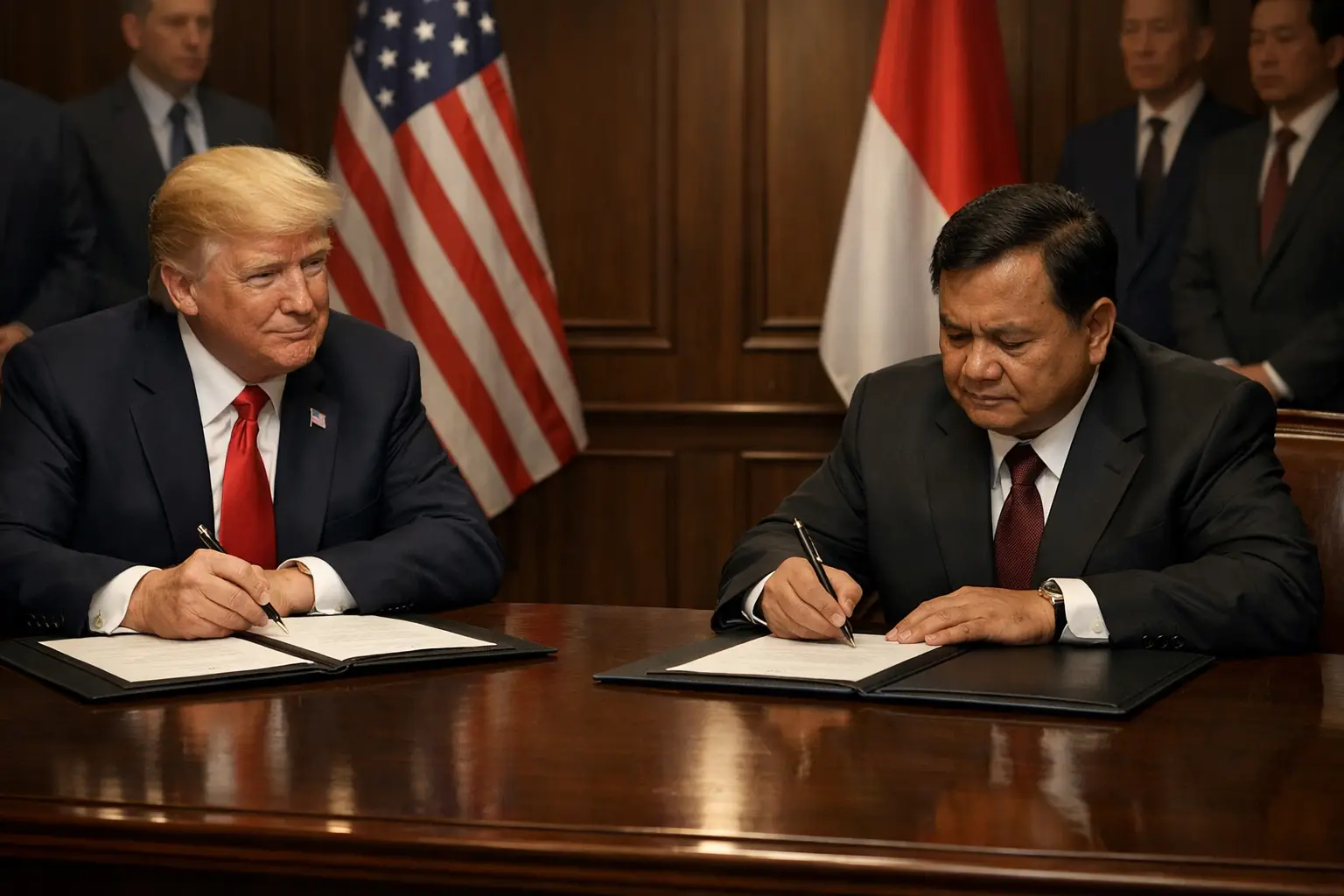
On February 19, 2026, Donald Trump and Prabowo Subianto finalized the “grand bargain” between the United States and Indonesia (US-Indonesia Agreement on Reciprocal Trade).
Under the agreement, the United States agreed to reduce tariff pressure on Jakarta from 32% to 19% and to introduce duty-free access for Indonesian textile and apparel products—a strategic sector that has been severely damaged by unfair competition from the PRC.
The preferential regime is tied to the use of American rather than Chinese cotton and synthetic fibers. The deal establishes a model in which Washington trades tariff concessions for the structural displacement of the PRC from the supply chains of key Asian economies.
In return, Indonesia committed to providing duty-free access for 99% of American goods, including agricultural products, pharmaceuticals, electronics, and automobiles that previously faced protectionist restrictions; this regime will also include large-scale deregulation.
Additionally, Jakarta pledged to join efforts to counter the global steel overproduction crisis, to block attempts by third countries to circumvent U.S. tariffs through Indonesian jurisdiction, and to fully lift restrictions on U.S. access to critical minerals.
The agreement requires Indonesia to purchase at least $33 billion worth of U.S. goods. At the same time, the United States reserves the right to reinstate the 32% tariff on Indonesian products.
This would occur if President Prabowo Subianto’s administration makes an alternative “grand bargain” with a country that, in Donald Trump’s view, poses a threat to U.S. national security—a provision known as the poison-pill clause
This mechanism limits Jakarta’s ability to strike strategic pacts with Beijing while enjoying American preferences. Indonesia became the third Southeast Asian nation to accept this format, after Malaysia and Cambodia.
President Prabowo Subianto’s decision to sign the “grand bargain” during the inaugural Peace Council summit—after long delays caused by disproportionately favorable terms for the United States—resulted from the worsening Indonesian economic situation and the narrowing room for Jakarta’s geopolitical maneuvering.
The Prabowo administration faces competitive pressure that is compressing the time available for decision-making. India, Vietnam, Malaysia, and the Philippines have already secured preferential access to the American market, while Indonesia’s economy of 280 million people urgently needs large-scale foreign investment to sustain employment.
Jakarta had hoped that Washington would be unable to close a deal with India, giving Indonesia leverage to negotiate better terms. The February agreements between Trump and Modi disproved this calculation.
Further delay would have left Indonesia as the only major Southeast Asian economy without preferential access to the U.S. market, with growing dependence on the PRC, Russia, and Turkey.
Prabowo Subianto chose to sign the “grand bargain” to safeguard Indonesia’s competitive standing in the face of global economic changes and the United States’ ongoing policy of “strategic decoupling” from the People’s Republic of China. These external pressures are compounded by Indonesia’s own fiscal weaknesses.
After Jakarta introduced a state-funded free-meal program costing around $30 billion annually and expanded fiscal stimulus for the rural economy, international investors—including those once seen as alternatives to American capital—began to question the reliability of the Indonesian jurisdiction.
This was reflected in cautious forecasts and rating downgrades from leading financial institutions, notably Morgan Stanley and Moody’s.
Analysts highlighted fiscal risks stemming from the imbalance between massive budget expenditures and a weak revenue base, creating a threat to Indonesia’s status as an emerging market.
Since President Prabowo uses economic paternalism as a tool for legitimizing power and sees no option to scale back populist programs, his team chose to offset investment risks through a political agreement with Washington.
This calculation rests on the belief that American and other pro-democratic capital will flow into Indonesia thanks to the U.S. preferential regime, despite warnings from financial institutions.
The Donald Trump administration shares this approach, because for it Indonesian jurisdiction serves as a tool to accelerate supply-chain diversification rather than a target for structural economic reforms.
Jakarta is now confronting the consequences of its long-standing dependence on the PRC as a strategic infrastructure donor—a dependence long welcomed by Indonesian elites as a source of illicit enrichment.
In the lead-up to the signing of the “grand bargain” between Donald Trump and Prabowo Subianto, the Indonesian government showed it was unable to efficiently manage spending on Whoosh, the region’s first high-speed rail line.
This rail line, connecting Jakarta to Bandung—the administrative center of West Java province—is considered a strategic national infrastructure asset.
In 2015, the Joko Widodo administration turned down Japan’s proposal to serve as the lead investor in the project. Instead, it favored the People’s Republic of China, which offered to fund 75% of the new railway’s cost under the Belt and Road Initiative.
In return, China received concession rights extending until 2069 through the joint venture KCIC—Kereta Cepat Indonesia China. Joko Widodo’s main justification at the time was that the project would not require any state guarantees or appropriations..
However, an audit conducted by President Prabowo’s administration in mid-2025 revealed critical unprofitability of Whoosh despite its final cost exceeding $7.3 billion.
In particular, its operating revenues do not cover debt obligations to Chinese creditors, who continue to demand payments regardless of KCIC’s own earnings.
Because the railway cannot generate sufficient profit, in February 2026 Jakarta was forced to draw on national budget funds to repay the next tranche of the Chinese loan—despite earlier assurances that state finances would not be involved.
This unfolded amid waning investor confidence in Indonesia and a sharp increase in spending on populist social programs. Given comparable precedents within Indonesia and the wider Indo-Pacific region, this misalignment of interests emerged as a key factor hastening the conclusion of the “grand bargain” with the United States.
The operational problems of the Whoosh high-speed rail line directly correlate with the systemic crisis in Indonesia’s textile industry, which remains one of the largest employment sectors in Central Java, West Java, and Banten provinces.
The industry is under pressure from overproduction in the PRC and the continued influx of cheap imports into the domestic market.
According to Indonesia’s industry association APSyFI, approximately 30 textile factories closed in the first half of 2024 alone—and the trend continues, creating social tension that affects support for the Prabowo Subianto administration.
In response, the Indonesian government initiated the creation of a state-owned enterprise capitalized at $6 billion to modernize textile production capacity.
However, the plan’s effectiveness critically depends on access to the U.S. market, where there is steady demand for supply-chain diversification and substitution of Chinese-origin goods.
The signing of the “grand bargain” with Donald Trump and preparations for a deepened trade agreement with the European Union modeled on India’s—already scheduled for May 2026—demonstrate Jakarta’s systemic calculation for long-term distancing from an economic model oriented toward the PRC.
Prabowo Subianto’s decision indicates that relations between Jakarta and People’s Republic of China have reached a breaking point. Despite expressing public support for Xi Jinping’s initiatives, participating in BRICS, and engaging in joint military activities, he approaches ties with China pragmatically.
For Prabowo Subianto, engagement with the PRC serves primarily as a means to sustain investment flows into technology and extractive sectors, especially the nickel industry.
Further alignment with Beijing, however, carries real risks of losing partnerships with the United States, Japan, and Australia—without which Jakarta would face strategic economic and defense weakening.
In this connection, Indonesia has accelerated its OECD accession process and signed an updated Joint Security Treaty with Australia in February 2026.
A separate vector has been Indonesia’s accession to the Peace Council initiated by Donald Trump to resolve the Gaza conflict, allowing Prabowo Subianto to satisfy the foreign-policy demands of the country’s Muslim population while simultaneously integrating into the White House’s diplomatic infrastructure.
At the same time, the existence of agreements with the United States that contain restrictions on strategic pacts with third jurisdictions gives Washington a durable advantage in the competition for influence over Jakarta.
An additional factor in the policy review is security pressure from the PRC that extends beyond territorial disputes in the South China Sea.
At the end of 2025, the Indonesian government documented unauthorized use by Chinese contractors of the runway at the Morowali industrial park—a strategic nickel-processing hub; similar interference is believed to have been occurring since 2019.
This triggered a domestic political scandal over violation of national sovereignty and provoked rising inter-ethnic tension in the region.
The combination of economic losses from infrastructure projects, weakening of key economic sectors, and a worsening security environment is pushing the Prabowo Subianto administration toward a more pragmatic foreign policy with the United States.
This shift comes at the cost of abandoning corrupt ties with the People’s Republic of China and moving away from civilizational alignment with Turkey.
Finally, the stability of the Prabowo Subianto administration is being tested by a critical rise in protest potential caused by systemic erosion of state institutions and the entrenchment of clan-oligarchic connections.
The catalyst for public discontent was the mass civil unrest of 2025, which erupted in reaction to power consolidation and the rollback of democratic procedures.
In particular, Prabowo Subianto radicalized the political course of his predecessor Joko Widodo—the father of current Vice President Gibran Rakabuming Raka.
This continuity has transformed into an institutional restoration of autocratic governance mechanisms, essentially nullifying the achievements of the Reformasi era (the period of democratization after 1998).
A key element of this transformation has been the dismantling of checks and balances. President Prabowo’s administration deliberately weakened the Corruption Eradication Commission and turned the Constitutional Court into a politically controlled body, enabling the legalization of questionable legislative initiatives.
In addition, its review of legislation on the armed forces and police essentially restored the practice of appointing military personnel to key government positions, effectively returning Indonesia to the practices of the Suharto regime.
At the same time, the Indonesian government tightened regulatory controls over civil society and increased oversight of the media and any criticism directed at the President.
It also launched a review of electoral laws aimed at ending direct elections for local government bodies and replacing them with centralized presidential appointments.
These political maneuvers coincided with unfavorable macroeconomic dynamics, creating an extremely destabilizing social configuration. The most vulnerable group is youth under 30—a segment that comprises 50% of the population.
With social mobility blocked and institutional transparency lacking, students and the young middle class have begun looking to regional models of power transformation, particularly the examples of Bangladesh and Nepal, where kleptocratic elites were removed not through evolution but through revolution.
Until now, Prabowo Subianto has contained protests by combining political pressure with populist promises targeted at impoverished youth and rural voters—particularly through free-meal programs and agricultural subsidies.
However, under intensified U.S. tariff pressure, EU trade restrictions, and unfair competition from the PRC, this model has proven purely situational and financially unsustainable.
The decisive factor prompting a correction of this approach was the audit of internal political-security risks—particularly after the death sentence of Sheikh Hasina.
Recognizing the prospect that social discontent could transform into uncontrolled multi-million-person protests with potential escalation to a 1998-style forceful scenario, Prabowo Subianto decided to avoid creating a point of no return in the relationship between the authorities and society.
The signing of the “grand bargain” proposed by the Donald Trump administration—including formalized guarantees limiting Chinese presence—became an unavoidable step for domestic political stabilization.
The decisive pressure factor on Prabowo was the Bangladesh precedent—another Muslim Indo-Pacific state with similar demographics, where uncontrolled protests led to a change of power.
In particular, the government of Tarique Rahman—leader of the Nationalist Party and son of Khaleda Zia (“mother of the nation,” who waged a long struggle against Sheikh Hasina)—is currently balancing between Donald Trump’s demands and the need to preserve Chinese financing.
Dhaka is analyzing whether the U.S. Supreme Court ruling on tariffs will allow it to abandon obligations taken by the previous transitional government.
Under the framework agreement of the Muhammad Yunus government, failure to comply with the U.S. deal threatens the return of tariffs to 37% from the current 19%.
This mechanism can be activated if Bangladesh concludes new economic agreements with the PRC or Russia without accounting for Washington’s concerns. Similar conditions apply to Indonesia.
Given domestic social discontent and critical dependence on the U.S. market, Prime Minister Rahman’s government will clearly preserve the current agreement—which will simultaneously become an additional factor drawing Bangladesh and Indonesia closer together.
The U.S.-Indonesia agreement goes beyond trade arrangements. Washington is building a network of tariff agreements across Southeast Asia, each including mechanisms to block strategic pacts with the PRC.
For Prabowo Subianto, this step represents a forced attempt to simultaneously stabilize the macro-financial situation, reduce protest potential, and avoid critical dependence on the PRC.
At the same time, the signed agreement limits Indonesia’s strategic autonomy, locking it into the orbit of American economic and security architecture.
Following Malaysia, Cambodia, and Indonesia, Washington has now closed its third tariff agreement as part of a systemic strategy to create a network of loyal jurisdictions in Southeast Asia.
The space for multi-vector balancing that “middle powers” in the region have used for decades is shrinking with each signed agreement. Through tariff incentives and sanction safeguards, they are gradually distancing themselves from the PRC.
At the same time, the U.S. Supreme Court’s February 20, 2026, ruling declaring the use of IEEPA for imposing tariffs unconstitutional formally undermined the legal basis for these agreements.
Within hours, the Trump administration replaced the canceled tariffs with a global 10% levy under Section 122 of the Trade Act of 1974, with a threat to raise it to 15%. Trade Representative Jamieson Greer stated that the White House would “stand by” the concluded agreements regardless of the court decision.
Trump warned countries that might try to “play games” with the Supreme Court ruling, promising significantly higher duties through alternative legal mechanisms.
For Indonesia, Cambodia, and Malaysia, withdrawing from the agreements carries a paradoxical risk. Section 122 allows only a 150-day period, yet the administration has already launched “expedited” investigations under Section 301, targeting unfair trade practices, and Section 232, addressing threats to national security.
These investigations grant the President the authority to impose unlimited tariff rates once the formal procedures are completed.
Former U.S. Trade Representative Mike Froman assessed that most countries will not risk breaking the agreements and provoking Trump into using alternative tools.
Indonesia has officially confirmed that the agreement has not yet been ratified but has so far made no statement about any intention to review its terms.
Washington’s ability to replicate this model with new jurisdictions remains in question. Sections 301 and 232 require formal investigations lasting from several months to a year and a half, while Section 122 is limited to 150 days and requires congressional extension.
At this stage, the Trump administration has lost the ability to impose tariffs immediately and unilaterally—the tool that provided negotiating leverage over Jakarta, Phnom Penh, and Kuala Lumpur.