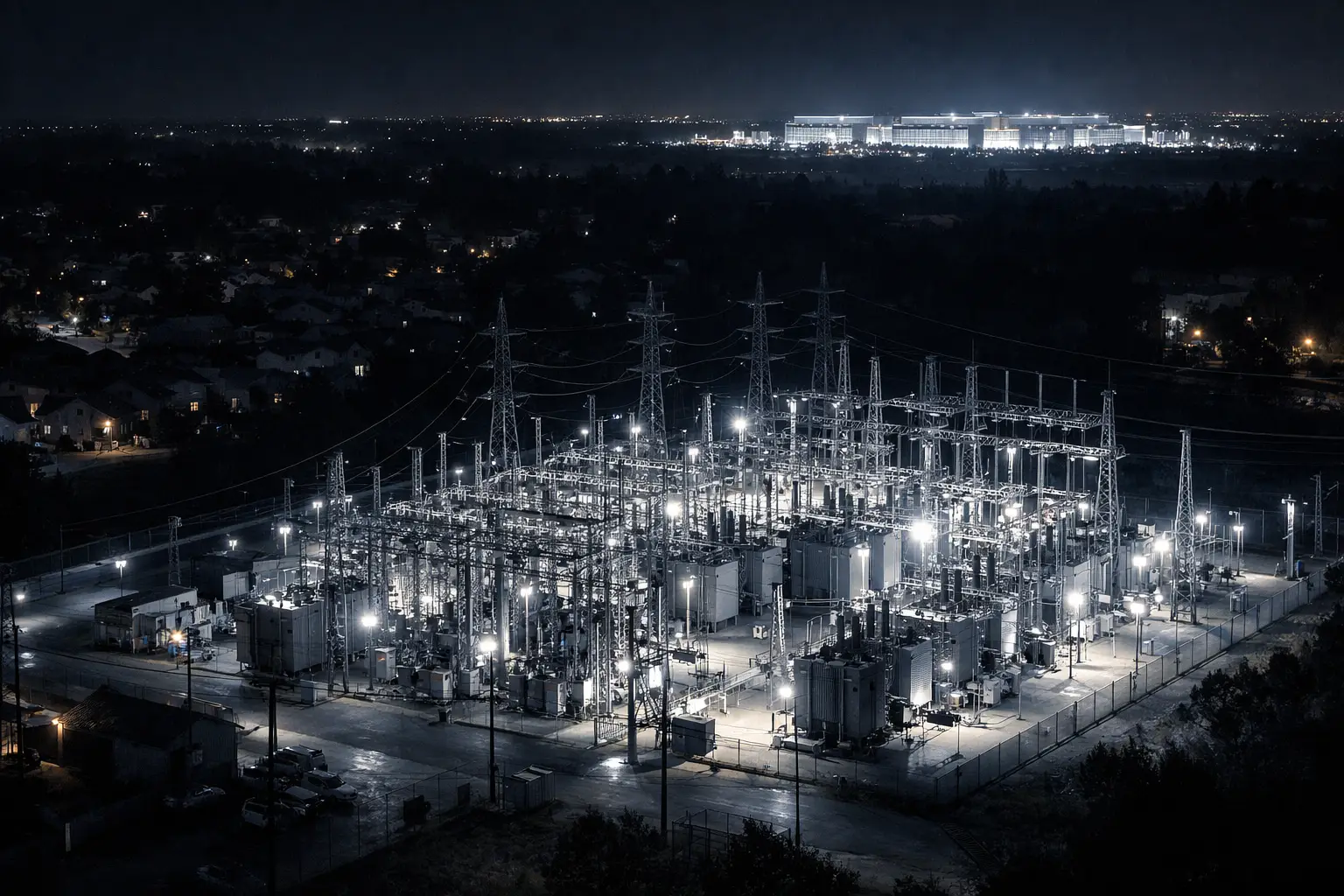
At the end of December 2025, the largest US power grid operator, PJM Interconnection, recorded record results from a capacity auction, which directly translate into increased electricity bills in 13 states and the District of Columbia.
The price reached $333.44 per megawatt-day, and the gap between available capacity and reliability requirements was about 6,600 megawatts, underscoring a systemic imbalance between the pace of connecting AI data centers and the pace of introducing new generation.
According to Reuters, capacity prices in PJM have risen by approximately 1,000% over a two-year period precisely because the demand from large AI data centers has begun to outpace supply, and in some jurisdictions, bills have already increased by more than 20% since the summer of 2024.
At a time when governors are demanding additional price caps and appealing to FERC, the energy limit of the AI economy is turning into a political limit ahead of the 2026 midterm elections.
The expansion of data center infrastructure and the search for alternative computing formats are linked to the fundamental problem of the AI economy: each subsequent stage of its integration into business processes, logistics, industry, and everyday life requires exponential growth in computing power while simultaneously reducing the marginal cost of these computations.
This involves a transition from AI as a separate digital service to AI as a foundational layer of the economy, where algorithms are embedded into production lines, transportation, energy, finance, and consumer devices, creating a constant demand for cheap, stable, and scalable computations.
Land-based data centers in the US partially address this task through capital concentration, but they quickly hit physical limits—electricity costs, water shortages for cooling, worn-out networks, and spatial constraints that are not compensated by deregulation or tax incentives.
Within the land-based logic, American companies have more actively considered relocating some capacities to cold jurisdictions, including Greenland and northern regions of Canada, where natural cooling reduces water pressure and stabilizes the energy balance.
However, this solution remains derivative of land-based infrastructure, dependent on network connections, permits, and sovereign regimes, thus not removing the key vulnerability that Beijing is trying to bypass through orbital placement of computations.
On May 14, 2025, the PRC launched the first batch of the Three-Body Computing Constellation into orbit—12 computing satellites with a combined performance of 5 POPS and 30 terabytes of storage.
This launch serves as the starting module of an infrastructure that Zhejiang Lab envisions as a future system with thousands of devices and a total target power of 1,000 POPS.
The US data center market in 2025 became one of the few segments where the number of deals, volumes of capital investments, and speed of decision-making indicate stable business interest in long-term bets on AI infrastructure as the basis for future growth.
By the end of December 2025, the value of M&A deals for buying and selling data centers reached about $70 billion amid growing demand for AI products.
Washington views the expansion of data centers as confirmation of US technological leadership, but at the same time, it shifts a significant portion of the social and resource negative consequences of this process to the state level.
Nearly two-thirds of new data centers built after 2022 are concentrated in high water stress zones, and five states—Virginia, Texas, Arizona, Illinois, and California—accumulate 72% of such facilities, creating pinpoint pressure on infrastructure.
Thus, in Arizona and Texas, where 26 facilities are located each, the economic logic of AI investments collides with climate constraints, as water consumption for server cooling enters into direct competition with the agricultural sector and residential construction.
Accordingly, such a configuration in these states intensifies political pressure on Republican initiatives, forcing the party to account for the complex and fragmented structure of local economies in the pre-election period, which systematically undermines the possibility of building a universal and scalable electoral strategy.
The Republican Party benefits from the growth of investments in the Sun Belt, but loses control over the narrative in states where data centers are associated with water shortages, network overloads, and declining quality of life, rather than new jobs.
Moreover, economic risks overlay infrastructure ones, as in 2025, states that form about a third of US GDP are in recession or at high risk of downturn, including parts of regions where AI infrastructure is actively developing.
Among states in water-stressed regions are Virginia and Illinois, which show elevated risks of economic slowdown, while California holds at a plateau.
The example of the state of Maine with GDP growth of only 0.8% in the second quarter of 2025 against the US average of 2.1%, and unemployment in Washington at 6.4% after federal cuts, illustrates the asymmetry of economic pressure between regions.
The US energy infrastructure, with an average age of 70 years, is entering a phase of systemic wear, and the load from AI data centers accelerates this process, increasing the frequency of blackouts in California and other coastal states.
San Francisco, with its rolling power outages at the end of 2025, became an example of how the combination of outdated networks, fires, and high demand from data centers erodes trust in the authorities’ ability to manage large energy and water infrastructure.
For local communities, data centers increasingly embody external capital that consumes water and electricity, leaving tax benefits to states but creating daily inconveniences for residents of specific counties.
Against the backdrop that 45% of states are in recession or on the brink, social discontent concentrates precisely where the economic benefits of AI do not outweigh the infrastructure and resource costs.
Ahead of the 2026 midterm elections, Republicans risk losing positions in water- and energy-deficient states, where data centers become triggers for local protests, and national rhetoric about technological breakthroughs does not translate into tangible improvements in living conditions.
In the end, the expansion of AI infrastructure forms a configuration where the popularity of data centers among businesses coexists with electoral alienation at the local level, laying the groundwork for 2026 that technological growth will work against the political positions of its beneficiaries.
The transition of computing power to space is forming as a response to the structural limit of land-based data centers, where energy consumption in tens of gigawatts, water shortages for cooling, and physical competition for land become systemic constraints on scaling the AI economy.
Orbital data centers change the very logic of infrastructure, utilizing continuous 24/7 solar power, passive heat dissipation in vacuum, and physical isolation, which sharply reduces operational risks and increases attractiveness for critical computations.
A key advantage becomes data processing directly in orbit, where training AI models and analyzing terabytes of satellite information occur without transmission delays to Earth, reducing latency from seconds to milliseconds in response systems.
The market valuation of this transformation is already fixed at about $39 billion by 2035, shifting space computing from an experimental niche to a segment of long-term infrastructure investments.
In the Three-Body Computing Constellation, an integrated AI model of the 8 billion parameter class processes data directly in orbit, shortening the decision-making cycle in emergency situations, scientific programs, and infrastructure monitoring, and removing ground-based bottlenecks in data transmission and routing.
In 2026, Zhejiang Lab, a Chinese research laboratory in Zhejiang Province focused on advanced technologies, plans to expand the constellation to over 50 satellites.
The goal is to achieve a performance of 1 EOPS (Exa Operations Per Second), which is a thousand times more powerful than POPS and sufficient to simulate complex global models in real time. This expansion will establish the architecture for space-based cloud computing.
The US responds to this Chinese expansion through mobilization of corporate capital, where Amazon announces gigawatt orbital data centers, Starcloud (a company developing orbital computing, linked to the SpaceX ecosystem) tests NVIDIA’s most powerful GPU for AI computations, the NVIDIA H100, in Starcloud-1 with ambitions to scale capacities to 5 GW.
Moreover, although China already holds a technological lead in relocating capacities to space, SpaceX is scaling Starlink V3, its third-generation satellite internet system with thousands of satellites for global coverage.
At the same time, Google is testing the Trillium TPU, its fourth-generation tensor processing units for AI, through its internal Project Suncatcher, with performance up to 4.7 times better than previous versions.
Relocating computing infrastructure to space changes for the US the very framework of technological competition, as the limitations of land-based data centers are no longer removed by regulatory relaxations or budget injections, but require a systemic breakthrough in infrastructure format.
For Washington, this means that control over future computing power goes beyond state energy policy and shifts to the plane of space strategy, where defense, AI, satellite networks, and long-term dominance in data chains are combined.
In the domestic political dimension, space data centers relieve some of the social pressure around water shortages, blackouts, and community resistance in key states, which directly affects Republican positions ahead of the 2026 midterm elections.
However, the delayed effect of this strategy creates a time gap, as orbital computing cannot quickly replace land-based infrastructure, and American voters evaluate economic policy through prices, employment, and the state of local networks and services today.
As a result, for the Republican Party, the technological race in space becomes an argument for strategic future, which poorly converts into short-term electoral mobilization, especially in states with high recession risks and worn-out infrastructure.
For China, space computing serves a different function, as Beijing has already used state coordination to fix the first advantage, shifting AI and satellite data into a centralized model of strategic management.
The case of the Three-Body Computing Constellation is an early institutionalization of the orbital data contour, carried out by an autocratic state.
The PRC is building an architecture in which data collection, processing, and distribution are closed in an autonomous cycle, suitable for military-civilian applications, from satellite reconnaissance to critical infrastructure management, and this creates structural asymmetry relative to the US, which relies on fragmented private capital initiatives.
For the US, the issue of orbital computing is a test of the ability to institutionalize this contour as national infrastructure with clear industrial policy, coordination with defense planning, allied integration, and regimes of control over critical components.
Otherwise, the PRC will consolidate standards and data routing, and thus levers of influence in the foundational layer of the future economy.
In the domestic political dimension, computing infrastructure becomes a marker of the quality of a society’s technological development, because it determines whether AI growth can improve welfare without degrading everyday quality of life.
When AI is scaled through land-based data centers that drive up tariffs, worsen conflicts over water and networks, and offer limited local employment benefits, the development of these centers becomes a symbol of the gap between technological promises and social reality. This imbalance creates political risks for the White House.