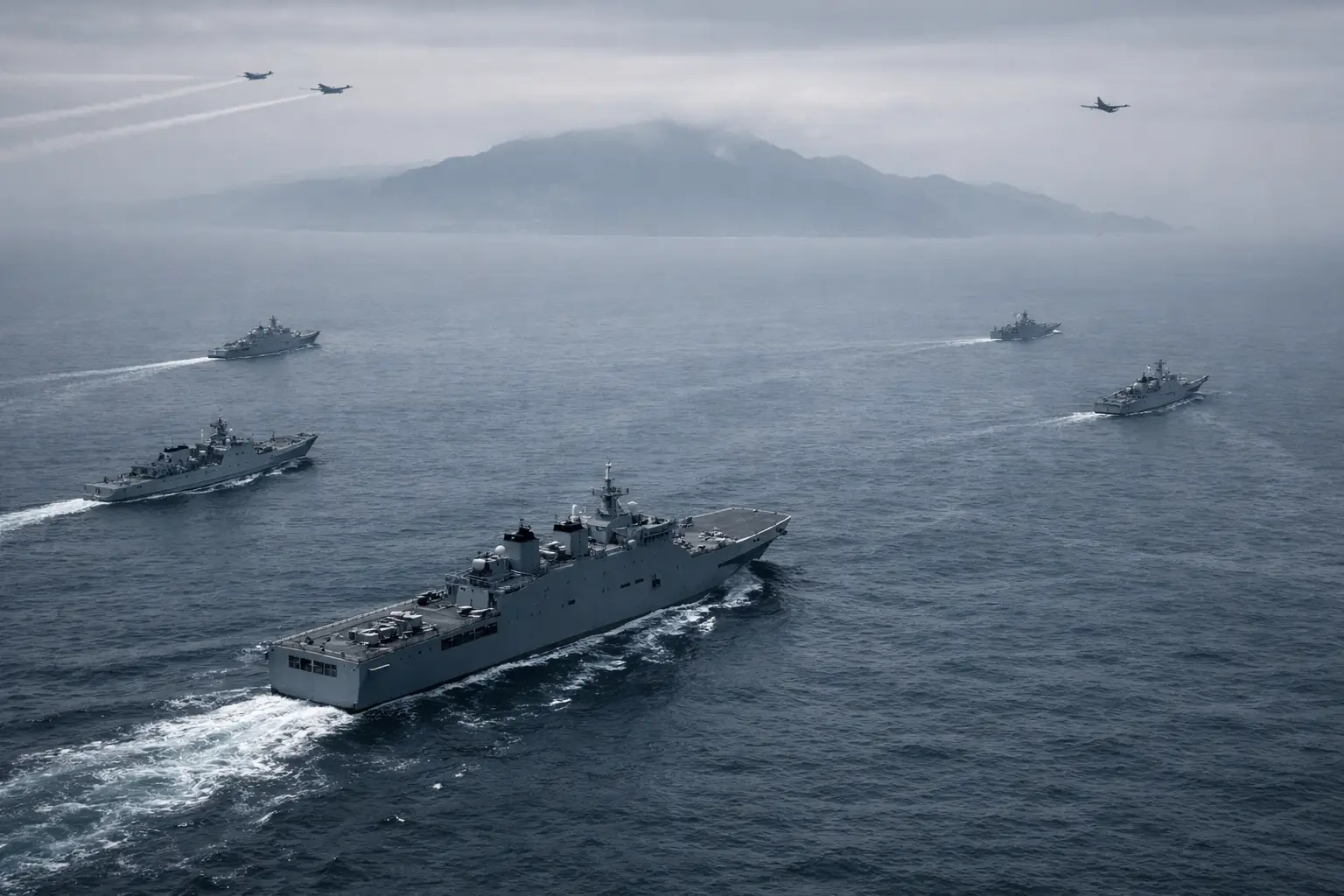
From December 29 to 31, 2025, the People’s Liberation Army of China (PLA) unannouncedly conducted military exercises Justice Mission 2025—the sixth maneuvers since 2022 aimed at practicing a scenario of total invasion of Taiwan and at the same time the largest among them.
Unlike the previous Joint Sword and Strait Thunder, the current exercises included a number of unprecedented tactical decisions.
In particular, the PRC significantly densified the encirclement chain, advancing much closer to the island of Taiwan; for the first time practiced a potential invasion simultaneously from three directions—from the East China Sea, South China Sea, and Philippine Sea; and also carried out a full-scale simulation of complete blocking of sea and air communications to the northern and southern ports of Taiwan.
Thus, this involves a new level of practicing an integrated blockade that combined live-fire exercises with modeling strikes on Taiwanese military infrastructure.
Simultaneously, the PRC Ministry of Foreign Affairs for the first time publicly declared that the goal of the anti-Taiwan exercises is not just “suppressing separatism,” but containing “external forces.”
Despite the absence of direct mentions, this statement was addressed to Japan and the United States, which in the second half of 2025 significantly increased diplomatic and military support for Taipei.
The new Chinese military provocation around Taiwan occurred in the context of Xi Jinping’s attempts to cement the geopolitical conjuncture, in which the PRC and its allies—primarily the Russian Federation and the DPRK—consistently raise the threshold of permissible escalation without the onset of direct strategic consequences.
Beijing has been systematically expanding both the scale and intensity of its anti-Taiwan maneuvers.
At the same time, it is “normalizing” broader escalation practices, including regular sea and air incursions into Japanese territory (often coordinated with the Russian military), testing long-range missiles with potential nuclear payloads in the Second Island Chain, and conducting unannounced large-scale exercises around Australia.
In aggregate, these actions demonstrate the PRC’s intent to consolidate military presence both in the north and south of the Pacific—and in parallel weaken the regional presence of the US.
The political logic of this strategy lies not so much in escalation as an end in itself, but in changing the negotiation framework with the United States.
By consistently “normalizing” provocative actions, Beijing deprives the White House of the ability to demand their cessation, forcing discussions on the scales, forms, and time limits of Chinese actions in the Indo-Pacific, rather than the PLA’s right to carry them out.
From Xi Jinping’s perspective, this is a way to impose on the United States a new security reality that they are forced to recognize in practice, even denying it at the level of rhetoric. In a narrower sense, the PRC is preparing for future negotiations with Donald Trump, scheduled for April 2026 in Beijing.
The ultimate goal of the Chinese strategy is to create favorable diplomatic conditions for an invasion of Taiwan. This assessment is supported by the Pentagon’s conclusions, sent to the U.S. Congress on December 23, 2025, in the Annual Report to Congress: Military and Security Developments Involving the People’s Republic of China 2025.
According to the report, the PLA is steadily advancing toward its declared objective of being able to defeat Taiwan in a war and achieve a “strategic advantage” over the U.S. by the end of 2027.
At the same time, the Department of Defense notes that multi-domain weakening of US positions—in both non-nuclear and nuclear potential—is viewed by Beijing as a guarantee of successful PLA advancement regarding Taiwan.
Despite the public acknowledgment of the growing threat to Taiwan, the Donald Trump administration does not view the Justice Mission 2025 exercises as a significant variable in the security conjuncture in East Asia or a push toward the start of real hostilities.
This is confirmed by the corresponding statement from the US President on December 29. Instead, it is focused on strategic aspects of containment, increasingly convinced that the PRC is unable to launch a full-scale invasion given the formation of dense defense interdependence along the First Island Chain.
Under such logic, the defining variable is not the totality of separate reactions to Chinese force projection, but the development of an integrated regional defense architecture that must multiply exceed the cost of a forceful scenario for Beijing.
It is in this context that at the end of December 2025, the White House announced readiness to sell weapons to Taiwan worth over $11 billion.
This involves a package of eight agreements covering 82 HIMARS launchers, 420 ATACMS missiles, over 2,600 Javelin and TOW anti-tank systems, strike drones, and logistical transport; it complements the autumn agreements on supplying components for modernizing Taiwanese F-16 fighters.
In aggregate, these steps are aimed both at disrupting possible PLA amphibious operations under the scenario of the Allied landing in Normandy in 1944, to which Russia is increasingly actively contributing—and at reducing the PRC’s potential during ground battles in deep sections of the island.
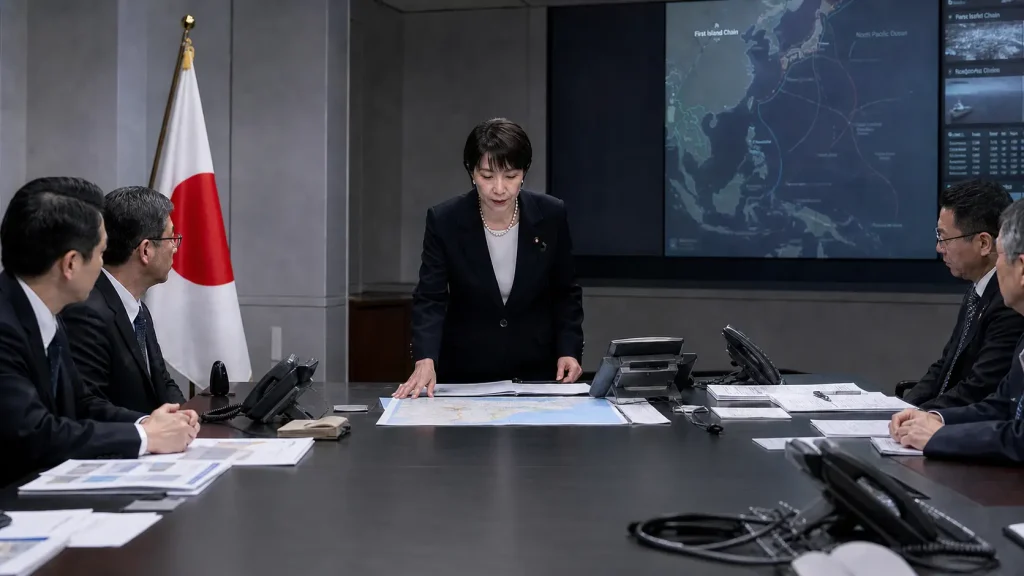
Simultaneously, the US continues to provide direct and indirect support to the Japanese government, which at the end of autumn 2025 for the first time publicly stated readiness to use Self-Defense Forces for potential protection of Taiwan in case of a PRC attack.
In particular, the White House welcomed the decision of Prime Minister Sanae Takaichi to increase defense spending to 2% of GDP starting April 1, 2026—that is, the beginning of the new fiscal year—including funding for American military infrastructure in Okinawa Prefecture.
At the same time, Donald Trump expects that during her tenure, Tokyo will announce further increases in defense spending to 3% of GDP—within their anti-Chinese consensus.
It is expected that this topic will feature in the next negotiations between Donald Trump and Sanae Takaichi, which are to take place from January to March 2026 in Washington.
Such dynamics are fundamentally unacceptable for Xi Jinping, who throughout 2025 failed to ensure the coming to power of pro-Chinese political forces in any of the East Asian democratic states.
Beijing’s particular concern is caused by the consolidation of power around Japan’s Prime Minister Sanae Takaichi—a political protégé of Shinzo Abe, who is now adapting his strategic doctrine in accordance with Taro Aso’s security views: the Vice President of the Liberal Democratic Party (LDP) and one of Japan’s key centers of influence.
It would be in Beijing’s interests for the unprecedented military-economic pressure on Tokyo, which intensified after Sanae Takaichi’s statement on readiness to defend Taiwan, to transform into a factor undermining her positions both within the LDP and among voters.
However, according to the results of a joint poll by Sankei Shimbun and FNN on December 21, the level of support for Prime Minister Takaichi’s government reached 75.9%—the highest indicator since she took office.
Notably, the maximum support for her tough anti-autocratic line is demonstrated by the 18-30 age group (up to 92.4%)—that is, Japan’s core mobilization and political potential.
Given that Sanae Takaichi and Taro Aso have systematically taken into account the domestic political factors that led to the erosion of Fumio Kishida’s and Shigeru Ishiba’s leadership, the current government has formed a stable model of retaining power in the medium-term perspective.
This essentially deprives the PRC of the ability to strategically weaken Japan’s defense potential through political methods and ultimately achieve Tokyo’s non-participation in countering an invasion of Taiwan.
The realization of such a configuration forced Xi Jinping to resort to using the Russian escalation “card,” directed directly against Sanae Takaichi’s government.
At the beginning of December 2025, the Kremlin publicly declared readiness to “cleanse” Japan of “manifestations of Nazism,” essentially reproducing the rhetoric that preceded the full-scale aggression against Ukraine.
Then on December 28—on the eve of the Justice Mission 2025 exercises—Russian Foreign Minister Sergey Lavrov stated Russia’s readiness to side with the PRC in case of a Chinese invasion of Taiwan; in addition, he emphasized that Japan must “carefully weigh” any further security decisions.
Although at the current stage this primarily involves a strategy of intimidating Japanese and Taiwanese societies, the scenario of Chinese-Russian complicity in a regional conflict has long been considered realistic by East Asian democracies.
In particular, since 2023, analytical centers affiliated with the defense ministries of Japan and Taiwan have proceeded from the assumption that the Russian Federation will provide the PRC with support during a war—from logistical support to participation in joint military operations.
Confirmation of such logic is served by increasingly frequent cases of exposing a Russian element in preparing PLA offensive operations, as well as the statement by Secretary General Mark Rutte on December 21, according to which the PRC may plan a simultaneous offensive in Europe and Asia with Russia’s assistance.
The United States takes this factor into account, operating on the belief that if it cannot counter Chinese influence on the Russian Federation, Beijing can use Russia as a tool for secondary escalation. This could include creating a military threat to Japan in the Sea of Okhotsk and coordinating Russian and DPRK actions against South Korea.
Accordingly, the White House aims to reach an “agreement” with Putin as soon as possible regarding the expulsion of the PRC from Russian jurisdiction, which, among other things, will include stopping the war in Ukraine on compromise terms.
At the same time, neither the US nor Japan demonstrates readiness for any strategic concessions on the issue of the security architecture of East Asia.
Against the backdrop of Chinese-Russian provocations, Japan’s LDP sent two delegations of high-ranking deputies to Taipei for negotiations with President Lai and the Taiwanese government, clearly signaling political continuity of support.
In parallel, the Donald Trump administration deepened Taiwan’s involvement in the implementation of the project to build the Luzon Economic Corridor—a strategic artery of the First Island Chain, implemented jointly by the governments of the US, Japan, Australia, and the Philippines.
In combination with record volumes of American arms sales to Taiwan, this indicates the absence of concern on the part of the White House regarding the risks of large-scale Chinese escalation in the short-term perspective.
From a deeper perspective, this involves a mirror tactic of strategic coercion, aimed at forcing the PRC to de facto recognize a new security reality in which Taiwan is under the direct protection of consolidated democratic alliances.
Under such conditions, the Justice Mission 2025 exercises are viewed by democratic allies not as a separate provocation, but as an element of the PRC’s systemic strategy of phased normalization of military escalation in the Indo-Pacific.
This involves a deliberate attempt by Beijing to change the very negotiation framework around Taiwan, depriving the United States of the ability to question the PLA’s right to project and apply force; that is, an intent to consolidate the PLA’s presence around Taiwan as a structural constant of regional security ahead of a potential large-scale escalation.
At the same time, the reaction of Washington and Tokyo shows that this logic is not producing the expected response.
Rather than pursuing symmetric escalation, the U.S. and Japan are focusing on raising the cost of any forceful action by the PRC through integrating defense capabilities, strengthening Japan’s security leadership, and accelerating Taiwan’s rearmament.
The key deterrent factor for Xi Jinping remains not a separate reaction to the exercises, but the stability of political regimes in the democratic states of East Asia.
The consolidation of power in Japan around Sanae Takaichi’s government, as well as the preservation of US-Japanese-Taiwanese coordination, essentially nullifies the PRC’s bet on domestic political erosion in the region.
This will prompt the PRC to fuel destructive processes within Taiwan itself, promoting new—openly pro-Chinese—leadership of the opposition Kuomintang.
In the end, Justice Mission 2025 rather outlines the limits of the PRC’s maneuver before the April negotiations with Donald Trump, rather than signaling its readiness for an immediate forceful scenario.
Despite the absence of a political breakthrough in the positions of key democratic actors and the inability to impose on the U.S. a negotiation framework advantageous for itself regarding Taiwan, the military parameters of the PRC’s strategy are consistently expanding—which is directly recorded in the Pentagon’s specialized report for December 2025.
Under these conditions, Beijing is betting on protracted strategic coercion, deliberately postponing the decision on full-scale escalation until the moment of systemic erosion of the regional defense architecture.
The Donald Trump administration at the same time realizes these intentions—and in 2026 will focus regional efforts on narrowing both the escalation and negotiation space for the PRC.