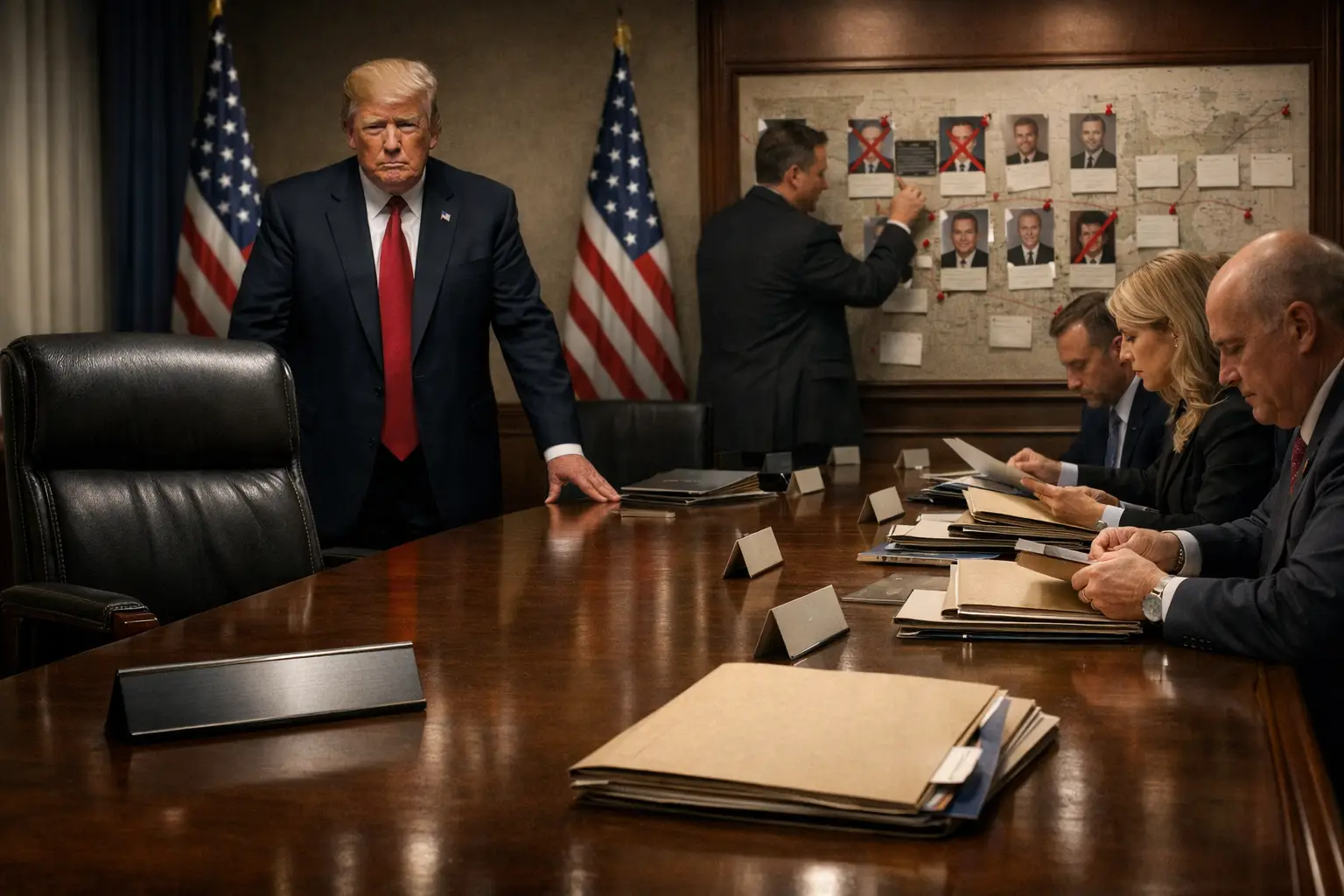
On March 5, 2026, in his social network Truth Social, Donald Trump announced the dismissal of Kristi Noem from the position of U.S. Secretary of Homeland Security and announced that the next head of this federal agency would be Republican Senator from Oklahoma Markwayne Mullin.
Noem will relinquish her powers on March 31, 2026, becoming the first dismissed member of the current Republican Cabinet. She will then take up the position of U.S. special envoy in the “Shield of the Americas” initiative—a coalition of Western Hemisphere states created to coordinate countermeasures against organized crime and drug cartels.
The tool for stabilizing the social conflict caused by the overreach of immigration agents and the inadequate response of DHS to law enforcement actions is the dismissal from the position of the head of the Department, whom the American public associated with the excessive use of force by agency employees.
On the day of the announcement of Noem’s resignation, Trump gave an interview to an ABC News journalist, during which the American President criticized conservative commentator and former Fox News host Tucker Carlson.
Donald Trump emphasized that Carlson, who the day before skeptically assessed the coordinated U.S.-Israeli attacks against Iran, is not a representative of the MAGA movement and has distanced himself from the party course laid out by Trump during the first year of his presidency.
The personnel decisions and public statements of the U.S. President at the beginning of March 2026 demonstrated that Trump’s team is consistently implementing a strategy of intraparty consolidation ahead of the midterm elections to Congress.
The results of these elections will test the integrity, effectiveness, and public support of the current administration’s political course.
According to the White House’s calculations, the stabilization of the entire domestic American political discourse must be preceded by the elimination of opposition movements within the Republican Party that position themselves as an alternative to the administration’s foreign policy course.
By distancing itself from key MAGA figures and changing their roles in the party, the administration prevents any intraparty group from opposing White House policies. This also lowers electoral risks for Republicans, which have grown during the first year of Trump’s term.
According to averaged data from the aggregator RealClear Polling, from January 2025 to March 2026, the President’s approval rating decreased from 50.5% to 43.4%.
More than 54% of voters have a negative attitude toward the Republican Party, which gives Democrats an advantage in the upcoming congressional elections.
Democratic candidates are ready to be supported by 47% of American respondents, while politicians running from the Republican Party are planned to be voted for by 42.6% of voters. The main reason for the decline in the President’s and his administration’s ratings remains socio-economic problems in the USA.
However, citizens’ critical attitude toward the administration and other Republican politicians has been fueled by dissatisfaction with the White House’s immigration policy. This policy was implemented by Kristi Noem.
The killings by immigration agents of community activists and the overreach by ICE law enforcement officers during raids aimed at detecting and deporting migrants have significantly increased Noem’s unpopularity.
According to a Daily Mail/JL Partners poll conducted at the end of January 2026, only a third of Americans approved of the work of the head of the Department of Homeland Security (DHS), while 46% emphasized the need for her dismissal from the position.
A January 2026 AP-NORC study found that 61% of Americans do not support the Republican administration’s immigration measures, and 42% of voters, according to a CNN/SSRS poll, believe that the situation with security and law and order in U.S. cities has worsened during the first year of Trump’s term.
Taking into account voters’ dissatisfaction with the administration’s immigration policy, Democrats in Congress applied simultaneous personnel and financial pressure on the White House.
In mid-January 2026, the Democratic faction in the House of Representatives introduced a resolution to impeach the head of DHS—a document that by the end of the month was supported by 140 congressmen.
Although Democratic senators approved appropriations for most ministries, preventing a long-term federal shutdown and allowing the Departments of Defense, Labor, Health and Human Services, Education, and Housing and Urban Development to resume work, Democrats blocked funding for DHS.
As a result, the Department of Homeland Security has been in shutdown mode since February 14, 2026.
In order to achieve agreement on funding for the Department, Republicans made a series of concessions to Democrats, agreeing to equip ICE officers with body cameras, strengthen oversight mechanisms over law enforcement activities, and reduce funding for deportation measures by $115 million.
However, the leadership of the Democratic faction in the Senate continued to block the allocation of funds to DHS—thus, during the March 5, 2026, session, an absolute majority of Democrats again refused to support funding for the Department of Homeland Security.
The start of the U.S.-Israeli operation against the ayatollah regime and the subsequent military-political escalation in the Middle East make it impossible to continue the shutdown of one of the key federal bodies of the USA.
Despite the fact that the law passed in 2025 called “One Big Beautiful Bill” provided for the allocation of about $165 billion to DHS, employees of a number of institutions and offices within the Department will not receive salaries during the shutdown.
During previous shutdowns, DHS faced a rapid increase in the number of resignations, and the reduction in agency staff caused delays in checks at airport checkpoints and the curtailment of a number of functions of the Federal Emergency Management Agency (FEMA).
The need to stabilize DHS activities amid escalating foreign policy challenges, significant social discontent, and a high level of public polarization prompted Trump’s team to announce Kristi Noem’s resignation.
The change in DHS leadership was presented as a politically significant concession to Democrats, designed to activate bipartisan negotiations on agreeing the agency’s budget for the 2026 fiscal year.
At the same time, transferring Noem to the less public position of special envoy eliminated a factor that systematically exacerbated reputational risks for the Republican team.
An additional factor that contributed to the decision to dismiss Kristi Noem was her statement during congressional hearings that Donald Trump personally approved an advertising campaign aimed at highlighting DHS immigration policy.
The White House publicly denied supporting the Ministry’s $220 million media project funded by public funds. Meanwhile, Noem’s rhetoric began to be seen within the administration as putting Republicans in a vulnerable position and complicating the promotion of the President’s political agenda to the public and party donors.
While Noem’s resignation demonstrated the White House’s desire to partially adjust the migration course to preserve domestic political stability, the President’s public condemnation of Tucker Carlson aims to consolidate control over intraparty discourse.
The first factor that prompted the presidential administration to increase pressure on MAGA speakers disloyal to the White House was the systematic attempts by the conservative part of the MAGA movement to form autonomous ideological and political positions independent of the White House.
After the start of the U.S.-Israeli operation against the Iranian ayatollah regime, Tucker Carlson, Marjorie Taylor Greene, Alex Jones, Nick Fuentes, and a number of other conservative opinion leaders criticized this foreign policy move by the White House.
The rhetoric of right‑conservative speakers about military actions in Iran reflected the continuation of the previously established isolationist stance of many MAGA figures.
This position repeatedly caused conflicts between the White House and the most conservative groups of Republicans during the first year of Trump’s presidency.
Steve Bannon, Laura Loomer, Marjorie Taylor Greene, as well as conservative Senator Rand Paul, systematically condemned the deployment of U.S. troops in the Caribbean Sea in the fall of 2025.
Despite the successful conduct of the operation in Venezuela, which resulted in the arrest and removal to the USA of Nicolás Maduro, Greene condemned the operation against Venezuela and called on the presidential administration to instead focus on the internal priorities of the United States.
The isolationist position of MAGA speakers is reinforced by the skeptical attitude of most Americans toward the American operation against the ayatollah regime.
According to a Marist poll, 56% of Americans do not approve of U.S. involvement in military actions in the Middle East. At the same time, 84% of Americans consider Iran a threat to the national security of the United States, which significantly changes the public perception of MAGA movement’s criticism of the White House.
Public denial of the expediency of military actions against a regime whose existence most Americans perceive as a direct security challenge positions MAGA isolationists as a force that places ideological principles above the national interests of the country.
The White House’s distancing from the isolationist group of Republicans at the moment of escalation of geopolitical confrontation becomes advantageous for Trump’s team also in view of the change in the President’s political role during wartime.
The leader of a state conducting a military operation against external adversaries receives additional public credit of trust, and unequivocal and destructive criticism of his foreign policy decisions is perceived by society as one that weakens the country’s position in confrontation with an external enemy.
Isolationist ideas, which call for the USA to abandon the tactic of “coercive diplomacy” toward autocracies allied with the PRC, have become irrelevant.
The White House now acts systematically ahead of China’s plan for comprehensive pressure on the USA and consistently works to eliminate the PRC’s footholds in Latin America and the Middle East.
The emergence of an organized group of Republicans opposing the White House’s policy of intensified pressure on the “external contour” of the authoritarian axis creates conditions for intraparty fragmentation.
This fragmentation will limit the effectiveness of the White House and Congress and weaken the consolidation of the Republican electorate.
Despite the vulnerability of criticism of the administration’s foreign policy course, the views of the MAGA movement opposing the White House’s strategy also extend to the administration’s domestic initiatives.
The most conservative groups of Republicans criticized the rise in inflation levels throughout 2025, and also expressed their unfavorable attitude toward the H-1B visa program, support for which the President publicly confirmed in November 2025.
The totality of these discrepancies gradually transformed MAGA speakers critically attuned to the Republican administration into a separate intraparty faction, an attempt at ideological formalization of which was made by Marjorie Taylor Greene, who proposed a new political concept “America First America Only.”
While conducting military actions against Iran strengthens the consensus of Republican voters regarding the presidential course, public criticism by Carlson, Greene, and other MAGA figures of the administration’s domestic initiatives narrows the electoral base of the Republican Party and reduces support for the President in society.
MAGA isolationists are carrying out a comprehensive discreditation of the presidential strategy, thereby increasing the USA’s vulnerability to internal conflicts.
To prevent such risks during the active phase of the operation against Iran, the Trump administration is narrowing the influence of MAGA isolationists and minimizing their role in politics through public distancing. It is also reorienting party discourse to priorities that align with the White House’s foreign policy course.
Another factor that conditioned the criticism of Carlson and opinion leaders in solidarity with him was the reduction in Republican voters’ loyalty to the MAGA movement—the number of Republicans identifying with MAGA decreased from 57% in April 2025 to 50% in December of the same year.
The narrowing of the MAGA movement’s electoral base reduced its value for the administration, in view of which Trump’s team no longer considers it expedient to maintain the previous level of influence of the most conservative groups in the Republican environment.
The personnel and political decisions of the Trump administration at the beginning of March 2026 form the foundations for the internal unity of the Republican Party, which in the further perspective should become the basis for the consolidation of the majority of American society.
The formation of internal consensus among U.S. political elites, economic influence groups, and the public becomes a key indicator of Washington’s ability to counter the axis of autocracies.
It also shows the country’s capacity to outpace the PRC’s foreign policy calculations and conduct further geopolitical confrontation on terms set by the White House.
Noem’s dismissal and the public condemnation of Carlson were implemented synchronously—and both steps are inscribed in one time horizon.
The midterm elections to Congress will be the first electoral test of whether this consolidation converts into a political result: whether American society perceives the wartime President as a leader worthy of an extended mandate of trust.