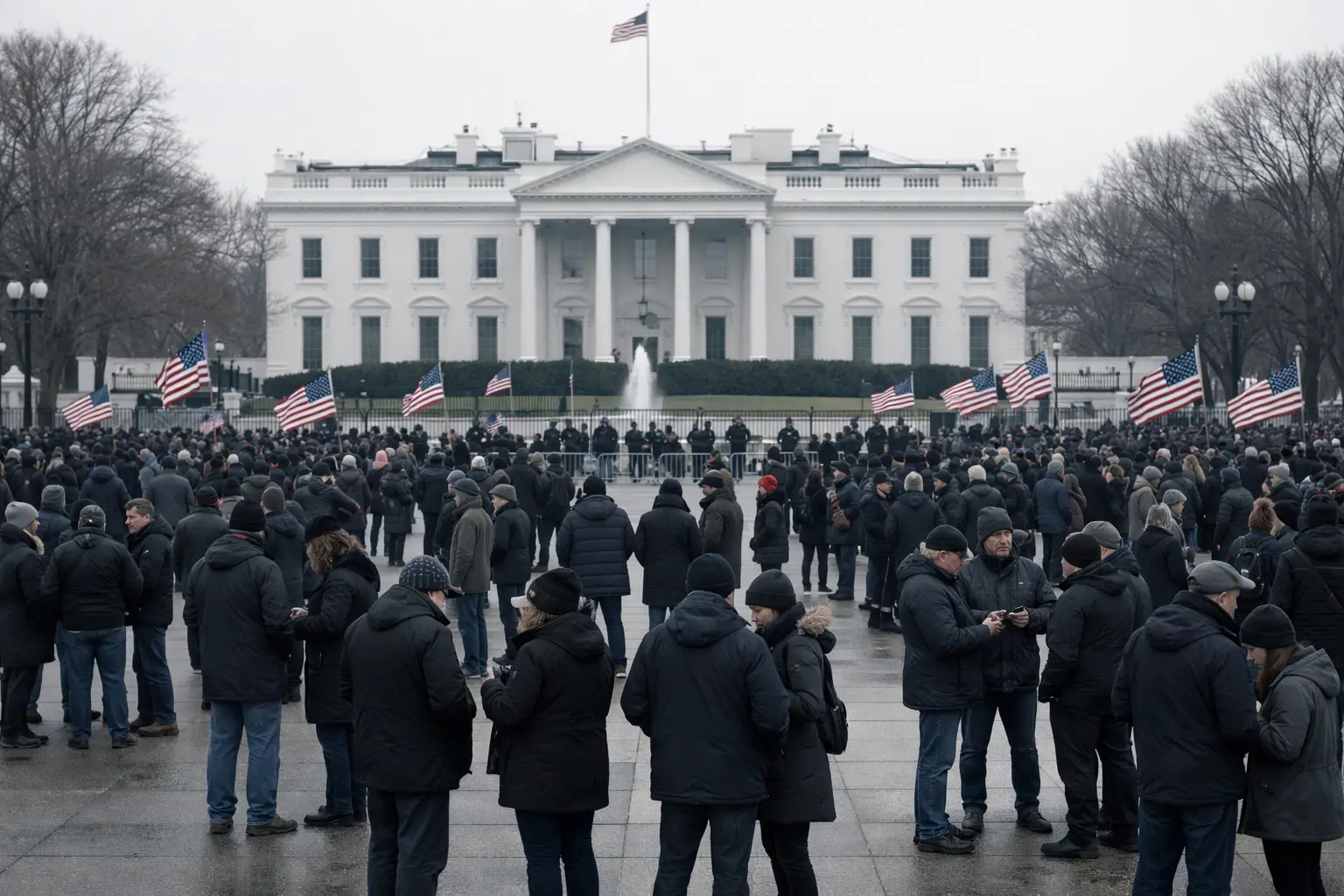
On January 10-11, 2026, a wave of mass demonstrations under the name “ICE Out For Good” took place in the United States—over 1,000 protest actions were organized across the country, including in the District of Columbia, where participants gathered in front of the White House.
The trigger for the activation of protests directed against the activities of the U.S. Immigration and Customs Enforcement (ICE) was the killing of a woman in Minneapolis and two migrants in Portland by immigration agents, which occurred on January 7-8, 2026.
Additional public outrage was caused by the Republican administration’s reaction to these events. The White House rejected accusations of excessive use of force by law enforcement, attempting to portray the shooting as justified actions by federal institutions to protect the country from internal destabilization.
Commenting on the situation in Minneapolis, Donald Trump stated that the ICE officer shot the woman in self-defense, and Secretary of Homeland Security Kristi Noem accused the deceased of attempting to run over law enforcement officers with her car and called the incident an “act of domestic terrorism” committed against ICE officers.
A similar position was expressed by Vice President JD Vance, who assessed the clash between law enforcement and the woman as a tragedy caused by the actions of the deceased, and also assured ICE officers of the administration’s support for their actions.
The dissatisfaction of the American public with the deployment of ICE law enforcement in an increasing number of American cities, their exceeding of authority, and the reaction of government officials to the actions of law enforcement agencies turned the protest into a nationwide non-partisan movement.
Citizens with different political views and social backgrounds joined the protests, and the unifying factor for the demonstration participants was distrust of the methods used and approved by the White House to ensure internal security.
At the same time, the wave of citizen outrage, triggered by the actions and statements of the Republican administration, became a political window of opportunity for progressive groups in the Democratic Party.
On one hand, they expect to transform decentralized actions against law enforcement violence into a trend with specific political leaders, who will become the leaders of the progressives.
On the other hand, through further coordination of anti-government activity and the formation of a unified protest movement, progressives intend to infiltrate their own political slogans into it, supplementing citizens’ demands for law enforcement to adhere to the limits of force application with a broader ideological agenda.
According to the plan of progressive grassroots organizations, which have already joined the coordination of protests, in the future, the current public demands should be joined by calls to cancel immigration raids by American security forces, stop the deployment of the National Guard in Democratic megacities, as well as rhetoric condemning Israel’s actions in Gaza and the US in Venezuela.
Even before the activation of the “ICE Out For Good” protests, progressive politicians attempted to position themselves as representatives and spokespeople for public outrage over law enforcement actions, thereby signaling their intention to formulate protest demands and speak on behalf of its participants.
On the day of the shooting in Minneapolis, member of the progressive “Squad” group in Congress Ilhan Omar condemned ICE’s actions and characterized the incident as “state violence.”
During the activation of protests, Congresswoman Alexandria Ocasio-Cortez and Rashida Tlaib joined in sharp criticism of immigration police, expressing demands for the disbandment of ICE.
Their faction colleague Pramila Jayapal supported public resistance, and Senator Bernie Sanders called on protest participants to stop the activities of these law enforcement officers as soon as possible.
Statements by leaders of the progressive political establishment are accompanied by active involvement in protest funding from donor structures affiliated with George Soros and the Council on American-Islamic Relations (CAIR).
These funds and non-profit organizations consistently support grassroots initiatives of progressives, democratic socialists, and immigrant movements aimed against the activities of the current administration.
In particular, they funded organizations that coordinated and provided technical support for the “No Kings” protests in June and October 2025.
After the shooting in Minneapolis, public movements that coordinated pro-Palestinian protests, actions in support of migrants after the start of Trump’s term, as well as events condemning the US operation in Venezuela, consolidated and took over the organizational management of the “ICE Out For Good” campaign.
A central role in this coalition is played by the organization Indivisible, which emerged in 2016 to coordinate progressive campaigns and actions aimed at countering the initiatives of the first Trump administration.
Every year since its founding, the “Open Society” foundations, founded by George Soros and currently headed by his son Alex, have funded Indivisible.
In 2023 alone, “Open Society” provided the mentioned organization with a grant of $3 million, and cumulatively for the period 2018-2023, Indivisible received $7.85 million from the network affiliated with the Soros family.
The co-founders and executive directors of Indivisible are Ezra Levin and his wife Leah Greenberg, who have personal contacts with politicians from the Democratic Party and indirect ties to George Soros.
Both heads of Indivisible worked in the offices of Democratic congressmen, and Greenberg in 2017 held the position of director of political affairs in the team of Tom Perriello, who ran for governor of Virginia that same year.
A year after his defeat in the primaries, Perriello became the executive director of the Open Society Foundation and held this position until July 2023.
Having become one of the main coordinators of the “ICE Out For Good” company, Indivisible has effectively turned into an intermediary between the “Open Society” funds and the coalition coordinating the current protest campaign.
Another leader of the mass actions was the Council on American-Islamic Relations (CAIR), whose executive director of the Minnesota chapter, Jaylani Hussein, organized protest rallies in Minneapolis directed against ICE.
Before the activation of mass actions in January 2026, CAIR’s activities were primarily focused on financial, political, and legal support for pro-Palestinian protesters.
As a result of 2023, the organization’s revenues amounted to $17.4 million, while CAIR’s total expenditures for the mentioned year were $15.2 million.
External financial contributions, which constitute the absolute majority of CAIR’s revenues, the organization receives primarily from progressive charitable foundations and public organizations, as well as from funds whose source of material support is the Muslim Brotherhood and the State of Qatar.
One of the main founders of CAIR was the non-profit organization Tides Foundation, which also allocated funds to the coordinators of the “No Kings” protests.
In parallel, Tides was involved in funding the main coordinators of anti-Israeli protests on US university campuses, allocating funds to activist groups “Jewish Voice for Peace,” “IfNotNow,” “Code Pink,” and the Westchester Peace Action Committee, which in turn supported non-profit structures called “American Muslims for Palestine” and “Students for Justice in Palestine.”
After the decrease in intensity of pro-Palestinian actions, the activist structures involved in their organization and funding did not cease their public activity. Donor support from the Tides Foundation and organizations affiliated with it allowed for the activation of new campaigns opposing the White House.
At the end of 2025, Code Pink became one of the key coordinators of protests against US policy in Venezuela, and together with other progressive movements, joined the organization of mass actions in at least 65 US localities.
Tides Foundation is part of a broader network of organizations Tides Network, which also includes Tides Advocacy—an organization that allocated a $350,000 grant to Indivisible.
Tides’ ability to support protests directed against the Trump administration’s policies directly and through its affiliated network of non-profit organizations is ensured in particular by regular funding from “Open Society.” During 2020-2023, Tides Network received at least $43.6 million from funds managed by the Soros family.
The actions of the network of grassroots groups, which have political support from progressive politicians and receive stable funding from organizations affiliated with “Open Society,” are one of the ways to increase socio-political tension and polarization of the American public, which directly affects the level of support for the Republican team ahead of the 2026 elections.
Political and socio-economic dissatisfaction of the electorate is increasingly directed against the current administration and personally Donald Trump.
The foreign policy achievements of the administration, including the operation to arrest Nicolás Maduro, do not lead to a significant recovery in the level of support for the White House.
According to averaged RealClearPolling indicators, over the past few months, the approval rating of the President’s activities fluctuates at 42-44% and has no prospects for returning to the levels Trump had at the beginning of his term.
A series of local and special elections that took place during the fall of 2025 in a number of states demonstrated to the presidential team the political risks of strengthening grassroots networks capable of supporting protest activity and quickly launching new mass campaigns.
Ahead of the 2026 midterm elections, the key threat from the functioning of such organizations lies in their ability to accelerate the reduction of the Republican Party’s electoral resources.
For moderate voters, such protests regularly recreate a negative image of the White House and present Republicans as a force incapable of reaching compromise with political opponents and ensuring processes of de-escalation of tension in society.
On the other hand, the conservative electorate perceives mass street actions as the White House’s inability to establish control over internal stability, which demotivates part of the Republicans to support Trump’s team.
Such political risks prompted the presidential administration to launch a series of measures aimed at limiting financial support for the progressive movement and reducing the influence of structures associated with the Soros family on grassroots organizations.
Since 2025, federal agencies have intensified inspections of non-profit organizations that receive funding from “Open Society” funds and initiated a review of tax benefits for grant programs.
The White House’s efforts led to progressive non-profit organizations losing over 22,000 employees in the first half of 2025, and further pressure from the administration creates risks of opening criminal proceedings against the leadership of non-profit structures and grassroots protest participants.
At the same time, actions by Republican congressmen, including accusations against platforms for collecting donations for the Democratic Party’s electoral needs of receiving contributions of opaque origin and organizing investigations into their activities in the Capitol, create reputational and legal risks for other Democratic donors.
Decisions by the Department of Homeland Security aimed at restricting the activities of CAIR and other pro-Palestinian activist groups have led to the suspension of federal grants for Muslim non-profit organizations, which have come under scrutiny by the administration.
The campaign to complicate the activities of protest networks was intended to demonstrate to voters that the White House controls internal stability, as well as to position Donald Trump as a guarantor of order, public safety, and managerial decisiveness.
However, several waves of activation of mass anti-government actions during the end of 2025 and the beginning of 2026 demonstrated the ability of activist structures and their sponsors to operate despite administrative pressure.
The insufficient effectiveness of attempts to limit the activities of grassroots organizations contributes to the pre-election strategy of the Democratic Party, and primarily its progressive faction.
As the 2026 electoral campaign approaches, most public opinion polls record a general advantage of the Democratic Party over Republicans in the elections to the Senate and House of Representatives.
Indicators from the RealClear Polling aggregator show that since November 2025, Democrats have consistently led Republicans by 3-5%.
The gradual increase in Democratic Party ratings after the defeat in the 2024 elections forms among Democratic political elites and party donors an incentive not to allow the recovery of support for the presidential team during 2026.
One of the means to achieve such a goal was the protest campaign against ICE. Progressive groups, which resorted to public support for actions and infiltrating their political slogans into the non-partisan movement against law enforcement actions, expect to convert public dissatisfaction with security forces into gradual voter disillusionment with the White House’s political agenda.
The task of demotivating voters is gradually being achieved—thus, assessments by Donald Trump and other officials of the Republican administration of ICE officers’ actions did not demonstrate the government reaction that society expected, and therefore could not stabilize public sentiments.
The White House’s inability to avoid another wave of political polarization became for progressive factions confirmation of the correctness of the strategy they chose, aimed at preventing the growth of public support for Trump’s team during the pre-election year.
In the conditions of a new wave of protests in the US, financial donors of activist structures, primarily the Soros network, together with representatives of progressive groups in the Democratic Party, receive favorable conditions for expanding political influence.
Their key goal is to transform the current protest activity into a tool for political and electoral motivation of the population dissatisfied with White House policy during the 2026 midterm elections.
The victory of progressive candidates in the mayoral elections in New York and Seattle, the increase in Alexandria Ocasio-Cortez’s ratings as a potential Democratic Party nominee in the 2028 presidential campaign, as well as attempts to use political crises to increase their electoral base laid the foundation for further growth of progressive influence in the Democratic Party.
These political changes, according to the calculations of the network of donors led by the Soros family and progressive political groups, should ensure the success of the Democratic Party in the 2026 midterm elections and at the same time increase the role of the progressive faction in shaping the nationwide political agenda.