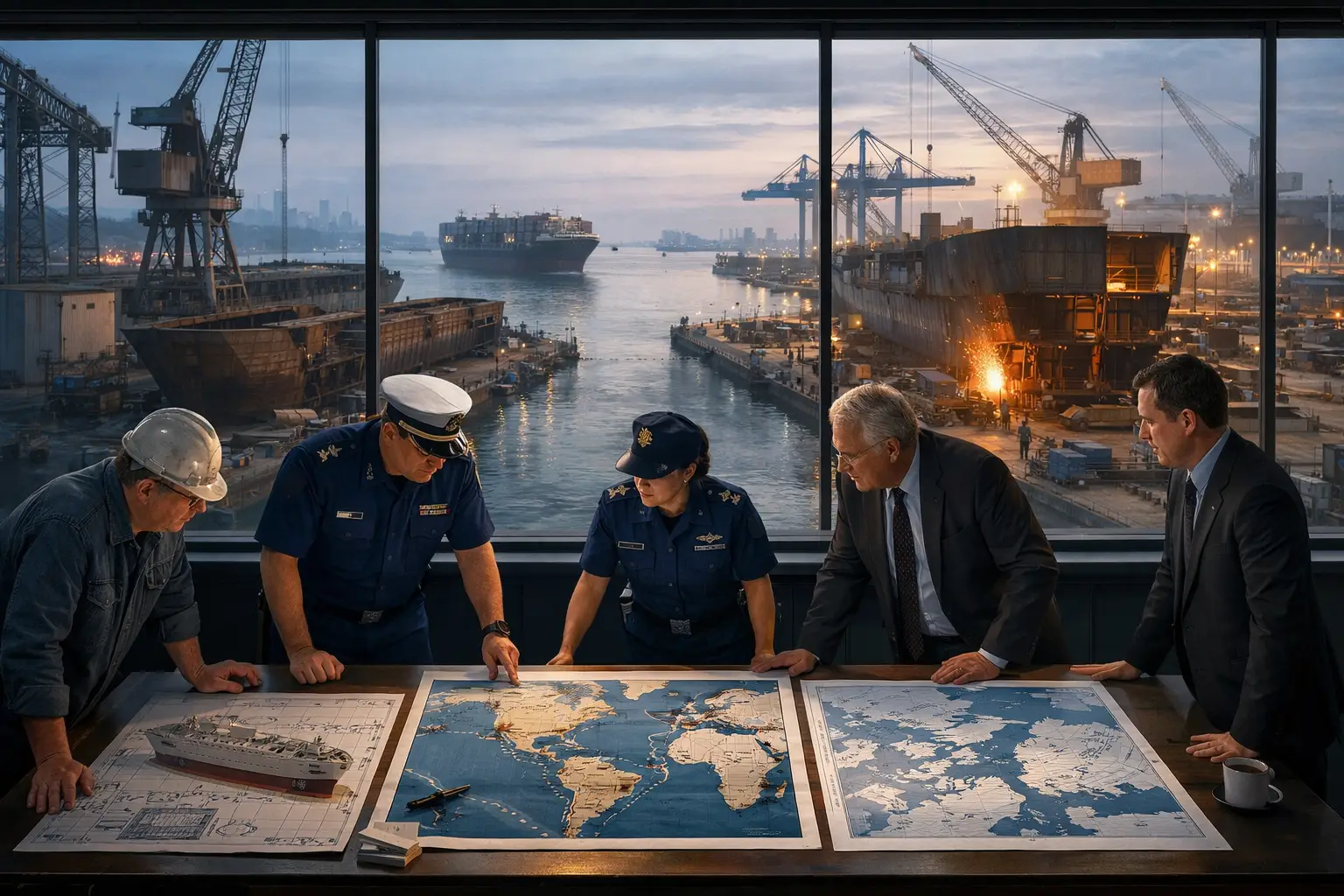
On February 13, 2026, the Trump administration released a plan to revive U.S. shipbuilding and other maritime enterprises, funded by port fees on cargo delivered to the United States on Chinese-built vessels.
The Maritime Action Plan offers a roadmap for reviving U.S. shipbuilding, which has declined since World War II and now significantly lags behind China and other countries, such as Japan and South Korea.
By its function, this plan goes beyond industrial policy. Washington acknowledges that Beijing has concentrated control over three critical links in global logistics simultaneously: ship production, port infrastructure management, and operational access to key transit routes.
This configuration allows China, in the event of escalation, to limit the throughput capacity of trade corridors for competitors without the use of military force.
The Trump Maritime Plan is aimed at dismantling this dependence in three directions: reviving domestic shipbuilding, displacing Chinese operators from ports in the Western Hemisphere, and forming an autonomous icebreaker fleet to control Arctic routes.
The decline in the U.S. share of global shipbuilding to 0.13%, with China’s dominance at over 50% of world production, has formed a structural dependence of American maritime logistics on the Chinese industrial base.
Currently, fewer than 200 ocean-going commercial vessels operate under the U.S. flag, while over 80% of imports and exports are transported by foreign fleets, a significant portion of which are built in China or controlled by Chinese operators.
This creates a direct vulnerability scenario: in the event of conflict or sanctions escalation, Chinese shipping companies could limit U.S. access to vessels, raise tariffs, or change routes, which could disrupt supplies of energy carriers, industrial components, and critical minerals to the U.S. within a few weeks.
Therefore, Washington is acting simultaneously in two directions: reviving its own shipbuilding and dismantling Chinese positions in port infrastructure in the Western Hemisphere.
Panama’s decision to revoke the rights of Hong Kong’s CK Hutchison to manage the canal’s ports, adopted on February 13, 2026, after a series of negotiations with the United States, became a direct blow to Chinese presence in the transport corridor that provides transit between the Atlantic and Pacific Oceans.
The contract, which had been in effect for over two decades for CK Hutchison, allowed the Hong Kong operator to control the key terminals of Balboa and Cristobal, through which about 40% of the canal’s container transit passes.
This decision meant for the U.S. the dismantling of one of China’s most important logistical bridgeheads in the Western Hemisphere, as control over the canal’s ports created the possibility to influence the speed, priority, and conditions of cargo passage in this territory.
The loss of these assets deprives Beijing of a tool to control a key artery of world trade, through which about 5% of global maritime turnover passes.
Panama is not the only strategic bridgehead that Washington is trying to secure. In South America, China has already established its own logistical network linked to resource extraction: through the Port of Chancay in Peru, opened in November 2024, COSCO Shipping provides a direct route for exporting Peruvian copper and Chilean lithium to Asia, bypassing traditional U.S.-controlled nodes.
In response, the U.S. approved a $1.5 billion package to relocate the Peruvian naval base and expand the Port of Callao near the PRC port, creating an alternative maritime infrastructure center under its own strategic influence.
This decision forms a balancing node that limits the monopolization of regional shipments by Chinese ports and ensures U.S. presence in a key Pacific Ocean trade corridor.
Behind these individual cases lies a single model: Beijing, through state-owned companies—COSCO, China Merchants Port, Hutchison—controls or operates over 100 ports in more than 60 countries.
This network is created as commercial, but if necessary, its infrastructure can support naval operations—as is already happening at the base in Djibouti, built next to a Chinese commercial terminal.
Control over ports allows determining the conditions of access to transport routes and creating logistical restrictions for competitors in the event of conflict.
Displacing Chinese operators from ports is only one part of the strategy. The second is creating a fleet that will replace Chinese vessels on these routes.
For this, Washington uses port fees from Chinese-built vessels as a tool for direct funding of industry revival, forming about $3.2 billion in annual revenues for the Maritime Security Trust Fund, which creates an autonomous source for modernizing shipyards and expanding production capacities without increasing the budget deficit.
This decision forms a closed cycle of resource redistribution, within which the use of Chinese vessels generates funding for creating their American replacements, gradually changing the balance of control over logistical infrastructure.
In the event of conflict, the ability to rely on its own fleet will determine the U.S. capability to maintain exports of oil, liquefied gas, and agricultural products, which account for approximately 25% of all exports.
New vessels are needed not exclusively for existing trade routes. The sharpest deficit is in the Arctic, where the reduction of ice cover opens routes that can shorten transportation time between Europe and Asia by 30–40%.
But without an icebreaker fleet, the U.S. physically cannot be present there—and this vacuum is already being filled by Russia and China. Control over these routes allows determining the conditions for transit of energy carriers, critical minerals, and strategic raw materials, which directly affect the structure of global trade.
Russia already controls the world’s largest icebreaker fleet, which allows it to regulate traffic on the Northern Sea Route and create an advantage in access to new transport corridors.
This creates a situation in which American carriers within sanctions restrictions may face limitations or additional costs, which will affect their competitiveness in global trade.
In this configuration, Finland occupies a key place—cooperation with Finnish shipyards is used as a tool to revive competencies that the U.S. lost after reducing the shipbuilding base from over 300 shipyards in the 1980s to fewer than 20 active large enterprises today, which has sharply limited the ability to quickly build a specialized fleet.
In 2024 and 2026, the U.S. Coast Guard signed contracts totaling over $6 billion, including under the Arctic Security Cutter program, to build new icebreakers using Finnish engineering solutions.
The agreements also involve transferring technologies to American shipyards, including Bollinger Shipyards in Louisiana, where a production base for the serial construction of these vessels is being established.
This means a transition from a model of importing ready-made platforms to creating a domestic production cycle that allows building icebreakers, tankers, and transport vessels without external dependence.
Finland’s role is determined by its actual control over a critical technological niche: Finnish shipyards, including Helsinki Shipyard and Meyer Turku, have designed or built about 70% of the world’s icebreaker fleet.
These technologies allow shortening the cycle of creating an American icebreaker fleet from 15–20 years to approximately 5–7 years, which radically changes the time horizon of American presence in the Arctic.
For the U.S., this means the ability to ensure constant navigation in a region where, according to US Geological Survey estimates, about 13% of the world’s undiscovered oil reserves and 30% of natural gas are concentrated, access to which is determined by the physical presence of a fleet.
For comparison, today the U.S. has only two functional heavy icebreakers—Polar Star (commissioned in 1976) and Healy (commissioned in 1999), while Russia operates over 40 icebreakers, including nuclear vessels of the Arktika class.
This asymmetry means that in the event of conflict or route blockade, the U.S. is physically unable to provide escort for its own tankers and transport vessels, creating a risk of losing access to new energy routes and resources.
The introduction of new American icebreakers changes this configuration, creating the ability to guarantee the transportation of energy resources from Alaska, Greenland, and Arctic shelves even in the event of geopolitical escalation, when access to routes may be restricted by competitors.
Reviving shipbuilding, displacing Chinese operators from ports, and building an icebreaker fleet form a single system designed to deprive Beijing of the ability to use maritime logistics as a tool of pressure.
But risks remain: American shipyards have not built large commercial vessels for decades, and the shortage of qualified welders and engineers is estimated in the tens of thousands.
Meanwhile, China is already responding by ramping up orders at its own shipyards and offering partners in Southeast Asia and Africa preferential terms for port construction.
The Trump administration’s Maritime Plan acknowledges a structural problem that Washington ignored for three decades: while the U.S. reduced civilian shipbuilding, Beijing concentrated control over ship production, port operations, and transit routes into a single chain.
Port fees from Chinese-built vessels, contracts with Finnish shipyards for icebreaker construction, and efforts to displace Chinese operators from the Panama Canal—each of these Washington initiatives targets a different aspect of dependence on Chinese maritime infrastructure.
However, reviving the U.S. shipbuilding base takes decades, while China’s advantage continues to grow each year. This gap between the scale of the challenge and the pace of response remains the primary vulnerability of the Trump administration’s plans.