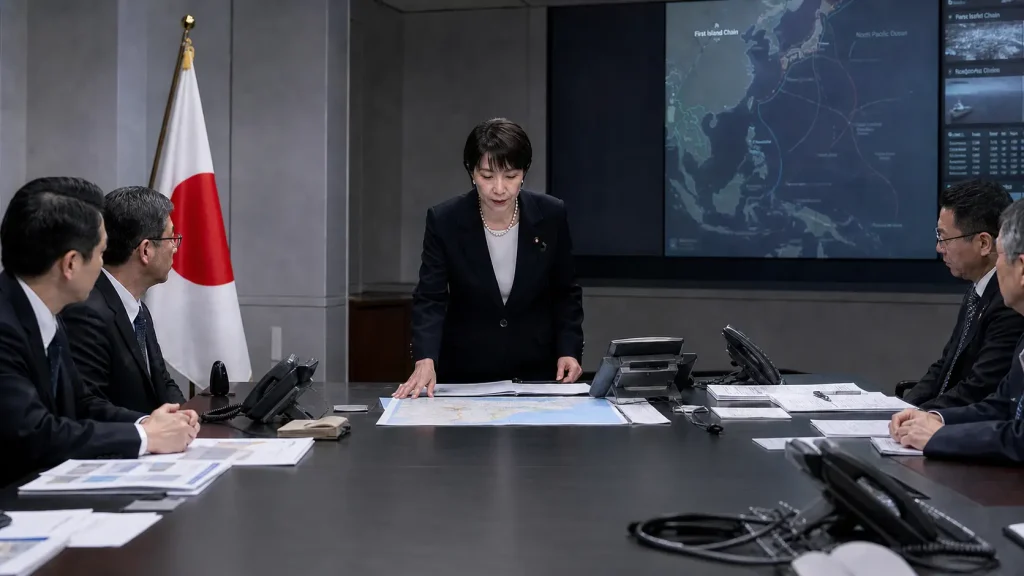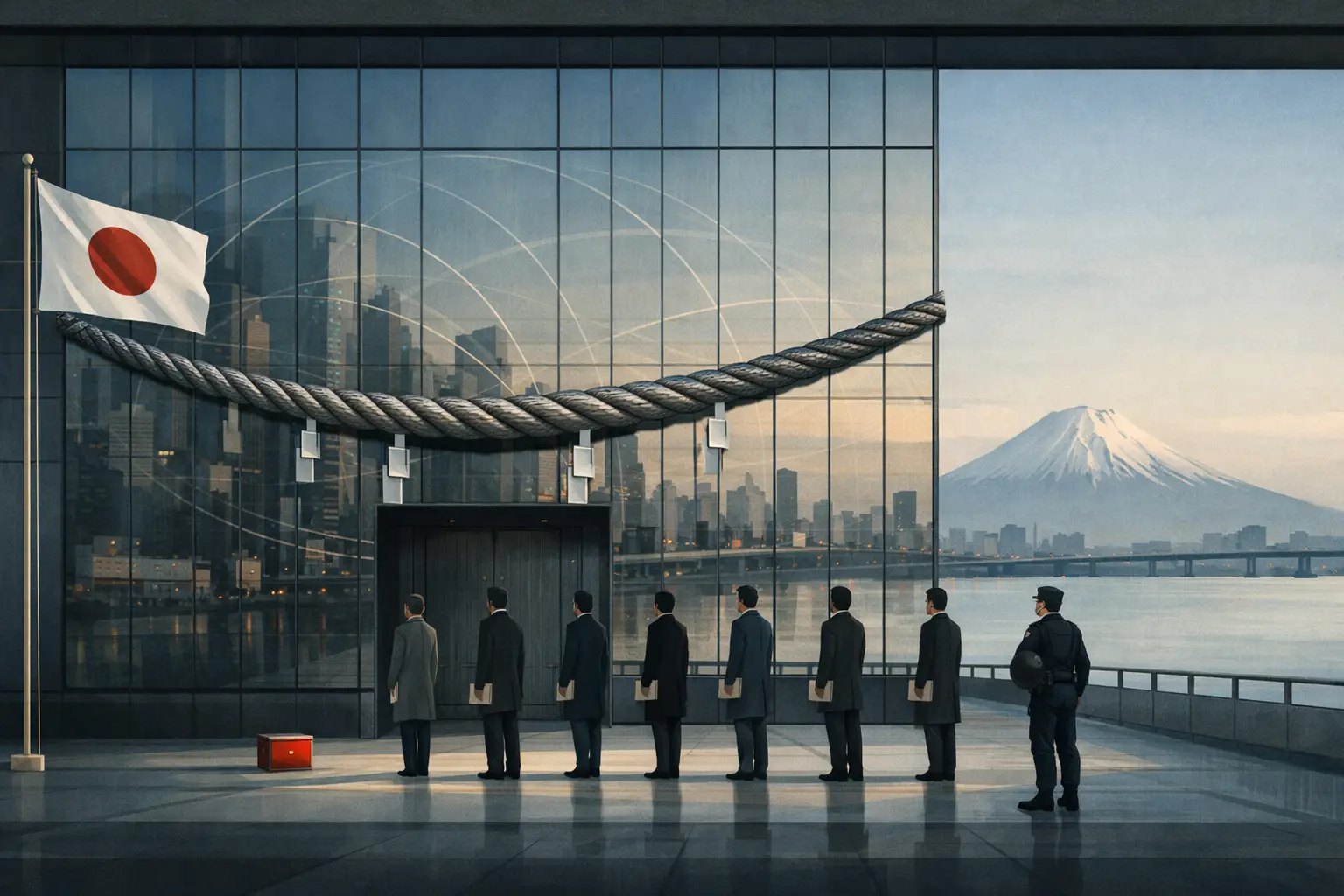
On February 8, 2026, Japan’s Liberal Democratic Party (LDP), led by Prime Minister Sanae Takaichi, secured 316 of 465 seats in the House of Representatives—the party’s strongest result in its 71-year history.
The LDP now controls 68 percent of the lower chamber outright; together with its new coalition partner, Nippon Ishin no Kai, it holds 352 seats, or 75 percent.
According to available estimates, this represents the highest seat share achieved by a governing party in the modern history of liberal democracies.
The result surpasses the two-thirds constitutional threshold required to initiate revision of Article 9, which since 1947 has prohibited Japan from maintaining fully fledged armed forces.
The formal procedure—approval by both houses of the Diet followed by a nationwide referendum—is designed to unfold over several years. However, for the first time in history, the ruling coalition possesses the arithmetic capacity to begin the process.
The pacifist opposition—the Constitutional Democratic Party and Komeito, united in a “Centrist Reformist Alliance”—lost 128 seats, retaining only 49, the worst performance for antimilitarist forces in the history of Japanese parliamentarianism.
The principal opposition pole in Japanese politics is no longer the left flank but an alternative right. The ideologically proximate Democratic Party for the People, the ultranationalist Sanseito, and the Mirai Party jointly control 53 seats—forces that share a platform centered on restoring full sovereignty and revising the postwar pacifist framework.
Markets reacted immediately: the Nikkei index surged 5.7 percent to a record 56,363.94. Shares of defense companies rose sharply—from +5 percent (Mitsubishi Heavy Industries) to +17 percent (Kawasaki Heavy Industries)—while the technology sector joined the rally (Advantest +12 percent, SoftBank Group +6 percent).
The rise in defense stocks reflects expectations of accelerated militarization. The rally in technology and industrial equities, however, signals a broader shift in market sentiment.
Investors are pricing in a reallocation of capital toward the Japanese economy, from Takaichi’s fiscal expansion to the structural repatriation of funds that had flowed abroad for decades under the Bank of Japan’s ultra-low interest rate regime.
This electoral victory initiates a process comparable in scale to the Meiji Restoration—a strategic exit from the artificial condition of a “defenseless nation” in which Japan has existed for eighty years.
The first restoration (Meiji, 1868) transformed a feudal polity into an industrial empire. The second (postwar, 1945–1952) dismantled that empire and reconstituted Japan as an economically powerful but strategically dependent protectorate of Washington.
The “Third Restoration,” the project of sovereigntist forces within the Japanese establishment represented by Takaichi, aims to restore Japan’s sovereign agency by converting three decades of accumulated economic frustration into independent military and ideological power.
The conversion mechanism entails removing constitutional restrictions on the use of force and building a fully developed defense-industrial complex with export capacity, alongside establishing an independent intelligence infrastructure.
It also involves constructing a network of security partnerships in which Tokyo operates not as Washington’s junior partner but as a sovereign node of deterrence, with ambitions extending beyond the Indo-Pacific.
Unlike previous efforts, the Japanese government interprets American isolationism not as a threat but as both freedom of action and an associated responsibility.
For the United States, this transformation reflects a fundamental recalibration of its relationship with its principal Pacific ally. Washington is deliberately lifting constraints imposed on Japan’s economy in the late twentieth century in order to cultivate a fully capable security partner.
This concession is acceptable under current geopolitical conditions because the strategic value of a sovereign partner capable of autonomous deterrence exceeds that of a financially dependent ally with limited operational agency.
For the first time in eighty years, the United States gains an ally that does more than increase defense spending in response to American requests. Japan is positioned to shape the regional security architecture independently—from defending the Taiwan Strait to controlling key island chains.
This alters the logic of the U.S. presence in the Indo-Pacific: rather than bearing the full burden as guarantor, Japan becomes a senior partner within a network of sovereign allies.
The anti-Japanese campaign launched by Xi Jinping in November 2025, intended to undermine the LDP’s electoral base, produced the opposite effect—accelerating domestic consolidation around a hardline security posture.
Takaichi’s ability to convert her mandate into irreversible institutional change depends on the persistence of the external pressure that enabled this consolidation.
The scale of the current strategic pivot reflects the depth of its underlying drivers—two successive traumas inflicted by the same ally.
Following Japan’s 1945 surrender, the occupation administration (SCAP) deliberately dismantled Japanese sovereignty. Article 9 of the Constitution stripped the country of the right to wage war, while the 1946 “Humanity Declaration” compelled the Emperor to renounce his divine status and State Shinto was abolished.
Japan was thus reformatted into a condition of controlled defenselessness—economically useful, yet strategically dependent.
Washington facilitated Japan’s recovery insofar as it served Cold War imperatives. By 1988, Japan had become the world’s second-largest economy; 32 of the 50 largest companies by market capitalization were Japanese.
However, when this success began to challenge American leadership, the Plaza Accord (1985) undermined export competitiveness, the asset bubble collapsed, and the country entered its “lost decades.”
Nominal GDP declined from $5.5 trillion (1995) to $4.2 trillion (2023)—the only G7 case of economic contraction over three decades. GDP per capita fell from third globally to thirty-sixth.
Labor productivity became the lowest in the G7 and ranked 29th among 38 countries. Of the world’s top 50 companies by market capitalization, only one remained Japanese.
The social cost was severe: more than 30,000 suicides annually for 14 consecutive years; 1.46 million hikikomori living in complete social isolation; and population decline for sixteen consecutive years—down 908,000 in 2024 alone, with a fertility rate of 1.2 children per woman, half the replacement level.
A nation twice deprived of strategic autonomy by the same ally—first militarily, then economically—lost the capacity for strategic initiative for three decades.
This accumulated frustration is the driving force of the “Third Restoration.” The scale of unrealized ambitions explains both the breadth of the transformation and the speed with which society has endorsed dismantling postwar constraints. Trump’s isolationism served as the catalyst, converting latent readiness for change into a concrete political mandate.
LDP Vice President Taro Aso—one of Japan’s most influential political figures, who had previously called for restoring the Japanese “will to fight”—publicly articulated this logic in a programmatic address on February 4, 2026.
The United States, he argued, no longer intends to act as the “world’s policeman”; therefore, Japan must assume full responsibility for its own security and prepare for defensive war.
He identified the Taiwan Strait and the Korean Peninsula as potential theaters—marking the first public naming of specific geographic directions toward which Japan is preparing to project force.
The speech was delivered in Nara—Takaichi’s electoral base and the city where Shinzo Abe was assassinated. In the Japanese political context, this symbolic location imbues the statement with the character of an oath to continue Abe’s course under more severe security conditions.
The Trump administration responded immediately. President Trump and Treasury Secretary Scott Bessent publicly emphasized that the White House “fully supports” the LDP’s course and views it as strengthening American power in Asia. Takaichi described the alliance’s potential as “limitless.”
The Prime Minister’s visit to Washington on March 19 is the most anticipated event in bilateral relations since the revision of the Defense Cooperation Guidelines.
Given the scope of the agenda—from nuclear deterrence to joint defense of the Taiwan Strait—the talks extend beyond routine alliance affirmation and approach a reconsideration of the core parameters of the 1960 Treaty of Mutual Cooperation and Security, which has defined the alliance architecture for six decades.
The White House expects Tokyo to substantially intensify economic, security, and defense exchanges with Taipei, constructing a coordinated deterrence model vis-à-vis the PRC.
This is intended to strengthen U.S. leverage in meetings with Xi Jinping in spring and fall 2026 and to weaken the Kuomintang ahead of Taiwan’s 2026–2028 electoral cycle.
The unprecedented mandate opens access to previously taboo domains, including the potential deployment of U.S. nuclear capabilities on Japanese territory—implying revision of the “Three Non-Nuclear Principles” (not producing, not possessing, not introducing nuclear weapons), in place since 1967.
Authorization for transit and basing of U.S. nuclear weapons on Japanese soil would create a direct nuclear deterrent threat to the PRC along its eastern seaboard—a qualitatively different level of risk compared to forces based in Guam or Hawaii.
This marks a shift from an asymmetric model—where the United States protects and Japan pays—to a partnership of distributed responsibility, in which Tokyo assumes a substantive share of the strategic burden.
The FY2026 defense budget stands at ¥9.04 trillion ($58 billion)—a 9.4 percent year-over-year increase and the twelfth consecutive record. Over four years, defense outlays have risen from ¥5.4 trillion to ¥9 trillion.
Including supplementary appropriations, total FY2025 defense spending reached ¥11 trillion ($70 billion)—2 percent of GDP, achieved two years ahead of schedule.
The five-year armaments program (2023–2027) allocates $275 billion, positioning Japan as the world’s third-largest defense spender after the United States and the PRC. The financial mechanism underpinning this transformation rests on a structural shift in Japanese monetary policy.
For three decades, the Bank of Japan’s ultra-low rates pushed capital abroad. Japanese institutional investors—pension funds, insurers, and megabanks—accumulated approximately $1.2 trillion in U.S. Treasury securities, making Japan the largest foreign holder of U.S. debt.
However, the normalization cycle that began in 2024 has changed this logic. The policy rate hike to 0.75 percent in December 2025—the highest level since 1995—and the rise in 40-year Japanese Government Bond (JGB) yields above 4 percent in January 2026 have created conditions in which holding U.S. assets is no longer economically attractive for Japanese institutions.
On a currency-hedged basis, JGB yields have exceeded U.S. Treasury yields for the first time since 2007, creating structural incentives for capital repatriation.
According to Goldman Sachs, if the policy rate reaches 1 percent by end-2026 and 10-year JGB yields rise to 2.5 percent, Japanese institutions could shift from net buyers to net sellers of U.S. Treasuries—potentially swinging by up to $96 billion annually.
For the “Third Restoration,” this dynamic carries dual significance. Freed capital provides the financial base for reindustrialization and militarization: funds that for decades subsidized the U.S. deficit are being redirected toward the domestic defense-industrial base, infrastructure, and technology sectors.
Japan’s record FY2026 general budget of ¥122.3 trillion ($784 billion), approved by Takaichi’s cabinet in December 2025, reflects this fiscal expansion.
Reduced Japanese holdings of U.S. debt exert upward pressure on Treasury yields, increasing the cost of servicing the American deficit—a side effect of allied militarization that Washington nonetheless encourages.
Bond markets have already registered this risk: the sharp selloff in JGBs in January 2026, triggered by the snap election announcement and Takaichi’s fiscal plans, immediately transmitted into a rise in 10-year U.S. Treasury yields above 4.3 percent.
This shift unfolds within a coordinated U.S.–Japan strategy of remilitarization and reindustrialization, mitigating the risk that Treasury divestment is interpreted as financial retaliation against an ally.
Repatriated capital is being allocated across multiple vectors. Japanese corporations are expanding acquisitions of strategic assets—Mitsubishi agreed in January 2026 to acquire U.S. gas producer Aethon Energy for $5.2 billion; Jera invested in shale production in the Haynesville basin.
In October 2025, Takaichi and Trump signed a framework agreement on critical minerals and rare earth elements, under which Japanese firms plan up to $550 billion in investments in U.S. energy, AI, and raw-material infrastructure.
Simultaneously, insurers and pension funds are rotating from foreign bonds toward domestic Japanese markets, alternative investments, and corporate credit. Morgan Stanley identifies this as the first structural shift in Japanese institutional investment behavior in a quarter century.
Japan is financing its strategic autonomy through the same financial architecture that for decades underpinned American hegemony.
$6.2 billion has been allocated for long-range strike capabilities—enabling engagement of targets beyond an adversary’s reach—including Type-12 missiles with a 1,000-kilometer range. The first batteries are scheduled for deployment in Kyushu by March 2026, one year ahead of schedule.
This represents a qualitatively new class of weaponry for a country that for eighty years confined itself to self-defense. The Type-12 missiles can strike ships and land targets within a radius encompassing China’s eastern coastline—meaning that for the first time since 1945, Japan acquires the capability to strike potential adversary territory.
In partnership with the United Kingdom and Italy, Japan is developing a next-generation fighter with AI-enabled drone escorts (deployment projected for 2035).
Australia selected Mitsubishi Heavy Industries to modernize its frigate fleet—the first major Japanese defense export contract, transforming Tokyo from a security importer into a security provider.
Deterrence of the PRC, however, unfolds amid deep economic interdependence that constrains escalation and precludes Tokyo from imposing trade restrictions on the American model.
The scale of dependence is measurable. The PRC has remained Japan’s largest trading partner since 2005. Bilateral trade reached $293 billion in 2024 (20.2 percent of Japan’s total trade) and rose to $322 billion in 2025.
China accounts for 22.5 percent of Japanese imports and 17.6 percent of exports; Japan remains China’s third-largest trading partner after the United States and South Korea.
Japanese firms have established more than 55,000 enterprises in China with cumulative investments exceeding $130 billion. Although FDI fell 60 percent over the past decade (from ¥1.2 trillion to ¥493 billion in 2024), flows in the first three quarters of 2025 increased 55.5 percent year over year.
Toyota is building a new EV plant in Shanghai; Panasonic is expanding semiconductor materials production in Suzhou.
The tourism sector reflects similar vulnerability: 8.2 million Chinese visitors in the first ten months of 2025 (up 40.7 percent), accounting for 21–24 percent of total foreign tourist spending in Japan (¥8.1 trillion in 2024).
After Takaichi’s November 2025 statements on Taiwan, arrivals declined 45 percent in December. Nomura Research Institute estimated that a one-year rare earth embargo could cost 0.5 percent of GDP (¥660 billion).
Dependence on critical minerals remains structural. Japan imports 60 percent of rare earth elements from China (down from 90 percent after the 2010 Senkaku crisis) but remains almost entirely dependent on the PRC for heavy rare earths used in EV magnets and defense industries.
Following Beijing’s global export restrictions on rare earths in April 2025, Suzuki Motor suspended production of the Swift model due to component shortages—the first production halt by a Japanese automaker caused by Chinese export controls. In January 2026, Beijing additionally banned exports of dual-use goods directly to Japan.
Interdependence continues to deepen: bilateral trade grew 4.7 percent in 2024 and another 10 percent in 2025; 58 percent of Japanese firms in China plan to increase or maintain investment levels. Even amid intensifying security rivalry, economic integration persists.
Accordingly, Takaichi’s strategy is not premised on economic decoupling from Beijing—which would harm Japanese industry more severely than China’s—but on constructing military deterrence while preserving trade dependence.
Japan is preparing for a Taiwan Strait contingency while simultaneously expanding trade with the country against which that deterrence is directed.
The limited space for economic coercion renders military capability the primary available instrument of deterrence. Tokyo is therefore accelerating force development, compensating through technology for demographic constraints.
To address manpower shortages—a direct result of demographic decline that reduced the population by 908,000 in 2024 alone—Japan has introduced the SHIELD program (Strategic Highly Integrated Experimentation for Lethal Defense).
The initiative involves large-scale deployment of unmanned aerial, surface, and subsurface systems, backed by a $640 million budget and aiming for operational readiness by March 2028.
Collectively, these capabilities transform Japan from America’s “unsinkable aircraft carrier” into an autonomous security node capable of conducting deterrence operations without direct U.S. force involvement.
The full magnitude of Beijing’s strategic setback becomes apparent in light of the fact that China’s pressure campaign was intended precisely to prevent this outcome.
Following Prime Minister Takaichi’s explicit declaration in November 2025 of Japan’s readiness to participate in Taiwan’s defense, Xi Jinping launched a coordinated anti-Japanese campaign combining diplomatic, economic, trade, and military pressure with large-scale digital disinformation.
Diplomatic coercion took the form of sharply worded public statements and ambassadorial recalls. Economic pressure included restrictions on imports of Japanese goods and threats to revise investment conditions. Militarily, Beijing demonstrated resolve through increased PLA Navy activity in the East China Sea and around the Senkaku Islands.
Simultaneously, Chinese propaganda channels amplified support for the ultranationalist Sanseito party—which had achieved limited success in the July 2025 House of Councillors elections—and conducted an extensive information campaign across Japanese social media platforms.
The objective was to erode the LDP’s electoral base by invoking public fears of renewed war and to secure victory for a more China-aligned opposition.
A methodology widely employed by Chinese and Russian intelligence services in Europe—where the cultivation of populist and far-right forces has repeatedly destabilized electoral processes—produced the opposite effect in Japan.
Influenced by Russia’s war against Ukraine and growing awareness of the risk of a Taiwan contingency, Japanese society consolidated around the LDP’s hardline security doctrine. Voting for Takaichi became, in effect, a vote against Chinese coercion.
For Beijing, this outcome implies that any scenario involving forceful pressure on Taiwan now increases the probability of institutionally prepared Japanese participation in deterrence—a risk that did not exist two years earlier.
This setback for the PRC is compounded by the consolidation of the Quad. Between 2024 and 2026, all four member states produced electoral outcomes centered on deterring Beijing.
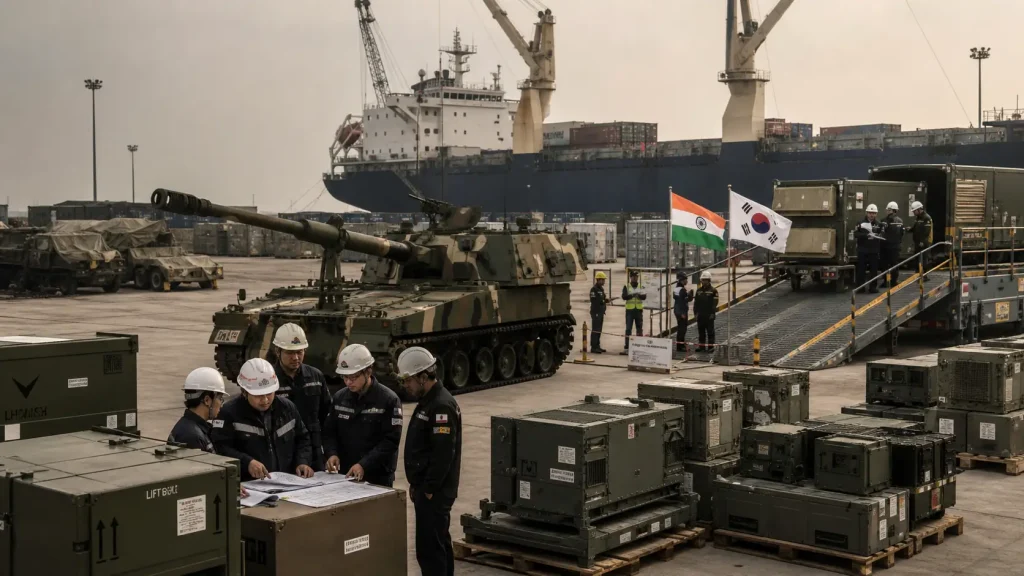
The U.S. National Defense Authorization Act (NDAA) for FY2026 designates India as a key defense partner and calls for integration of the defense-industrial bases of five countries: the United States, India, Japan, Australia, and South Korea.
Trump’s February agreement with Prime Minister Modi to finalize a “grand bargain” completed the formation of a durable system of transactional alignment.
Japan’s defense normalization fills a critical gap in this architecture: until now, Tokyo possessed capital and technology but lacked the political mandate to deploy them.
This “lattice defense” model had been discussed by Trump and the late Shinzo Abe but was unattainable absent a Japanese mandate for full-spectrum militarization.
Operationally, Japan controls the northern segment of the First Island Chain (from Hokkaido to Okinawa); Australia anchors the southern segment (from Timor to the Solomon Islands); India secures the western flank through dominance of the Indian Ocean; and South Korea provides a buffer on the Korean Peninsula.
Each node operates autonomously yet remains integrated through common weapons standards and intelligence-sharing frameworks.
This configuration benefits Washington: Japan assumes a larger share of financial and operational commitments beyond the “American Hemisphere,” offsetting the costs of U.S. strategic retrenchment.
The durability of the “Third Restoration” depends on the domestic political mechanics that enabled it—above all, the LDP’s ability to sustain its new coalition alignment.
For 26 years, the party governed in coalition with Komeito, the political arm of the Buddhist organization Soka Gakkai, whose formal ideology was “humanitarian socialism.”
That alliance delivered 6–7 million votes but systematically constrained the LDP’s security evolution. Komeito empowered internal “left” factions within the LDP and restrained remilitarization. After removing Shigeru Ishiba—the most left-leaning leader in the party’s history—from power, Takaichi terminated the partnership in October 2025.
Analysts predicted electoral disaster for concrete reasons: Soka Gakkai provided 6–7 million votes nationwide and a grassroots organizational infrastructure—voter mobilization, door-to-door canvassing, and coordination in single-member districts where margins are often decided by a few thousand votes.
The loss of this machine was expected to cost the LDP dozens of seats. Instead, a move widely forecast to trigger electoral collapse delivered an unprecedented victory and substantial support among voters aged 18–60—the core electorate for future campaigns.
The new coalition partner, Nippon Ishin no Kai, acts not as a restraint but as a driver of militarization. Instead of limiting security ambitions, the LDP now governs with a party that shares—and in some areas, such as constitutional revision and force expansion, even goes beyond—its hardline positions.
Tokyo plans to dismantle the legislative framework that for decades constrained arms exports. The current “Three Principles on Transfer of Defense Equipment and Technology” restrict exports to five nonlethal categories: rescue, transport, warning, surveillance, and mine-clearing equipment.
On December 15, 2025, the LDP and Nippon Ishin agreed to abolish these restrictions; the corresponding bill is expected to be submitted to the Cabinet in spring 2026.
Eliminating the “five categories” would open the path to exporting lethal systems, including Type-12 anti-ship and land-attack missiles with ranges up to 1,000 kilometers, upgraded Mogami-class frigates, and components of the next-generation fighter jointly developed with the United Kingdom and Italy.
For highly lethal platforms—missiles, destroyers, tanks—the National Security Council would review each export contract individually.
Potential recipients include 15 countries that have signed defense equipment transfer agreements with Japan, among them the Philippines, India, Indonesia, Vietnam, and Bangladesh, which concluded such an agreement on February 3, 2026.
The prohibition on supplying countries actively engaged in hostilities remains in place for now; Japan cannot export lethal weapons to active war zones, although the LDP is already debating revision of this constraint.
The prospect of lifting that ban creates an additional strategic lever vis-à-vis Beijing.
Export of Type-12 missiles to conflict zones of strategic importance to the PRC—most notably Ukraine—could alter the battlefield balance where Western allies have thus far withheld comparable systems: Germany has blocked transfer of Taurus cruise missiles, and the United States does not supply Tomahawk missiles.
Japanese long-range systems fill precisely this gap; even the mere legislative possibility of such transfers transforms Tokyo’s export policy into an instrument of deterrence toward Beijing.
This also enables Washington to delegate portions of the allied armament function in the Indo-Pacific. Japanese anti-ship missiles for the Philippines and integrated Unicorn antenna systems for India reduce strain on the U.S. defense-industrial base.
Takaichi’s electoral success has additional structural drivers. She cultivated an image as a leader without political dynasty ties and of middle-class origin—a sharp contrast to the dynastic character of Japan’s political class—thereby securing support among younger voters (18–29).
She aligns with a broader trend of conservative female leaders who combine hardline security positions with electoral appeal among moderates and younger constituencies.
A Mainichi Shimbun poll indicated that 41 percent of voters disapproved of the snap election decision, called only four months after Takaichi assumed the LDP presidency.
Nevertheless, her perceived resolve in defending Japan’s interests regarding Taiwan proved sufficiently consolidating: voters prioritized economic security and a firm stance toward China.
By contrast, the leadership of the Constitutional Democratic Party and Komeito continued to reproduce postwar pacifist narratives without presenting concrete proposals to strengthen national security—and voters responded with a record outflow of support.
A separate manifestation of the LDP’s strategic foresight was the neutralization of potential opposition from Tenrikyo, a nineteenth-century religious movement deeply rooted in Nara Prefecture—Takaichi’s electoral base.
Its direct electoral contribution is limited: 1.5–2 million adherents translate into at most one million votes—less than 5 percent of total LDP support. Its significance, however, lies not in numbers.
Under the doctrine of “Joyous Life” (Yokigurashi), Tenrikyo espouses universal pacifism and historically suffered persecution by the nationalist state following the Meiji Restoration (1868). The movement’s founder, Nakayama Miki, was repeatedly arrested because her teachings conflicted with State Shinto ideology.
An active religious organization with pacifist doctrine and institutional discipline could have become an organized ideological opponent of remilitarization—analogous to the role Soka Gakkai played for decades as a brake on the LDP’s security evolution.
For Tenrikyo’s leadership, however, the threat posed by the PRC and North Korea—“godless communism” endangering religious freedom and the Japanese way of life—proved more salient than doctrinal differences with the LDP’s agenda.
Takaichi, whose district includes the city of Tenri—the movement’s headquarters—secured Tenrikyo as a strategic partner by persuading its leadership that peace requires credible military capability. The concept of “Joyous Life” proved sufficiently adaptable to be reinterpreted as life within a strong and protected state.
The doctrinal basis for this flexibility lies in the teaching of kashimono-karimono: the human body is a “thing on loan” from God the Parent and must therefore serve the community rather than individual ambition.
The family is defined as the smallest unit of Joyous Life, and the moral code of the “eight dusts of the mind” condemns selfishness, arrogance, and greed.
This worldview places duty to the collective above individual autonomy—a structurally conservative orientation that renders Tenrikyo adherents natural allies of the political right, notwithstanding the movement’s declared pacifism.
Tenrikyo followers are present across corporate and civic communities throughout Japan and—unlike many adherents of Shinto, who rarely publicize their faith—maintain an explicitly visible presence. Their practice of hinokishin—selfless community service—makes them recognizable actors in public life.
Support for Takaichi’s course from a movement grounded in universalist pacifism signals to Japanese society that remilitarization is framed as protection of peaceful life conditions rather than a return to the militarist past from which Tenrikyo historically suffered.
Ideological shifts within Japanese society are deeper than any coalition realignment—this is what renders the “Third Restoration” potentially irreversible.
Takaichi’s significance lies not in the details of her regular visits to Yasukuni Shrine as a “private citizen,” but in the scale of the symbolic shift she embodies: the era of self-reproach for 1937–1945 has ended.
By demonstratively paying tamagushi-ryo—the offering fee for a sacred branch—from her own pocket, she legally shields herself from accusations of violating church–state separation while symbolically emphasizing that the act is not protocol but personal loyalty to those who died for the state.
The gradual disavowal of the 1946 Humanity Declaration, the restoration of elements of State Shinto as instruments of national consolidation, and references to a “New Showa Restoration” signal that Japan is reformatting its identity for an era of sovereign responsibility.
This process is reinforced by generational change: political leaders without personal memory of World War II now hold power, backed by an electorate aged 18–60.
The Takaichi government distinguishes between restraint grounded in capability and externally imposed defenselessness—and rejects the latter as a foundational principle.
For Takaichi, who consistently invokes the concept of kokutai—the sacred essence of Japanese statehood—defending that essence from external threats is not political calculation but a moral obligation.
Under the impact of Russia’s war against Ukraine and the rising threat to Taiwan, Japanese society has made a conscious choice: to move beyond a paradigm of guilt and focus on preparing for a conflict in which the PRC—not Japan—would be the principal aggressor.
Washington gains a partner that thinks in terms of deterrence and power projection—the same vocabulary employed by the Pentagon.
The period 2026–2028 will test Takaichi’s ability to turn her mandate into lasting institutional change, completing Shinzo Abe’s unfinished program under very different external conditions.
This includes breaking with Komeito, revising the constitution, and pursuing full remilitarization—goals that were part of Abe’s agenda but were previously constrained by coalition dynamics and limited external pressure.
Trump’s isolationism, Beijing’s assertiveness, and the war in Ukraine created a window of opportunity that Abe did not possess.
Institutional objectives include increasing defense spending to 3 percent of GDP; lifting arms export restrictions; establishing independent intelligence capabilities; returning to nuclear energy; integrating civilian and military technologies; and expanding presence along the island chains.
Constitutional revision of Article 9, despite the requisite parliamentary majority, remains a long-term horizon: the referendum procedure implies a timeline extending to approximately 2028–2029.
Revision of Japan’s three core strategic security documents is scheduled for December 2026—a critical inflection point after which dismantling the new structures would become significantly more difficult.
This projection assumes sustained external pressure—primarily from the PRC. A sharp de-escalation could slow the process; however, even under such a scenario, the institutional inertia of launched programs—the five-year armaments plan, SHIELD, and the joint fighter project—possesses sufficient momentum to continue.
If the transformation is completed, a Taiwan Strait contingency would no longer require the U.S. Navy to operate alone. Japan would secure the northern flank, control the Ryukyu chain, provide logistical depth—and do so with its own forces, pursuant to its own political decisions.
The deterrence architecture would shift from a single fulcrum centered on the Seventh Fleet to a distributed network in which Tokyo assumes a tangible share of operational risk.
In historical perspective, this transformation is comparable to the rupture following the end of the shogunate—with one crucial distinction: this time, Japan is rearming not against the West, but as its full strategic partner.