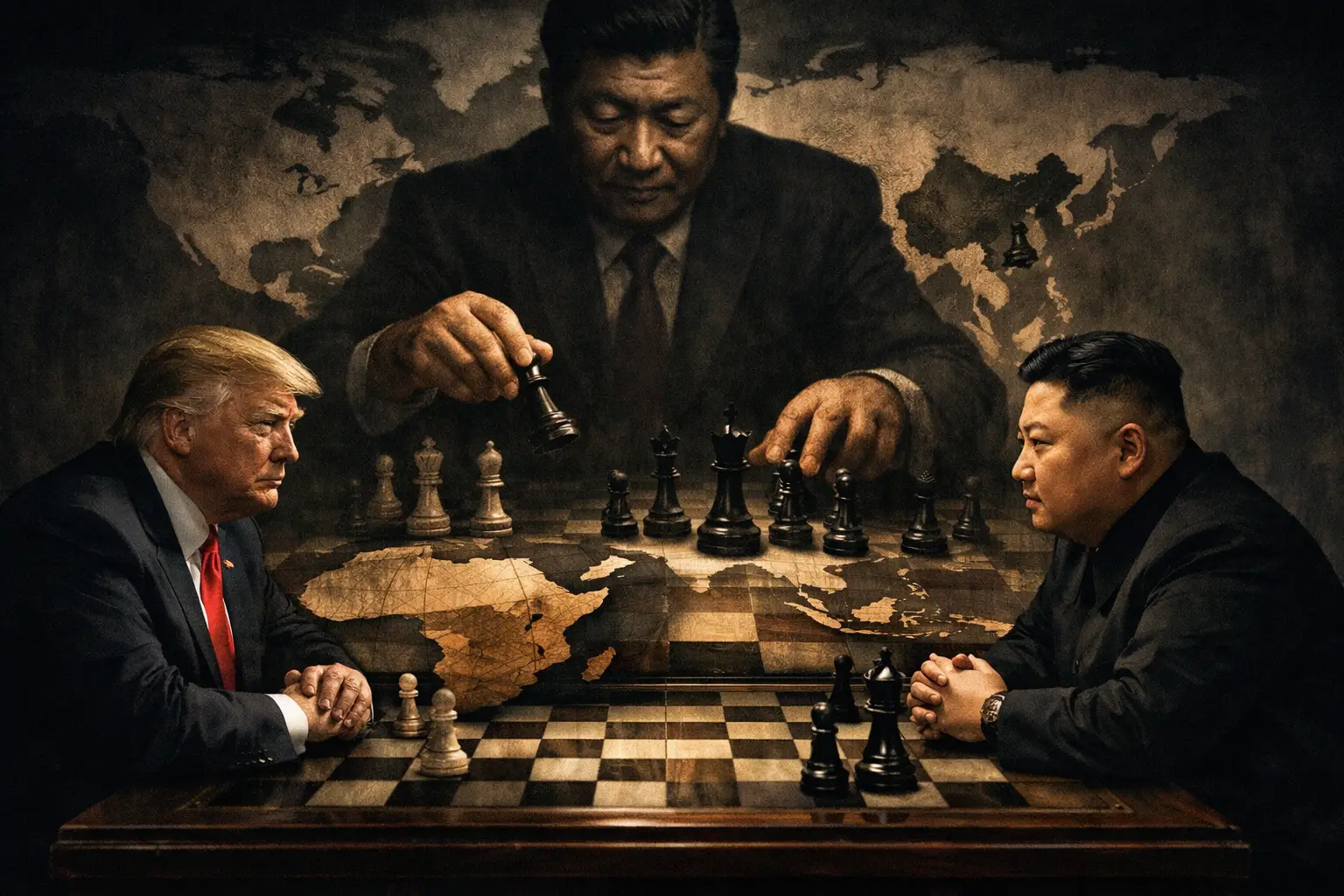
On December 16, 2025, the Korea National Diplomatic Academy (KNDA) under the South Korean Ministry of Foreign Affairs published a prognostic report, according to which a meeting between Donald Trump and Kim Jong Un may take place in 2026.
The basis for this is the presence of corresponding political will on the part of President Lee Jae-myung, as well as the leadership of the U.S. and the DPRK.
The report also notes that the time for such a meeting could be the period from March to May, when President Trump will be on a visit to the PRC.
At the same time, this KNDA forecast assumes that bilateral diplomacy between South Korea and the DPRK will remain at the lowest level—at least until the end of Russia’s war in Ukraine.
The KNDA forecast was published amid the White House’s decision to exclude mentions of the North Korean threat and, in particular, the need for denuclearization of the DPRK from the new U.S. National Security Strategy—for the first time in 22 years.
This decision is seen as a step toward recognizing the DPRK as a “nuclear state,” which Donald Trump has repeatedly stated after taking the presidential office.
After the disruption of the October meeting between Donald Trump and Kim Jong Un at the APEC summit in Gyeongju, the White House continued to rethink the American strategy toward the DPRK.
A key element of this shift was the strengthening of a “realistic” approach, which involves abandoning tough sanctions containment of North Korea’s nuclear program.
From the perspective of the current administration, such a policy does not improve the regional security conjuncture, but instead accelerates the strategic rapprochement of Pyongyang with the PRC and the RF.
Because of this, the U.S. is trying to advance a format of a “deal” with the DPRK, which de facto will include its recognition as a “nuclear state” and further reduction of American diplomatic pressure.
Kim Jong Un, in turn, must slow down the pace of militarization and refrain from the most destabilizing steps—in particular, participation in Russia’s war against Ukraine and testing long-range systems in Japanese and South Korean waters.
The most dangerous for the democratic camp is the DPRK’s expeditionary presence in geographies where the U.S. is already building a practical logic of dismantling Chinese support contours, primarily in Africa and the Middle East.
The appearance of North Korean units or formally privatized structures in the format of security contractors quickly changes local balances in favor of the autocratic bloc, as such presence does not require territorial captures and works as force insurance for regimes loyal to Beijing, covering Chinese economic and logistical assets.
The African direction of potential DPRK presence is optimal for Beijing due to the combination of low entry threshold, high political deniability, and managed escalation.
Contractual and semi-state formats allow integrating North Korean human resources to protect pro-authoritarian regimes in Africa without formal deployment of regular forces and without creating a direct clash scenario with the U.S.
Accordingly, Washington’s normalization track toward Pyongyang should be viewed as a tool for preemptively blocking such an expeditionary vector, which shifts North Korea’s entry into the external use of force market from the category of undesirable to unacceptable with clearly defined consequences.
These White House intentions are reinforced by the position of the Lee Jae-myung administration, which on December 16 held the first meeting of the South Korean-American intergovernmental group on DPRK issues with a focus on normalizing relations on the Korean Peninsula, rather than adhering to the sanctions regime.
In particular, the Blue House (the office of the President of South Korea, which resumed operations in the historic building in 2025) demonstrates readiness for concessions to Pyongyang—including the transfer of North Korean prisoners from Ukraine—in order to reduce escalation risks.
Such an approach corresponds to the Sunshine Policy of the ruling South Korean Democratic Party, oriented toward forming peaceful inter-Korean relations as a prerequisite for their further non-violent rapprochement.
From the perspective of the Donald Trump administration, Lee Jae-myung’s political approaches to the DPRK are ideologically naive.
At the same time, the American government does not object to such an approach—primarily because Seoul’s readiness to move toward normalizing relations with Pyongyang creates a window of opportunity for the U.S. to deeply rebuild the regional security architecture in its favor.
In particular, recognizing the DPRK as a “nuclear state” will allow the White House to reduce Pyongyang’s incentives for further escalation, limit its need for patronage from the PRC and the RF, and ultimately weaken their strategic triangle.
In parallel, this will allow the U.S. to significantly change the functional purpose of the American military presence on the Korean Peninsula by reorienting USFK from the North Korean threat to the Chinese one.
The latter will force South Korea to take responsibility for containing the DPRK and independently build a security network on the peninsula and deepen security coordination with Japan. Accordingly, it concerns the intention to implement a strategic transactional reconfiguration in East Asia without ideological or moral safeguards.
An additional factor that prompted the White House to choose this focus was the PRC’s decision to simultaneously abandon formal restrictions regarding the DPRK.
In particular, shortly before the publication of the new U.S. National Security Strategy, the Chinese government released a White Paper on arms control, in which mentions of “denuclearization of the Korean Peninsula” disappeared for the first time in 19 years; instead, Beijing called for “resolving differences through political means.”
This means that Xi Jinping guaranteed Kim Jong Un support in developing the DPRK’s nuclear program—within the campaign to unblock its offensive capabilities.
The key problem for implementing the U.S. North Korean strategy remains the very nature of Pyongyang’s dependence on the PRC and—at a more superficial level—on the RF.
As of the end of 2025, Kim Jong Un receives from autocratic allies all the necessary support to strengthen his own regime. This became a consequence of the real abandonment by the PRC and the RF of adherence to the UN sanctions regime against the DPRK after the start of Russia’s full-scale invasion of Ukraine.
In particular, autocratic neighbors are increasingly actively providing Pyongyang with currency revenues, food, technological components, and scientific expertise necessary to transform the DPRK into an effective offensive force without risks of regime change or growing domestic political pressure.
Under such conditions, Kim Jong Un is able to build up military-industrial infrastructure, create jobs according to the model of forced (slave) labor, and maintain basic social stability, promising the population “juche prosperity” at the expense of imported resources.
At the same time, the PRC and the RF have begun to provide Kim Jong Un with international platforms—access to military parades, SCO and BRICS summits, and other autocratic formats, which satisfies his ambitions as a “world leader.”
The only unmet need of Kim Jong Un remains limited access to the world arms market, which may appear after the U.S. decision to effectively recognize the DPRK as a “nuclear state.”
Accordingly, it concerns Pyongyang’s readiness to make certain tactical concessions to Washington, but under no circumstances abandon strategic alliance with the PRC and the RF, as this would directly threaten the regime’s security.
From a deeper perspective, such a situation reflects Xi Jinping’s strategic plan, for whom the DPRK is no less valuable an asset for expansion than the RF.
According to Chinese calculations, Pyongyang must play a critical role in those directions where other autocratic partners of Beijing cannot act openly.
First, it concerns providing human resources for foreign military campaigns that correspond to the PRC’s foreign policy goals—in both combat and military-industrial dimensions. Second, the DPRK is seen as a “safe” hub for assembling Chinese technologies, including drones and missiles.
In this context, Beijing proceeds from the fact that no state will dare to strike the DPRK first, which possesses a nuclear arsenal of over 55 warheads.
Third, the northern territories of the DPRK are of critical importance for Chinese force projection and logistics in the northern Pacific, as well as in the context of developing the Russian Arctic.
Under such conditions, Beijing will equate the stability of Kim Jong Un’s course to its own strategic stability, neutralizing any manifestations of pro-American sentiments in Pyongyang through a combination of bribery and pressure on local elites.
A feature of Chinese absorption of the DPRK and the RF, which has not yet been accounted for in the American strategy, is Beijing’s creation of its own transactional alliance model, which sometimes functions more effectively than the JAROKUS coalition.
Within it, Xi Jinping forms a system of interdependencies that cannot be replaced without losing expansive capabilities. On one hand, the PRC invests in building factories in the DPRK for localizing Russian technologies based on Chinese microelectronics.
On the other—facilitates the dispatch of North Korean workers to the RF for weapon assembly in the format of Chinese chips.
At the same time, North Korean society is increasingly integrated into the Chinese cultural-scientific space, forming perceptions of Beijing as the “world capital,” and also getting accustomed to the Russian language as the language of business, which became mandatory for schoolchildren from 2025.
In this way, a complex of dependence with a Chinese core is formed, which will not allow the DPRK and the RF to cross Xi Jinping’s “red lines.”
Beyond the framework of its own expansion, the PRC’s ultimate goal is scaling the Russian-North Korean aggression mechanism tested in Ukraine. It concerns forming a tool for indirect use of force, which if necessary would allow military pressure on Japan and South Korea without formal involvement of the PLA.
The African direction should be fixed as a zone of primary risk, as it is there that the PRC is capable of most effectively converting economic presence into force resilience of loyal regimes without formally opening a front against the U.S.
In this logic, Washington views Saudi Arabia as one of the key executors of deploying influence tools in Africa, including reliance on private military companies staffed with experienced servicemen who have participated in modern high-tech military conflicts.
In parallel, the U.S. administration proceeds from the fact that the autocratic axis will try to build a mirror force contour. It concerns military proxy structures staffed with North Korean personnel and effectively controlled by Pyongyang in the format of Chinese political and logistical patronage.
Such an appearance would mean stabilization of pro-Chinese regimes, preservation of Chinese port, corridor, and mining assets, and quick shift of local balance in favor of autocracies.
For the U.S., the appearance of a North Korean contract segment in Africa increases the overall cost of the American strategy to dismantle the Chinese influence architecture.
That is why the U.S. normalization track toward the DPRK must be built in such a way that Pyongyang’s expeditionary step in Africa is practically blocked, and attempts to prepare it automatically trigger mechanisms for forced neutralization of financial, logistical, and organizational channels of such deployment.
Realizing the impossibility of real interception of influence over Kim Jong Un, the Donald Trump administration has chosen a different containment logic—blocking these Beijing ambitions through parallel stimulation of Seoul and Tokyo to acquire hybrid nuclear status.
In the fall of 2025, this course has already materialized in allowing South Korea to begin forming a nuclear submarine fleet.
In parallel, the Japanese government accelerated the review of the “three non-nuclear principles” to create legal and political conditions for obtaining nuclear weapons—both in the format of national production and according to the nuclear sharing model with the U.S.
Such logic correlates with Donald Trump’s conviction that authoritarian regimes are not inclined to direct aggression against democracies that possess effective nuclear deterrence.
In a broader perspective, it concerns mirror reproduction of the model that the PRC applies to the DPRK.
At the same time, the White House does not consider the risk of undermining the Nuclear Non-Proliferation Treaty regime. It proceeds from the conviction that in the case of “unauthorized” development of relevant technologies outside American control, Washington will resort to forceful solutions following the example of the recent operation in Iran.
Practical manifestation of implementing the PRC’s expansive North Korean strategy were the latest steps in the economic and military-industrial sphere.
First, during the fall of 2025, there was a sharp and structurally significant revival of Chinese-North Korean trade: both official and secret. The catalyst for this process was the September meeting of Kim Jong Un and Xi Jinping during a military parade in Beijing—their first summit in 6 years.
According to data from China’s General Administration of Customs, in November, the volume of bilateral trade reached $281 million, which became the highest monthly indicator since October 2019.
The key driver of growth was Chinese exports to the DPRK, which increased to $244 million. This means that in 2025, the PRC may exceed the indicators of their official trade turnover in 2024, reaching over $2.2 billion.
In parallel, an expansion of the range of supplies from the PRC to the DPRK was recorded: in particular, Beijing doubled the shipment of machines and industrial equipment, as well as used vehicles.
South Korean intelligence also exposed facts of Beijing’s activation in transferring drone components, graphic processors, and other computer equipment prohibited by the UN sanctions regime.
In addition, the PRC branched out the number of shadow logistical schemes: in particular, the number of crossings along the Yalu River increased to 32 over a stretch of about 98 km.
It is these routes, through which truck movements are systematically recorded, that are used for “real” trade between the PRC and the DPRK, which significantly exceeds the $2 billion mark.
An additional indicative fact was the exposure of increased supplies of Chinese sugar to the DPRK. Despite the non-military significance of this group of goods, sugar, which is a historically scarce resource, is used by the Kim regime as a tool to encourage the army before participation in wars.
Second, Beijing has essentially begun to encourage the relocation of dual-use equipment assembly directly to the DPRK.
In mid-December 2025, it was exposed that the Chinese company Jiangsu Nengtai Automation Equipment Company transferred production capacities for drone assembly to North Korean territory.
In particular, company representatives openly advertised on Douyin (the Chinese version of TikTok) equipment that allows the production of at least 100 drones per day, emphasizing lower cost compared to production in the PRC.
This episode demonstrates Beijing’s systemic approach: relocating critical elements of the production cycle to the DPRK complements the long-standing practice of supplying Chinese drones, including DJI Mavic 2 Pro models and less known developments primarily intended for PLA needs.
Complementing this configuration is the PRC’s intention to begin systematic purchases of North Korean rare earth metals. In November 2025, the DPRK sent samples of palladium and rhodium to Beijing for analysis, declaring the possibility of their export in volumes up to 3 tons per month.
Given the high global cost of these metals and their criticality for semiconductor, drone, and aerospace industries, even partial implementation of this plan will become a significant factor in enriching North Korean elites—and strengthening the PRC’s positions in global technological competition with the United States.
Third, the Chinese government has sanctioned the involvement of North Korean labor for drone assembly on RF territory intended for the war in Ukraine.
At the end of December 2025, South Korea and Ukraine stated the DPRK’s intentions to send from 10 to 12 thousand women for drone assembly on the territory of the “Alabuga” economic zone.
A similar statement was made by the Japanese public broadcaster NHK. It is in this zone that the logistics terminal named after Deng Xiaoping is located—the largest PRC transit center in the RF, which, in particular, serves as a proxy for importing Chinese components to “Alabuga” for assembling strike unmanned aerial vehicles.
It is believed that women who already have experience working at foreign enterprises and have demonstrated their loyalty to the regime—primarily those working at Chinese fish processing plants—will be delegated for the needs of Russian military industry.
Specialized dormitories for their accommodation in “Alabuga” will also be built according to Chinese patterns. In addition to women, technicians and scientific personnel who also have experience cooperating with the PRC will be sent to the zone.
Notably, Beijing’s role in supporting Russian-North Korean cooperation will objectively grow after the sudden death of Alexander Matsegora—the RF ambassador to the DPRK, who from 2014 to 2025 played a key intermediary role in military synergy between the two regimes.
The absence in the Kremlin of an immediate replacement with thirty years of direct interaction experience both with the Kim regime and the Communist Party of China will preserve an operational vacuum at least until mid-spring 2025.
The involvement of North Korean labor in “Alabuga” reflects not so much the DPRK’s participation in the war against Ukraine as a broader Chinese escalatory architecture.
The PRC integrates capital, components, logistics, labor resources, and production standards into a single system, using the RF as a territorial platform and the DPRK as a source of disciplined and “cheap” labor.
Accordingly, the evolution of “Alabuga”—from a localizer of Shahed drone assembly to a multiplier of DPRK technological solutions—indicates not the Kremlin’s strategic success but Beijing-managed deployment of a distributed military-industrial ecosystem aimed at weakening U.S. positions.
Given such Beijing-managed escalatory branching, the implementation of the U.S. strategy toward the DPRK will further face complications—including in the aspect of preparing a meeting between Donald Trump and Kim Jong Un.
As of the end of 2025, the DPRK receives from Beijing and the RF currency revenues, food, technologies, and labor that ensure the regime’s stability, buildup of military potential, and ability to perform Beijing’s strategic tasks at the regional level.
This essentially nullifies American tools for intercepting influence over Pyongyang, leaving on the agenda primarily the de facto recognition of the DPRK as a “nuclear state.”
Under such conditions, the United States will focus on asymmetric, situational approaches to the DPRK, aimed not at inclining Kim Jong Un to abandon participation in the autocratic alliance, but at a broader change in the balance in East Asia.
The consequence of this process should be tactical slowing of Xi Jinping’s goals—and indirect coercion of South Korea and Japan to build up alliance relations and ultimately gradually acquire their own nuclear potential.
Trump–Kim summit in 2026: a White House tactical objective complicated by Chinese intervention
On December 16, 2025, the Korea National Diplomatic Academy (KNDA) under the South Korean Ministry of Foreign Affairs published a prognostic report, according to which a meeting between Donald Trump and Kim Jong Un may take place in 2026.
The basis for this is the presence of corresponding political will on the part of President Lee Jae-myung, as well as the leadership of the U.S. and the DPRK.
The report also notes that the time for such a meeting could be the period from March to May, when President Trump will be on a visit to the PRC.
At the same time, this KNDA forecast assumes that bilateral diplomacy between South Korea and the DPRK will remain at the lowest level—at least until the end of Russia’s war in Ukraine.
The KNDA forecast was published amid the White House’s decision to exclude mentions of the North Korean threat and, in particular, the need for denuclearization of the DPRK from the new U.S. National Security Strategy—for the first time in 22 years.
This decision is seen as a step toward recognizing the DPRK as a “nuclear state,” which Donald Trump has repeatedly stated after taking the presidential office.
After the disruption of the October meeting between Donald Trump and Kim Jong Un at the APEC summit in Gyeongju, the White House continued to rethink the American strategy toward the DPRK.
A key element of this shift was the strengthening of a “realistic” approach, which involves abandoning tough sanctions containment of North Korea’s nuclear program.
From the perspective of the current administration, such a policy does not improve the regional security conjuncture, but instead accelerates the strategic rapprochement of Pyongyang with the PRC and the RF.
Because of this, the U.S. is trying to advance a format of a “deal” with the DPRK, which de facto will include its recognition as a “nuclear state” and further reduction of American diplomatic pressure.
Kim Jong Un, in turn, must slow down the pace of militarization and refrain from the most destabilizing steps—in particular, participation in Russia’s war against Ukraine and testing long-range systems in Japanese and South Korean waters.
The most dangerous for the democratic camp is the DPRK’s expeditionary presence in geographies where the U.S. is already building a practical logic of dismantling Chinese support contours, primarily in Africa and the Middle East.
The appearance of North Korean units or formally privatized structures in the format of security contractors quickly changes local balances in favor of the autocratic bloc, as such presence does not require territorial captures and works as force insurance for regimes loyal to Beijing, covering Chinese economic and logistical assets.
The African direction of potential DPRK presence is optimal for Beijing due to the combination of low entry threshold, high political deniability, and managed escalation.
Contractual and semi-state formats allow integrating North Korean human resources to protect pro-authoritarian regimes in Africa without formal deployment of regular forces and without creating a direct clash scenario with the U.S.
Accordingly, Washington’s normalization track toward Pyongyang should be viewed as a tool for preemptively blocking such an expeditionary vector, which shifts North Korea’s entry into the external use of force market from the category of undesirable to unacceptable with clearly defined consequences.
These White House intentions are reinforced by the position of the Lee Jae-myung administration, which on December 16 held the first meeting of the South Korean-American intergovernmental group on DPRK issues with a focus on normalizing relations on the Korean Peninsula, rather than adhering to the sanctions regime.
In particular, the Blue House (the office of the President of South Korea, which resumed operations in the historic building in 2025) demonstrates readiness for concessions to Pyongyang—including the transfer of North Korean prisoners from Ukraine—in order to reduce escalation risks.
Such an approach corresponds to the Sunshine Policy of the ruling South Korean Democratic Party, oriented toward forming peaceful inter-Korean relations as a prerequisite for their further non-violent rapprochement.
From the perspective of the Donald Trump administration, Lee Jae-myung’s political approaches to the DPRK are ideologically naive.
At the same time, the American government does not object to such an approach—primarily because Seoul’s readiness to move toward normalizing relations with Pyongyang creates a window of opportunity for the U.S. to deeply rebuild the regional security architecture in its favor.
In particular, recognizing the DPRK as a “nuclear state” will allow the White House to reduce Pyongyang’s incentives for further escalation, limit its need for patronage from the PRC and the RF, and ultimately weaken their strategic triangle.
In parallel, this will allow the U.S. to significantly change the functional purpose of the American military presence on the Korean Peninsula by reorienting USFK from the North Korean threat to the Chinese one.
The latter will force South Korea to take responsibility for containing the DPRK and independently build a security network on the peninsula and deepen security coordination with Japan. Accordingly, it concerns the intention to implement a strategic transactional reconfiguration in East Asia without ideological or moral safeguards.
An additional factor that prompted the White House to choose this focus was the PRC’s decision to simultaneously abandon formal restrictions regarding the DPRK.
In particular, shortly before the publication of the new U.S. National Security Strategy, the Chinese government released a White Paper on arms control, in which mentions of “denuclearization of the Korean Peninsula” disappeared for the first time in 19 years; instead, Beijing called for “resolving differences through political means.”
This means that Xi Jinping guaranteed Kim Jong Un support in developing the DPRK’s nuclear program—within the campaign to unblock its offensive capabilities.
The key problem for implementing the U.S. North Korean strategy remains the very nature of Pyongyang’s dependence on the PRC and—at a more superficial level—on the RF.
As of the end of 2025, Kim Jong Un receives from autocratic allies all the necessary support to strengthen his own regime. This became a consequence of the real abandonment by the PRC and the RF of adherence to the UN sanctions regime against the DPRK after the start of Russia’s full-scale invasion of Ukraine.
In particular, autocratic neighbors are increasingly actively providing Pyongyang with currency revenues, food, technological components, and scientific expertise necessary to transform the DPRK into an effective offensive force without risks of regime change or growing domestic political pressure.
Under such conditions, Kim Jong Un is able to build up military-industrial infrastructure, create jobs according to the model of forced (slave) labor, and maintain basic social stability, promising the population “juche prosperity” at the expense of imported resources.
At the same time, the PRC and the RF have begun to provide Kim Jong Un with international platforms—access to military parades, SCO and BRICS summits, and other autocratic formats, which satisfies his ambitions as a “world leader.”
The only unmet need of Kim Jong Un remains limited access to the world arms market, which may appear after the U.S. decision to effectively recognize the DPRK as a “nuclear state.”
Accordingly, it concerns Pyongyang’s readiness to make certain tactical concessions to Washington, but under no circumstances abandon strategic alliance with the PRC and the RF, as this would directly threaten the regime’s security.
From a deeper perspective, such a situation reflects Xi Jinping’s strategic plan, for whom the DPRK is no less valuable an asset for expansion than the RF.
According to Chinese calculations, Pyongyang must play a critical role in those directions where other autocratic partners of Beijing cannot act openly.
First, it concerns providing human resources for foreign military campaigns that correspond to the PRC’s foreign policy goals—in both combat and military-industrial dimensions. Second, the DPRK is seen as a “safe” hub for assembling Chinese technologies, including drones and missiles.
In this context, Beijing proceeds from the fact that no state will dare to strike the DPRK first, which possesses a nuclear arsenal of over 55 warheads.
Third, the northern territories of the DPRK are of critical importance for Chinese force projection and logistics in the northern Pacific, as well as in the context of developing the Russian Arctic.
Under such conditions, Beijing will equate the stability of Kim Jong Un’s course to its own strategic stability, neutralizing any manifestations of pro-American sentiments in Pyongyang through a combination of bribery and pressure on local elites.
A feature of Chinese absorption of the DPRK and the RF, which has not yet been accounted for in the American strategy, is Beijing’s creation of its own transactional alliance model, which sometimes functions more effectively than the JAROKUS coalition.
Within it, Xi Jinping forms a system of interdependencies that cannot be replaced without losing expansive capabilities. On one hand, the PRC invests in building factories in the DPRK for localizing Russian technologies based on Chinese microelectronics.
On the other—facilitates the dispatch of North Korean workers to the RF for weapon assembly in the format of Chinese chips.
At the same time, North Korean society is increasingly integrated into the Chinese cultural-scientific space, forming perceptions of Beijing as the “world capital,” and also getting accustomed to the Russian language as the language of business, which became mandatory for schoolchildren from 2025.
In this way, a complex of dependence with a Chinese core is formed, which will not allow the DPRK and the RF to cross Xi Jinping’s “red lines.”
Beyond the framework of its own expansion, the PRC’s ultimate goal is scaling the Russian-North Korean aggression mechanism tested in Ukraine. It concerns forming a tool for indirect use of force, which if necessary would allow military pressure on Japan and South Korea without formal involvement of the PLA.
The African direction should be fixed as a zone of primary risk, as it is there that the PRC is capable of most effectively converting economic presence into force resilience of loyal regimes without formally opening a front against the U.S.
In this logic, Washington views Saudi Arabia as one of the key executors of deploying influence tools in Africa, including reliance on private military companies staffed with experienced servicemen who have participated in modern high-tech military conflicts.
In parallel, the U.S. administration proceeds from the fact that the autocratic axis will try to build a mirror force contour. It concerns military proxy structures staffed with North Korean personnel and effectively controlled by Pyongyang in the format of Chinese political and logistical patronage.
Such an appearance would mean stabilization of pro-Chinese regimes, preservation of Chinese port, corridor, and mining assets, and quick shift of local balance in favor of autocracies.
For the U.S., the appearance of a North Korean contract segment in Africa increases the overall cost of the American strategy to dismantle the Chinese influence architecture.
That is why the U.S. normalization track toward the DPRK must be built in such a way that Pyongyang’s expeditionary step in Africa is practically blocked, and attempts to prepare it automatically trigger mechanisms for forced neutralization of financial, logistical, and organizational channels of such deployment.
Realizing the impossibility of real interception of influence over Kim Jong Un, the Donald Trump administration has chosen a different containment logic—blocking these Beijing ambitions through parallel stimulation of Seoul and Tokyo to acquire hybrid nuclear status.
In the fall of 2025, this course has already materialized in allowing South Korea to begin forming a nuclear submarine fleet.
In parallel, the Japanese government accelerated the review of the “three non-nuclear principles” to create legal and political conditions for obtaining nuclear weapons—both in the format of national production and according to the nuclear sharing model with the U.S.
Such logic correlates with Donald Trump’s conviction that authoritarian regimes are not inclined to direct aggression against democracies that possess effective nuclear deterrence.
In a broader perspective, it concerns mirror reproduction of the model that the PRC applies to the DPRK.
At the same time, the White House does not consider the risk of undermining the Nuclear Non-Proliferation Treaty regime. It proceeds from the conviction that in the case of “unauthorized” development of relevant technologies outside American control, Washington will resort to forceful solutions following the example of the recent operation in Iran.
Practical manifestation of implementing the PRC’s expansive North Korean strategy were the latest steps in the economic and military-industrial sphere.
First, during the fall of 2025, there was a sharp and structurally significant revival of Chinese-North Korean trade: both official and secret. The catalyst for this process was the September meeting of Kim Jong Un and Xi Jinping during a military parade in Beijing—their first summit in 6 years.
According to data from China’s General Administration of Customs, in November, the volume of bilateral trade reached $281 million, which became the highest monthly indicator since October 2019.
The key driver of growth was Chinese exports to the DPRK, which increased to $244 million. This means that in 2025, the PRC may exceed the indicators of their official trade turnover in 2024, reaching over $2.2 billion.
In parallel, an expansion of the range of supplies from the PRC to the DPRK was recorded: in particular, Beijing doubled the shipment of machines and industrial equipment, as well as used vehicles.
South Korean intelligence also exposed facts of Beijing’s activation in transferring drone components, graphic processors, and other computer equipment prohibited by the UN sanctions regime.
In addition, the PRC branched out the number of shadow logistical schemes: in particular, the number of crossings along the Yalu River increased to 32 over a stretch of about 98 km.
It is these routes, through which truck movements are systematically recorded, that are used for “real” trade between the PRC and the DPRK, which significantly exceeds the $2 billion mark.
An additional indicative fact was the exposure of increased supplies of Chinese sugar to the DPRK. Despite the non-military significance of this group of goods, sugar, which is a historically scarce resource, is used by the Kim regime as a tool to encourage the army before participation in wars.
Second, Beijing has essentially begun to encourage the relocation of dual-use equipment assembly directly to the DPRK.
In mid-December 2025, it was exposed that the Chinese company Jiangsu Nengtai Automation Equipment Company transferred production capacities for drone assembly to North Korean territory.
In particular, company representatives openly advertised on Douyin (the Chinese version of TikTok) equipment that allows the production of at least 100 drones per day, emphasizing lower cost compared to production in the PRC.
This episode demonstrates Beijing’s systemic approach: relocating critical elements of the production cycle to the DPRK complements the long-standing practice of supplying Chinese drones, including DJI Mavic 2 Pro models and less known developments primarily intended for PLA needs.
Complementing this configuration is the PRC’s intention to begin systematic purchases of North Korean rare earth metals. In November 2025, the DPRK sent samples of palladium and rhodium to Beijing for analysis, declaring the possibility of their export in volumes up to 3 tons per month.
Given the high global cost of these metals and their criticality for semiconductor, drone, and aerospace industries, even partial implementation of this plan will become a significant factor in enriching North Korean elites—and strengthening the PRC’s positions in global technological competition with the United States.
Third, the Chinese government has sanctioned the involvement of North Korean labor for drone assembly on RF territory intended for the war in Ukraine.
At the end of December 2025, South Korea and Ukraine stated the DPRK’s intentions to send from 10 to 12 thousand women for drone assembly on the territory of the “Alabuga” economic zone.
A similar statement was made by the Japanese public broadcaster NHK. It is in this zone that the logistics terminal named after Deng Xiaoping is located—the largest PRC transit center in the RF, which, in particular, serves as a proxy for importing Chinese components to “Alabuga” for assembling strike unmanned aerial vehicles.
It is believed that women who already have experience working at foreign enterprises and have demonstrated their loyalty to the regime—primarily those working at Chinese fish processing plants—will be delegated for the needs of Russian military industry.
Specialized dormitories for their accommodation in “Alabuga” will also be built according to Chinese patterns. In addition to women, technicians and scientific personnel who also have experience cooperating with the PRC will be sent to the zone.
Notably, Beijing’s role in supporting Russian-North Korean cooperation will objectively grow after the sudden death of Alexander Matsegora—the RF ambassador to the DPRK, who from 2014 to 2025 played a key intermediary role in military synergy between the two regimes.
The absence in the Kremlin of an immediate replacement with thirty years of direct interaction experience both with the Kim regime and the Communist Party of China will preserve an operational vacuum at least until mid-spring 2025.
The involvement of North Korean labor in “Alabuga” reflects not so much the DPRK’s participation in the war against Ukraine as a broader Chinese escalatory architecture.
The PRC integrates capital, components, logistics, labor resources, and production standards into a single system, using the RF as a territorial platform and the DPRK as a source of disciplined and “cheap” labor.
Accordingly, the evolution of “Alabuga”—from a localizer of Shahed drone assembly to a multiplier of DPRK technological solutions—indicates not the Kremlin’s strategic success but Beijing-managed deployment of a distributed military-industrial ecosystem aimed at weakening U.S. positions.
Given such Beijing-managed escalatory branching, the implementation of the U.S. strategy toward the DPRK will further face complications—including in the aspect of preparing a meeting between Donald Trump and Kim Jong Un.
As of the end of 2025, the DPRK receives from Beijing and the RF currency revenues, food, technologies, and labor that ensure the regime’s stability, buildup of military potential, and ability to perform Beijing’s strategic tasks at the regional level.
This essentially nullifies American tools for intercepting influence over Pyongyang, leaving on the agenda primarily the de facto recognition of the DPRK as a “nuclear state.”
Under such conditions, the United States will focus on asymmetric, situational approaches to the DPRK, aimed not at inclining Kim Jong Un to abandon participation in the autocratic alliance, but at a broader change in the balance in East Asia.
The consequence of this process should be tactical slowing of Xi Jinping’s goals—and indirect coercion of South Korea and Japan to build up alliance relations and ultimately gradually acquire their own nuclear potential.