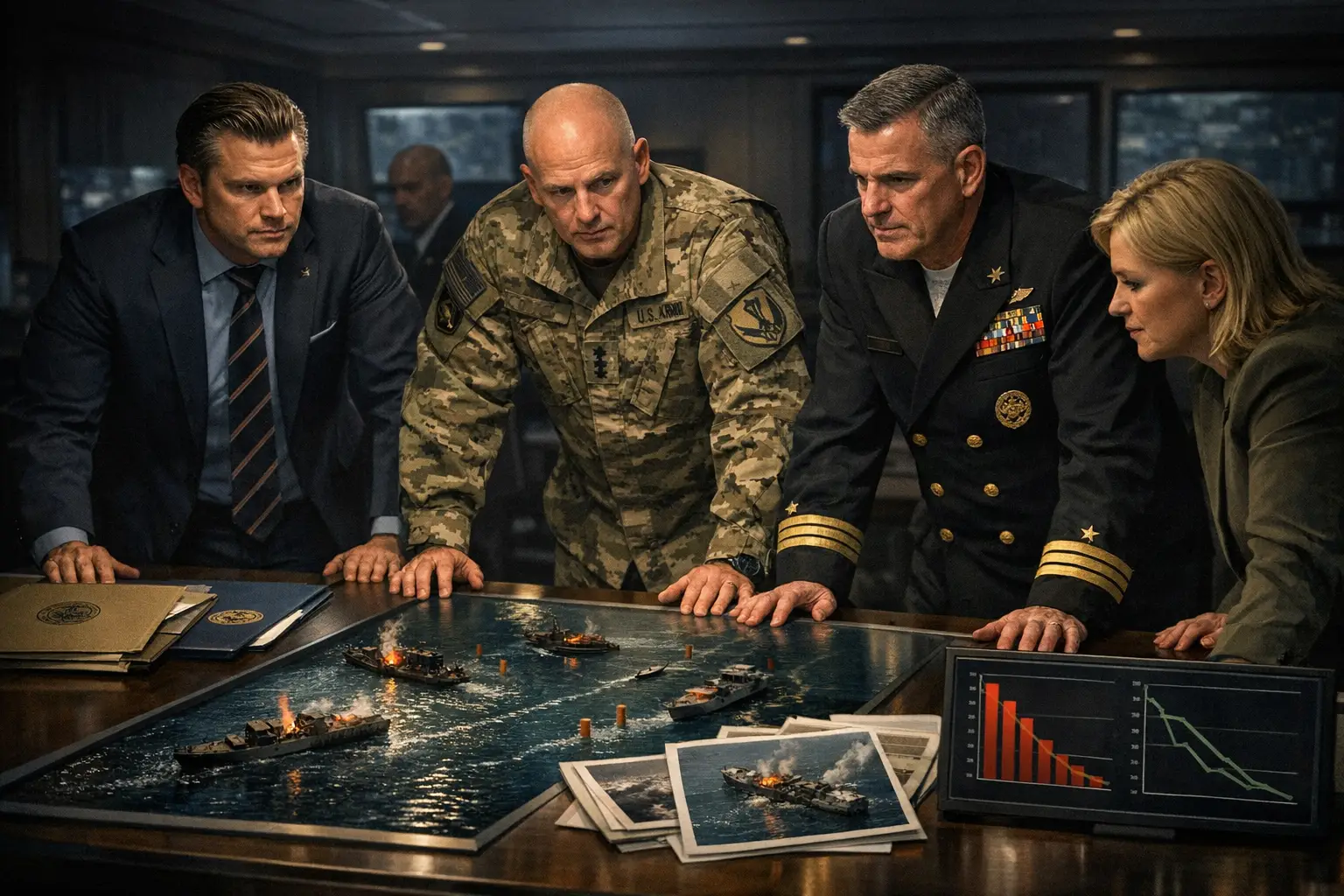
On March 5, 2026, U.S. Secretary of Defense Pete Hegseth and the commander of United States Central Command (CENTCOM), Brad Cooper, held a press briefing summarizing the results of the first week of Operation “Epic Fury.”
They reported that more than 30 vessels of the Iranian Navy had been destroyed and that no Iranian military ships remained in the Persian Gulf, the Strait of Hormuz, or the Gulf of Oman.
By March 10, the total number of destroyed ships had reached 50, meaning the conventional fleet of the Iranian Navy had ceased to exist as an operational force, and control of the strait would henceforth be exercised exclusively by the “mosquito fleet” of the Islamic Revolutionary Guard Corps (IRGC).
The number of ballistic missile strikes decreased by 90%, while UAV attacks dropped by 83%. These indicators reflect the structural degradation of the capabilities upon which the regime built its capacity for regional power projection.
The scale of the first week of the operation extends beyond the Middle Eastern region. A direct military confrontation between the democratic bloc and the authoritarian axis—one that strategic analysts had expected to emerge later in the decade in connection with a Taiwan contingency—has taken operational form earlier and in a different theater.
Both the timing and the direction of this development fall outside the planning assumptions of the authoritarian axis.
Analysts had linked the escalation point to the Indo-Pacific region, expected after the completion of the authoritarian bloc’s rearmament, under conditions of U.S. exhaustion in peripheral conflicts and maximum synchronization of pressure by allied regimes.
Washington initiated the active phase of confrontation before the completion of China’s rearmament and before the People’s Republic of China was able to prepare its partners for synchronized pressure along multiple directions simultaneously. This preemptive strategy is precisely what now shapes the trajectory of the global confrontation.
The central calculation of the authoritarian axis in its confrontation with democratic states rested on their presumed reluctance to act decisively—a calculation that had been regularly confirmed in practice.
Strategic planning in Beijing and among its partners relied on a pattern of asymmetric response. Under this assumption, the expulsion of Western presence from the Sahel and the expansion of North Korea’s missile capabilities did not trigger direct military strikes against their sources.
The same pattern held for the growth of Iranian proxy networks in Iraq, Syria, Lebanon, and Yemen, as well as Russia’s invasion of Ukraine. These developments reinforced the belief that such actions would not provoke immediate direct military retaliation.
The authoritarian axis operationalized this pattern as a managed instrument. Within this system, Iran served as the direct executor of coercive escalation logic.
Ship seizures, proxy financing, and missile strikes carried out through intermediaries created a mechanism of constant pressure, the intensity of which depended on the reactions of democratic states.
Calibrated escalation kept democratic states locked in the costly posture of deterrence without transitioning to counteroffensive actions. Washington broke this model by moving to preemptive action based on an assessment of the structural consequences of inaction over the coming decade.
The authoritarian axis assumed that Donald Trump would not risk actions capable of triggering an energy shock and a drop in approval ratings, particularly at a moment when the domestic political calendar constrains strategic decision-making.
Mortgage rates, inflation, and consumer prices in the United States remained at levels acceptable for most households, while oil and gas prices were below the average of the past decade. Operation “Epic Fury” demonstrated that the administration is willing to act beyond these electoral constraints.
The authoritarian axis had not developed a scenario for the possibility that a democratic leader might act outside predictable institutional behavior.
The absence of a coordinated response during the first week of the operation confirmed this gap as an operational reality—Beijing, Moscow, and Tehran are reacting autonomously to circumstances none of them defined.
Iran had been one of the key elements of the architecture that Beijing constructed with the expectation of synchronized destabilization across several regions ahead of a potential conflict in the Indo-Pacific.
The destruction of Iran’s strategic potential deprives China of a key instrument of peripheral pressure on Washington and reduces the probability of a global confrontation.
Without the ability to disperse U.S. forces across multiple theaters, Beijing loses the conditions under which an attack on Taiwan could plausibly succeed.
Parallel to the degradation of military infrastructure, U.S. and Israeli strikes carried out a political decapitation of the regime—the elimination of more than 40 senior officials, including Ali Khamenei, severed the chain of command between the political leadership, the security apparatus, and the air-defense system.
The disintegration of the command echelon reduced the regime’s ability to respond in a centralized manner and expanded the operational window for strikes against strategic facilities.
At the same time, the neutralization of Khamenei did not eliminate organized armed resistance nor dissolve the IRGC command structure.
The Corps retains a functional command system separate from the regime’s civilian bureaucracy, and under conditions of a supreme-authority vacuum, effective control over the security apparatus is concentrating within the IRGC rather than in institutions personally subordinate to Khamenei.
The IRGC is conducting consultations with Chinese partners regarding forms of support that could allow the armed confrontation to continue—including missile-weapon components and financial mechanisms for sanctions evasion.
Strikes carried out in the first days of March 2026 neutralized approximately 300 Iranian missile launchers and damaged key nodes of the country’s nuclear infrastructure—including the headquarters of the Atomic Energy Organization of Iran in Tehran, the explosives testing site at Parchin, and the nuclear facility at Natanz.
Regardless of how the active phase of the conflict develops, the strategic results of the operation’s first week are irreversible for Tehran. Restoring the ballistic arsenal, nuclear infrastructure, and naval capabilities will require extended time and a reorientation of regime resources toward internal reconstruction.
Financing and arming the Shiite “Axis of Resistance,” destabilizing neighboring states, and expanding the influence of the authoritarian bloc in the region will give way to the priority of rebuilding Tehran’s core military capabilities.
The reaction of Beijing and Moscow to the destruction of Iran’s strategic potential has been minimal. Russia limited itself to official condemnation of the U.S.–Israeli operation and began transferring intelligence to Iran on the location and movement of U.S. forces, information Moscow obtains through satellite assets.
China is considering financial assistance to the ayatollah regime, as well as supplies of military-equipment components and missile-system parts. However, Beijing continues to refrain from active involvement in the armed confrontation and avoids direct logistical support for Tehran.
Iran had been China’s closest partner after Russia and North Korea—a regime into which Beijing had invested decades of diplomatic, economic, and military engagement. China’s passive response to the risk of its physical destruction has signaled to Washington the real limits of solidarity within the authoritarian bloc.
Over the past 14 months, Beijing has lost three key partners—Bashar al Assad was overthrown, Nicolás Maduro was arrested and transferred to the United States, and Ali Khamenei was eliminated. None of these regimes received effective support from China at the moment of crisis.
Washington acted on the assumption that this window of Chinese passivity is temporary—the PRC’s capability and willingness to respond to the dismantling of allied regimes will grow as Chinese rearmament is completed and instruments of pressure are consolidated.
The operation against Iran—along with the parallel expansion of the U.S. presence in other regions—was implemented precisely during this interval, before the strategic situation becomes less favorable for Washington.
On March 3, 2026, the United States and Ecuador launched joint military operations against Chinese-backed narco-terrorist groups in that country, while the expansion of the U.S. oil blockade of Cuba led to intensified electricity outages and a complete blackout across two-thirds of the island.
In Africa, United States Africa Command (AFRICOM) in February 2026 deployed 100–200 military advisers to Nigeria to support operations against ISIS-affiliated groups Lakurawa and ISWAP, and in Somalia carried out a series of airstrikes against ISIS-Somalia and al Shabaab—at least six separate operations were recorded in February alone.
The scale of the operation is creating a force environment in which regional actors act in alignment with U.S. strategy without direct coordination with Washington.
Kurdish groups in Iraq are considering participation in combat operations against Tehran as a means of regaining positions lost in Syria, their activation placing additional strain on Iranian resources in the northwestern direction.
Azerbaijan used Iranian UAV strikes on its territory as grounds for relocating troops to combat positions along the 700-km border. The strategic encirclement of Tehran is tightening simultaneously along multiple perimeters, without Washington assuming direct political responsibility for each vector.
The configuration of Iran after the active phase of the operation remains an open variable in U.S. strategic planning—and this openness itself is an instrument of pressure.
Washington also retains the option of fragmenting Iran’s security space through external partners—Turkey and Azerbaijan in the north, Kurdish formations in the northwest, and Israel and Arab states in the south and center. Another option is to support internal Iranian forces opposing the Islamic Revolutionary Guard Corps.
The uncertainty regarding which of these vectors will be activated, and when, constitutes an independent instrument of pressure on Tehran and Beijing.
The first week of Operation “Epic Fury” and the broader set of U.S.-initiated measures against China-aligned forces on other continents demonstrate that the logic of relieving pressure points is already being implemented in practice.
From the Middle East to Latin America, Washington is systematically eliminating the support nodes Beijing expected to activate simultaneously in order to generate cumulative pressure on the United States.
Beijing maintains a position of strategic non-intervention in the Iranian conflict, relying on its own assessment of China’s structural advantages in long-term competition.
The Chinese leadership believes it can achieve a favorable outcome under any scenario, a calculation based on economic and industrial capacities that no other actor can replicate.
China retains monopoly control over the rare-earth elements market and maintains the ability to scale industrial production for any emerging market.
It also possesses the construction and technological capacity to develop post-conflict economic spaces and sustains state financing mechanisms that preserve structural competitive advantages regardless of economic conditions.
Participation in the current conflict would erode these capabilities; Beijing therefore views their consolidation as the primary instrument of dominance in the next phase of global redistribution.
This logic of consolidation shaped the parameters of China’s 2026–2030 Five-Year Development Plan, considered by the National People’s Congress on March 5, 2026—a strategic document built on the assumption of external predictability throughout the planning horizon.
Operation “Epic Fury,” unfolding at the same moment, altered the geopolitical parameters underlying the document’s key sections—defense planning, energy security, and the pace of technological rearmament.
The Chinese leadership had viewed any destabilization of the international environment as an instrument of its own strategy, without anticipating comprehensive preemptive actions by the democratic bloc against Chinese expansionist plans.
The coordinated U.S.–Israeli operation against Iran has invalidated that calculation at a moment when the Chinese economy is confronting a budget deficit and the exhaustion of reserves for expanding state spending.
The official budget deficit of the People’s Republic of China has stood at 4% for the second consecutive year, the highest level recorded in the past fifteen years.
The real broad deficit, which includes special-purpose bonds and off-budget expenditures, reached approximately 9.5% of GDP in 2026, comparable to the 9.9% of GDP projected for 2025.
The economic growth target for 2026 has been set at 4.5–5%, representing the lowest benchmark since 1991.
The high budget deficit, compounded by the need to contain further accumulation of debt obligations, directly affects defense appropriations. In the 2026 budget proposal, growth in the Chinese military budget was slowed to 7%, the lowest rate since 2021.
Additional evidence of fiscal constraints caused by economic slowdown was the decision to cut central government spending on official overseas travel, government vehicles, and ceremonial events by 7%.
The need to reduce even secondary expenditures has emerged under conditions of deflation that has persisted for four consecutive years.
In 2025, capital investment declined by 3.8% for the first time in a decade, real-estate investment fell by 17.2%, and the local government financing platforms used to attract off-budget borrowing accumulated significant debt burdens.
Under adverse economic conditions that are becoming systemic and long-term, armed support for Iran and a potential escalation of the China–Taiwan confrontation would require additional increases in military spending in an economy that has yet to generate stable domestic consumer demand.
The budget deficit and prolonged deflation in China create the context in which Beijing continues to pursue its established tactic of strategic waiting.
During the active phase of the conflict, Beijing refrains from actions requiring immediate expenditures, expecting instead to adapt to new realities once the situation stabilizes.
The Chinese leadership—for which economic stability remains the primary condition for maintaining political legitimacy and control over the country—has chosen to focus on domestic priorities, leaving Tehran without effective support.
China’s economic slowdown takes on a different dimension when compared with the dynamics of its trading partners. Global instability triggered by the Middle Eastern operation worsens macroeconomic indicators for most oil-importing countries, yet China’s structural vulnerability is deeper.
More than 70% of its oil consumption is covered by imports, about 90% of which are transported by sea, while the export-oriented structure of Chinese industrial production lacks mechanisms to offset rising costs through domestic demand.
The weakening of the Iranian regime creates a mixed risk configuration for Beijing. The radical Islamic dynamics financed by the ayatollah regime had threatened the security of infrastructure corridors of the Belt and Road Initiative in Central Asia, Pakistan, and the Middle East, and their weakening therefore aligns with Chinese interests.
At the same time, the vacuum created by the degradation of Iran’s security space opens opportunities for the expansion of Turkic geopolitical dynamics.
Turkey and pan-Turkic movements are claiming influence in regions bordering East Turkestan—the territory Beijing administers as the Xinjiang Uyghur Autonomous Region.
The strengthening of the Turkic geopolitical sphere in the post-Iranian space creates an additional vector of pressure on Beijing’s control over Xinjiang.
Beijing simultaneously loses an instrument of synchronized pressure against the United States while also removing a source of unpredictable destabilization affecting its own peripheral interests. This duality of interests is precisely what prevents China from active involvement in the conflict or openly declared support for Tehran.
This duality also has an economic dimension related to China’s energy dependence on the region. In 2025, approximately 50% of China’s crude-oil imports came from the states of the Persian Gulf, including 11–12% directly from Iran.
One consequence of the U.S.–Israeli operation against the ayatollah regime was the termination on March 5, 2026, of war-risk coverage by leading ship mutual-insurance organizations (P&I clubs) for tankers transiting the Strait of Hormuz.
Freight rates for very large crude carriers (VLCCs) on the Middle East–China route reached a record $423,736 per day. More than 150 tankers were halted until the security situation normalized, while major container carriers—MSC, Maersk, and Hapag-Lloyd—suspended transit through the strait.
Restrictions imposed by P&I insurers on tanker movement through the Strait of Hormuz, combined with rising freight rates, coincided with increasing oil prices following damage to fuel infrastructure in the Middle East.
From the launch of Operation “Epic Fury” until March 7, 2026, the price of Brent crude rose 20–25%, increasing from $72.48 to more than $93 per barrel.
China—whose economy depends on imported oil for more than 70% of consumption, about 90% of which arrives by sea—thus faced simultaneous increases in both oil prices and transportation costs.
Higher energy-transport costs raise the production cost of Chinese goods at every stage of manufacturing and distribution.
Because of slowing domestic demand for industrial goods, Chinese enterprises cannot compensate for rising costs through higher market prices, directly reducing the profitability of industrial production in China.
One of the first attempts by the Chinese leadership to mitigate the impact of an impending fuel crisis was a directive issued to major Chinese refineries to halt exports of diesel fuel and gasoline starting March 5, 2026.
At the same time, this decision—which indicates Beijing’s preparation for a potential energy shortage—does not resolve the problem of restoring stable oil supplies and instead conserves existing reserves in anticipation of the normalization of shipping through the Strait of Hormuz.
The withdrawal of war-risk insurance coverage for vessels in the Persian Gulf revealed that the strategic vulnerability the axis of autocracies intended to exploit against the United States and its allies after a global escalation has instead inflicted significant economic losses on China itself.
During previous Middle Eastern escalations, the ayatollah regime presented its ability to turn the strait into a zone of fire engagement as a tool of pressure on Gulf monarchies and Western countries.
However, since 80% of oil exports through the strait are directed to Asian markets, with 37.7% going directly to China, restrictions on transit have primarily harmed Iran’s own trading partners and political allies.
The mismatch between the plans of the authoritarian axis and the actual consequences of their implementation signaled to the White House that miscalculations exist in coordination among members of the authoritarian bloc when planning joint actions against democratic states.
Operation “Epic Fury,” unfolding amid growing global political instability across most regions, has prompted major investors and financial-market participants to reconsider capital allocation priorities in favor of more stable jurisdictions.
The Russo-Ukrainian War, U.S. operations against organized crime and China-aligned governments in Latin America, and rising military-political tensions in the Indo-Pacific had already stimulated global asset relocation in recent years.
The unprecedented escalation of armed confrontation in the Middle East has become a catalyst for capital withdrawal from high-risk regions, which since the beginning of Iranian attacks now include the Gulf monarchies.
Investors’ reassessment of global centers for attracting private capital is occurring in favor of the United States, evidenced by the consolidation of the dollar’s status as the most stable asset amid the rapid contraction of stock markets and falling prices for gold and U.S. Treasury bonds.
In contrast to those trends, as of March 5, 2026, the U.S. Dollar Index (DXY) rose to 99.00, posting a 2.4% weekly increase, the strongest weekly performance for the U.S. currency since 2022.
According to the Bloomberg Dollar Spot Index, published during the first week of the U.S.–Israeli operation in Iran, indices of 16 major global currencies declined, while the dollar index increased by 1.3%.
The strengthening of the dollar is occurring amid the complete depreciation of alternative financial architectures that the authoritarian bloc had spent years building.
China had invested significant political and financial resources in promoting the Chinese yuan as a settlement currency, developing digital payment tools within BRICS, and creating alternative interbank transfer infrastructure intended as an institutional foundation for gradually displacing the dollar in international settlements.
Under conditions of geopolitical turbulence, these initiatives lose operational relevance: no major actor will convert contracts into yuan at a moment when liquidity under pressure becomes the only criterion. The dollar meets this criterion—none of the alternatives do.
Notably, Gold, traditionally a safe-haven asset, jumped to $5,299 per ounce on the first day of the operation—an immediate market reaction to geopolitical escalation.
However, by March 6, the price had fallen to $5,097, dropping below pre-operation levels, despite the ongoing conflict and continued increases in oil prices.
Under conditions that previously would have generated sustained demand for defensive assets, gold failed to attract that demand, as capital moved directly into dollar-denominated instruments.
Because of investor-friendly tax policies and their status as the most stable financial jurisdictions in the Middle East, the United Arab Emirates and other Arab monarchies had remained an alternative hub for capital inflows until February 2026.
Iran’s current attacks on infrastructure and diplomatic facilities in Dubai, where more than 81,000 millionaires and billionaires reside, have deprived the city of its previous status as a safe destination for capital.
Demand for private flights out of the region significantly exceeds available supply and is comparable to the levels observed during the COVID-19 pandemic.
An additional factor increasing risks to capital stability in the UAE was the suspension of trading on the Abu Dhabi Securities Exchange and the Dubai Financial Market on March 2–3, 2026.
Capital from Dubai is partially relocating to jurisdictions in Singapore and Hong Kong, though a number of large investors are ultimately placing funds in U.S. dollar-denominated assets.
Although several U.S. multinational corporations, particularly those exporting goods and services to the Middle East, have faced temporary disruptions, shares of the U.S. defense-industrial sector are rising, allowing American defense companies to absorb part of the capital leaving the UAE.
During the first week of the U.S. operation against Iran, the share price of Raytheon Technologies increased 6.2%, while the stock values of Lockheed Martin and Northrop Grumman reached historic highs.
Given the expansion of Raytheon’s order backlog to $268 billion and Lockheed Martin’s to $194 billion, driven by current combat operations in the Middle East and the need for the United States to accelerate preparations for a new phase of global conflict, investors are purchasing shares of the U.S. defense sector at record levels.
The growth of order backlogs and market capitalization in the U.S. defense industry reflects investor expectations that Washington will retain the strategic initiative in subsequent stages of the global confrontation, and that the current operation marks the beginning of a prolonged cycle of American military activity.
China’s planning for a Taiwan scenario assumed the convergence of several conditions. One was the military and logistical exhaustion of the United States in peripheral theaters, combined with domestic political turbulence in the U.S. during an election cycle.
Another was the gradual drift of Taiwan’s political spectrum toward rapprochement with Beijing through the strengthening of pro-China forces.
Chinese planners expected these factors, together with broader fatigue within the democratic bloc under multi-front pressure, to align toward the end of the decade.
Operation “Epic Fury” was launched at a moment when none of these conditions had yet reached critical mass, and when the American domestic political calendar itself creates a logic of urgency for Washington.
The Republican administration is acting before the active phase of presidential-election preparations, before midterm elections that could alter congressional support for military operations, and before the long-term consequences of the Iranian campaign could affect the ratings of the Republican nominee.
Washington’s actions—aimed at preempting China’s plan for coordinated pressure—are being implemented simultaneously across several regions that could become peripheral theaters of global conflict following escalation of U.S.–China confrontation in the Indo-Pacific.
While Operation “Epic Fury” weakens the ayatollah regime in the Middle East, the Republican administration is simultaneously reducing Chinese presence in Latin America, a region Beijing had been developing as a second strategic direction of pressure against the United States.
To neutralize Chinese footholds in the Western Hemisphere, the Republican administration since mid-2025 has intensified implementation of the “Peace Through Strength” approach in Latin America.
China’s influence in the region had been building for decades, resulting in annual trade between China and Latin American countries exceeding $518 billion, as well as the integration of Chinese state-owned enterprises into energy grids, telecommunications infrastructure, and extractive industries across the region.
By employing coercive diplomacy, the United States partially dismantled Chinese footholds in less than a year. Together with pro-U.S. local governments, Washington formed the “Shield of the Americas” coalition to combat organized crime and narco-terrorist networks maintaining informal contacts with China.
The transformation of the regime in Venezuela, the campaign against the shadow fleets of authoritarian states, and the fuel blockade of Cuba disrupted long-standing trade and energy links within the authoritarian axis.
These developments have increased the vulnerability of the government in Havana, which remains the last foothold of China and Russia in the Caribbean Basin.
The collapse of the regime of Miguel Díaz-Canel weakens Beijing’s ability to maintain a stable geopolitical presence on the continent ahead of a new phase of global confrontation.
China had already reduced sovereign lending to the region since 2020, yet this managed reduction preserved Beijing’s control over the pace and conditions of its own strategic retreat. The loss of regional footholds under U.S. pressure eliminates that control.
The destruction of Iran’s key military capabilities and the systematic dismantling of the “Shiite axis” deprive Beijing of the central element of its Middle Eastern influence architecture.
Following the neutralization or significant weakening of the ayatollah regime, Beijing’s circle of strategic partners forming the core of the authoritarian bloc narrows to Russia and North Korea. The ability of both regimes to support China after an escalation of global confrontation is severely limited.
Moscow must commit most of its military, economic, and industrial capacity to continuing the war against Ukraine, while Pyongyang cannot function as a full strategic ally due to its critical dependence on China for fuel, industrial support, and trade.
The assumption of external-policy predictability upon which China relied when preparing its five-year development plan for the late 2020s is therefore no longer relevant.
The strikes against the Iranian regime, the White House’s successful counteraction against Latin American dictatorships, and the organization of coordinated energy pressure against the authoritarian axis have created geopolitical conditions insufficiently accounted for in China’s Fifteenth Development Plan.
On the eve of the first official visit by a U.S. president to Beijing in nine years, scheduled for March 31–April 2, 2026, the Chinese leadership enters a new round of confrontation in the position of a party forced to adjust its strategy according to the pace and parameters of the global competition defined by Washington.
Operation “Epic Fury” marks the beginning of a qualitatively new stage in global confrontation.
The overthrow of Nicolás Maduro tested the reaction of the authoritarian axis to U.S. forceful intervention against an allied regime, and demonstrated the absence of an effective response.
The operation against Iran transfers that logic into a full-scale military format: a strike against a key structural element of the geopolitical architecture of U.S. adversaries.
For two decades, the democratic bloc responded to the actions of Beijing and its partners within limits defined by international obligations, allied consensus, and electoral cycles.
Washington has now moved beyond those constraints, acting according to an assessment of structural risks on the horizon of the next decade—before the authoritarian axis could complete preparations for its own scenario.